How to Choose the Best Dog Stroller for Small and Medium Dogs
Choosing the right dog stroller for small dogs or medium-sized pets requires more than checking the product's appearance or maximum weight capacity. A suitable stroller should provide sufficient cabin space, structural stability, ventilation, safety, and comfortable handling for both the dog and the owner.
Small dogs may benefit from a lightweight and compact design, while medium-sized dogs often require a larger cabin, stronger frame, and higher load capacity. However, dog breeds vary considerably in body shape, weight, and mobility, so selecting a stroller based solely on breed classification may lead to an unsuitable fit.
Whether you are purchasing a stroller for daily walks, outdoor travel, senior pet care, or commercial distribution, understanding weight capacity, cabin dimensions, wheel construction, and folding mechanisms is essential.
This guide explains how to select a small dog stroller or medium dog stroller based on practical technical specifications, helping pet owners and buyers make informed purchasing decisions.

What Size Dog Stroller Do You Need?
The correct dog stroller size depends on three primary factors: the dog's body weight, physical dimensions, and the amount of usable cabin space.
Manufacturers commonly categorize strollers as small, medium, or large, but these classifications are not standardized across all brands. A small dog stroller from one supplier may have different internal dimensions and weight limits from another model.
Before choosing a pet stroller for small dogs, consider the following specifications:
Specification | Why It Matters |
|---|---|
Maximum weight capacity | Determines the supported pet load |
Internal cabin length | Allows the dog to lie down and reposition |
Internal cabin width | Provides lateral movement space |
Internal cabin height | Supports sitting and standing |
Product weight | Influences portability |
Wheel diameter | Affects handling across surfaces |
Frame construction | Influences rigidity and durability |
Folding dimensions | Determines storage convenience |
A stroller should support the dog's weight with an appropriate safety margin according to the manufacturer's recommendations. The cabin must also accommodate the dog's body dimensions without excessive restriction.
Small Dog Stroller Size Considerations
A small dog stroller is commonly intended for smaller breeds such as Chihuahuas, Yorkshire Terriers, Pomeranians, and similar-sized dogs. However, the actual suitability depends on individual measurements.
A compact stroller may be practical for owners who frequently use public transportation, travel by car, or store the stroller in a small apartment. Nevertheless, a smaller external frame should not result in inadequate interior space.
Medium Dog Stroller Size Considerations
A medium dog stroller generally requires greater attention to frame strength, wheel stability, and cabin dimensions.
Dogs in the medium-size category can have significantly different body proportions. A relatively lightweight dog with a long body may require more cabin length than a heavier but shorter dog.
Key principle: Select the stroller according to the dog's actual weight and body measurements rather than relying exclusively on the size label.
How to Measure Your Dog for a Stroller
Accurate measurements help ensure that the stroller provides adequate space and load support. Measure your dog while it is standing naturally on a level surface.
1. Measure Body Length
Measure from the front of the chest to the base of the tail.
This measurement helps determine the minimum cabin length required for the dog to lie down comfortably.
2. Measure Standing Height
Measure from the floor to the highest point of the shoulders.
This provides a useful reference when evaluating cabin height, particularly for dogs that need to sit or stand inside the stroller.
3. Measure Sitting Height
Measure from the floor to the top of the dog's head while sitting.
Sitting height is especially relevant when the stroller has a canopy, mesh cover, or enclosed cabin. The dog should not be forced into an uncomfortable position because of insufficient vertical space.
4. Measure Body Width
Measure the widest part of the dog's body, typically around the chest or shoulders.
This measurement helps determine whether the cabin width provides enough room for the dog to turn and reposition itself.
5. Check Body Weight
Use a reliable scale to determine the dog's current weight.
When purchasing a stroller for a growing dog, consider potential changes in body weight and size. For commercial products, suppliers should publish the recommended pet weight range and maximum supported load clearly.
Cabin Space vs External Dimensions
One of the most important considerations when choosing a dog stroller for small dogs is the difference between external product dimensions and usable internal cabin dimensions.
The exterior size includes the frame, wheels, handlebar, and other components. The dog can only use the actual interior cabin space.
Before ordering, ask the supplier for:
Internal cabin length
Internal cabin width
Internal cabin height
Maximum pet weight
Cabin floor structure
Entry opening dimensions
This information is more useful than relying on product photographs alone.
Best Dog Stroller Features for Small Dogs
The best features for a small dog stroller depend on the dog's needs and the owner's intended usage. Portability, comfort, and safety are often important priorities for small breeds.
Lightweight Frame Construction
A lightweight dog stroller can make daily transportation easier, particularly when the owner needs to lift the stroller into a vehicle or carry it upstairs.
Aluminum frames are commonly used in portable pet products because they can provide a balance between weight and structural rigidity. Steel frames may offer higher rigidity in certain designs but generally add weight.
When evaluating frame quality, consider:
Tube diameter and wall thickness
Joint construction
Frame alignment
Folding lock strength
Surface finish
Load-bearing design
A low product weight alone does not guarantee durability. The frame must be designed to support the intended load during normal operation.
Compact but Comfortable Cabin
A compact cabin may help reduce the overall stroller size, but the dog still needs sufficient space to sit, lie down, and change position.
Look for a cabin with an appropriate floor area and sufficient ventilation. The cabin floor should also be stable and easy to clean.
Ventilation Windows
Ventilation is essential for pet comfort, especially during warm weather.
Mesh panels on multiple sides can improve airflow and allow the owner to monitor the dog. Mesh material should be securely attached and appropriately resistant to tearing.
For enclosed cabins, avoid designs that restrict airflow or expose the dog to excessive heat.
Safety Tether
An internal safety tether helps reduce the risk of a dog jumping out of the cabin.
The tether should be adjustable and attached to a suitable structural point. It should not be used to restrain the dog in a way that limits normal movement or creates a strangulation hazard.
Owners should supervise their pets and follow the product's safety instructions.
Wheel Design
For small dogs used primarily on smooth sidewalks and indoor floors, compact wheels may be sufficient.
Swivel front wheels can improve maneuverability in narrow spaces, while wheel locks may provide greater directional stability.
If the stroller will be used on rough sidewalks, grass, or gravel, consider wheel diameter, tread, and suspension rather than focusing only on product weight.
Easy Folding Mechanism
A foldable stroller is useful for owners who need convenient storage or transportation.
The folding mechanism should be easy to operate and include a secure locking system when the stroller is open. Users should always remove the dog before folding the stroller.
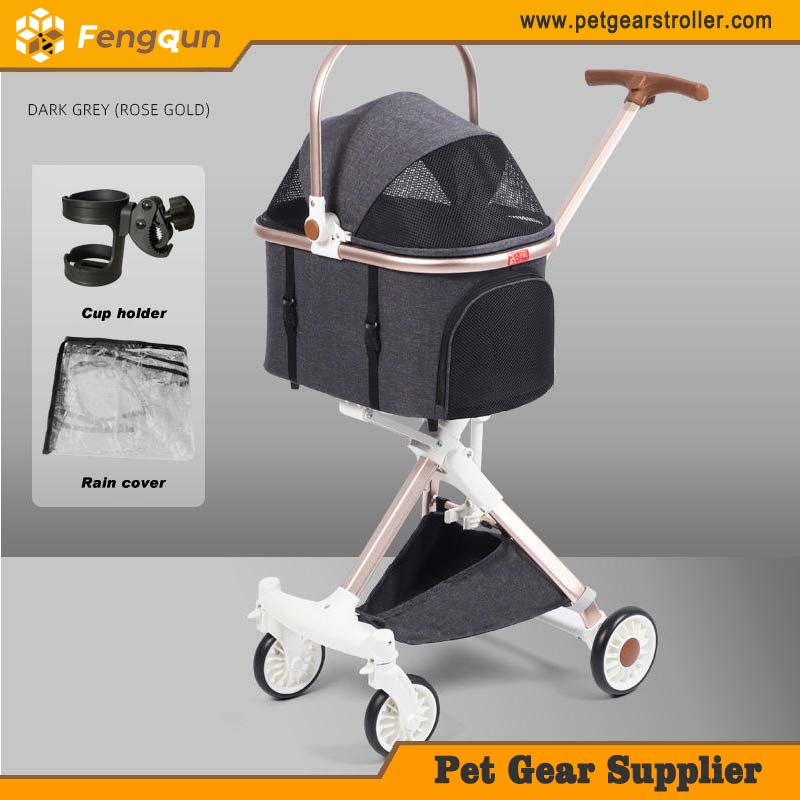
How to Choose a Dog Stroller for Medium Dogs
Selecting a dog stroller for medium dogs requires greater attention to structural load, cabin dimensions, and overall stability.
Compared with many small dog models, medium dog strollers may need larger frames, stronger wheel mounts, and more spacious cabins.
Frame Strength and Load Support
The frame must be designed to withstand the dog's weight and the forces generated during pushing, turning, and stopping.
Key areas to inspect include:
Frame joints
Wheel mounting points
Cabin support structure
Handlebar connections
Folding hinges
Base reinforcement
Manufacturers should specify the maximum supported load based on appropriate product testing and design requirements.
Larger Cabin Dimensions
Medium-sized dogs may need additional cabin length and height to maintain a comfortable posture.
Do not assume that a stroller rated for a particular weight will automatically provide sufficient cabin space. A dog with a long body or tall sitting height may require a larger interior even when its weight is relatively low.
Wheel Stability
Medium dogs generally place greater load demands on the frame and wheel system.
Larger wheels can improve the ability to roll over small obstacles, while a stable wheelbase can support predictable handling. The best configuration depends on the stroller's intended environment.
Braking System
A reliable parking brake is an important safety feature.
The braking mechanism should help prevent unintended movement when the stroller is stationary. Users should engage the brake before placing a dog inside or removing it from the cabin.
Lightweight vs Heavy-Duty Dog Strollers
The difference between a lightweight and heavy-duty dog stroller is primarily related to design priorities, rather than a universal weight classification.
Feature | Lightweight Dog Stroller | Heavy-Duty Dog Stroller |
|---|---|---|
Primary objective | Portability | Load support and durability |
Frame design | Compact and weight-conscious | Reinforced construction |
Cabin size | Often compact | Often larger |
Wheel configuration | Smaller or standard wheels | Larger or reinforced wheels |
Storage | Convenient | May require more space |
Typical application | Small dogs, travel | Medium/large dogs, outdoor use |
Handling | Easy to lift and transport | May require more pushing effort |
When to Choose a Lightweight Dog Stroller
A lightweight dog stroller may be suitable when:
The dog has a relatively low body weight.
The owner frequently transports the stroller.
Storage space is limited.
The primary environment consists of paved surfaces.
Easy folding and portability are important.
However, a lightweight design should still provide appropriate structural stability and a secure cabin.
When to Choose a Heavy-Duty Dog Stroller
A heavy-duty stroller may be more suitable when:
The dog has a higher body weight.
The stroller is used on uneven outdoor surfaces.
Greater cabin space is required.
The product must withstand frequent commercial or household use.
Additional structural reinforcement is necessary.
Heavy-duty does not automatically mean suitable for every medium-sized dog. Always check the manufacturer's specifications.
How Much Weight Can a Dog Stroller Hold?
The maximum weight capacity of a dog stroller depends on its frame construction, cabin base, wheel system, and load-bearing design.
A stroller may be advertised for small, medium, or large dogs, but these terms do not establish a universal capacity range.
For example, a product rated for a 20 lb dog should not be treated as suitable for a 30 lb dog unless the manufacturer explicitly confirms that the design supports that load.
Understanding Weight Capacity
When evaluating a stroller, distinguish between:
Maximum pet weight
Total product load capacity
Recommended operating load
Storage basket capacity
Combined weight for multiple pets
The storage basket capacity is not necessarily included in the pet cabin's weight rating. Confirm the manufacturer's definitions before purchasing.
Safety Margin and Real-World Use
Owners should follow the stated weight limit and avoid overloading the stroller with additional equipment or multiple pets.
For suppliers and retailers, product specifications should clearly communicate the recommended weight range and intended application. This improves customer expectations and reduces the risk of inappropriate product selection.
Best Dog Stroller for a 10 lb, 20 lb, 30 lb or 40 lb Dog
A dog's weight is a useful starting point when selecting a stroller, but it should always be considered alongside body length, sitting height, and cabin dimensions.
The following table provides a general selection framework rather than a universal product classification.
Dog Weight | Selection Considerations |
|---|---|
10 lb dog | Compact cabin, lightweight frame, sufficient turning space |
20 lb dog | Appropriate cabin width, reinforced base, adequate weight capacity |
30 lb dog | Larger interior, stronger frame, stable wheel system |
40 lb dog | Confirm high load capacity, cabin dimensions, wheel strength, and stability |
Dog Stroller for a 10 lb Dog
A 10 lb dog may be suitable for a compact small dog stroller, provided the cabin dimensions allow comfortable movement.
A lightweight frame and compact folding mechanism may be useful for owners who travel frequently.
Dog Stroller for a 20 lb Dog
A dog stroller for 20 lb dog should be evaluated based on both load capacity and interior dimensions.
A dog weighing 20 lb may have different body proportions depending on breed and age. Ensure that the cabin provides sufficient length and height, rather than selecting a model solely because its stated weight capacity matches the dog's weight.
Dog Stroller for a 30 lb Dog
A 30 lb dog may require a medium-size stroller with a more spacious cabin and stronger structural components.
Pay particular attention to frame rigidity, wheel mounts, brake performance, and cabin floor support.
Dog Stroller for a 40 lb Dog
A 40 lb dog generally requires more careful product evaluation.
The buyer should confirm the manufacturer's maximum supported pet weight, usable cabin space, and stability characteristics. A stroller intended for large or heavier pets may be more appropriate than a compact small dog model.
If the stroller will be used on uneven surfaces, consider an all terrain dog stroller with a suitable wheel configuration and suspension system.

Frequently Asked Questions
What is the best dog stroller for small dogs?
The best dog stroller for small dogs is one that provides suitable cabin dimensions, sufficient weight capacity, ventilation, safety features, and convenient handling. The ideal choice depends on the dog's measurements and the intended usage environment.
Can a medium-sized dog use a small dog stroller?
It depends on the stroller's actual weight capacity and internal dimensions. A medium-sized dog should not be placed in a stroller that does not adequately support its weight or provide sufficient cabin space.
Is a lightweight dog stroller durable?
A lightweight dog stroller can be durable when it uses appropriate materials, reliable joints, and a properly engineered frame. Product weight alone does not determine durability.
How do I choose a dog stroller for a 20 lb dog?
Check the maximum supported pet weight, internal cabin dimensions, floor support, and wheel stability. Measure the dog before purchasing to ensure that the stroller accommodates its body shape.
Are dog strollers suitable for daily walks?
Many dog strollers are designed for everyday use. The suitability depends on the product's construction, wheel system, cabin ventilation, and the walking environment. Inspect the stroller regularly and follow the manufacturer's usage instructions.
What is the difference between a small dog stroller and a medium dog stroller?
A small dog stroller often prioritizes compact size and portability, while a medium dog stroller may require greater cabin space and structural load support. Actual suitability should be determined by the dog's measurements and the product specifications.
Conclusion
Choosing the right dog stroller for small dogs or medium-sized pets requires a systematic evaluation of cabin dimensions, weight capacity, frame construction, wheels, ventilation, and safety features.
A lightweight dog stroller may be convenient for smaller pets and frequent transportation, while a medium dog stroller may require a larger cabin and reinforced structural components. For outdoor applications, wheel performance and suspension can also influence comfort and handling.
For pet-product manufacturers, retailers, and wholesale buyers, clear specifications are essential. Providing accurate cabin dimensions, recommended pet weight ranges, frame materials, folding dimensions, and safety features helps customers select products that meet their requirements.
Whether you need a small dog stroller, medium dog stroller, or a dog stroller for a 20 lb dog, the most reliable selection process begins with the dog's actual measurements and the intended usage environment. A well-designed pet stroller should balance comfort, structural stability, portability, and everyday usability.
Recommended linking:
Dog Stroller: Complete Guide to Choosing the Right Stroller for Your Dog
Recommend related products:





