Dog Stroller vs Pet Carrier: Which Is Better for Your Dog?
Choosing between a dog stroller and a pet carrier depends on your dog's size, mobility, temperament, and transportation needs. Both products are designed to make dog transportation more convenient, but they serve different purposes. A stroller uses wheels to support the dog's weight, while a carrier is designed to transport a pet by hand, shoulder strap, or backpack-style support.
For short trips, public transportation, and compact storage, a dog carrier may be the more practical option. For longer outdoor walks, senior dogs, and pets that become tired easily, a dog stroller can provide greater convenience and reduce the physical effort required from the owner.
Understanding the differences between these products can help pet owners choose the right solution for everyday activities, travel, and specialized pet care. This guide compares a dog stroller vs pet carrier in terms of design, comfort, portability, safety, and practical applications.

Dog Stroller vs Pet Carrier: What's the Difference?
The primary difference between a dog stroller and a pet carrier is how the pet's weight is supported during transportation.
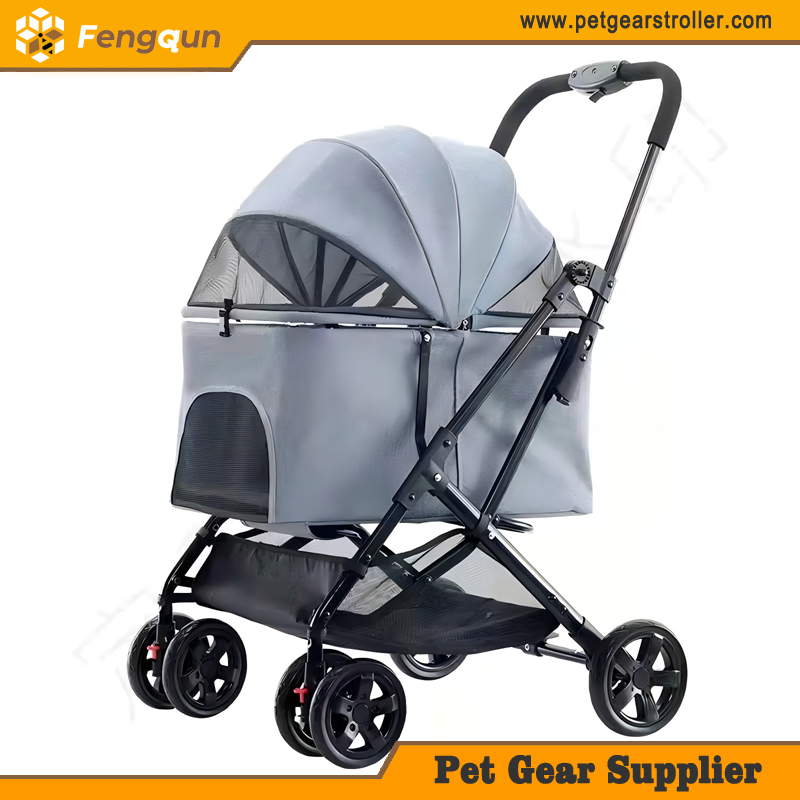
A dog stroller is a wheeled transportation system with a pet cabin, frame, handlebar, wheels, and braking mechanism. The wheels support most of the load, allowing the owner to move the dog without carrying its full weight.
A pet carrier, by comparison, is a portable enclosure designed to be carried or transported using handles, shoulder straps, or backpack-style support. Depending on the model, carriers may be made from fabric, reinforced plastic, or other rigid materials.
Key Differences Between Dog Strollers and Pet Carriers
| Feature | Dog Stroller | Pet Carrier |
|---|---|---|
| Transportation method | Pushed on wheels | Carried by hand or strap |
| Physical effort | Generally lower when rolling | Increases with pet weight |
| Portability | Depends on folding design | Often compact and portable |
| Storage | Requires space for the frame and wheels | Usually requires less storage space |
| Long outdoor walks | Convenient for suitable pets | Can become tiring to carry |
| Large dogs | Available in higher-capacity designs | Carrying options may be limited |
| Senior dogs | Useful when walking is difficult | Useful for short transfers if safely supported |
| Multiple pets | Double-stroller models available | Requires a suitably sized carrier |
| Uneven terrain | Depends on wheel size and suspension | Depends on the carrying method and operator |
| Travel compatibility | Must meet transport provider requirements | Must meet transport provider requirements |
Structural and Design Considerations
A dog stroller typically consists of a frame, cabin, wheel assembly, handlebar, braking system, and safety tether. Frame materials may include aluminum or steel, while the cabin commonly uses fabric panels and mesh ventilation windows.
A carrier generally prioritizes portability, secure closure, and ease of handling. Soft-sided carriers are often lighter and easier to store, while hard-sided models may offer more rigid enclosure walls.
Neither design is automatically better in every situation. The correct choice depends on the dog's dimensions, total weight, travel environment, and how long the pet will remain inside.
When Should You Choose a Dog Stroller?
A dog stroller is often the better option when the dog needs to travel over longer distances without walking continuously or being carried.
Long Outdoor Activities
For park visits, shopping areas, outdoor events, and extended walks, a stroller can allow a dog to rest while remaining with its owner.
Unlike a carrier, a stroller transfers most of the dog's weight to the wheels. This can be especially helpful when the pet is too heavy to carry comfortably for extended periods.
Dogs That Become Tired Easily
Small dogs may struggle to keep up during long walks, while larger pets may need occasional rest. A suitable stroller allows owners to adjust the amount of walking to the dog's needs.
Owners Who Need Easier Handling
A stroller can reduce the physical effort involved in transporting a pet, particularly when the dog is relatively heavy.
However, the stroller must be suitable for the dog's weight and body dimensions. Its frame, wheels, cabin, and braking system should all be rated for the intended load.
Outdoor Environments
A standard dog stroller is generally appropriate for smooth sidewalks and paved paths. If the intended route includes grass, gravel, or uneven pavement, consider an all-terrain configuration with appropriately sized wheels and, where available, suspension.
A stroller designed primarily for smooth surfaces may be difficult to maneuver over rough ground.
When Is a Pet Carrier Better?
A pet carrier is often more suitable when portability, compact storage, and short-distance transportation are the main priorities.
Short Trips
For brief trips to the veterinarian, quick transfers between a car and a building, or carrying a small dog over a short distance, a carrier may be more convenient than a stroller.
Compact Storage
A soft-sided dog carrier can often be folded or stored in a relatively small space. This is useful for people living in apartments or owners who have limited storage capacity.
A stroller, even when folded, generally requires space for its frame and wheels.
Public Transportation
A carrier may be easier to manage on crowded buses, trains, and other forms of public transportation, provided the transport operator permits pets and the carrier meets its requirements.
Some services require pets to remain in enclosed carriers, while others permit strollers under specific conditions. Always check the relevant rules before traveling.
Small Dogs and Puppies
A suitable carrier can provide convenient transportation for small dogs and puppies during short journeys.
The carrier should provide sufficient room for the dog to stand, turn around, and lie down comfortably, subject to the applicable transport requirements. Ventilation, secure closures, and a supportive base are also important.
Travel Where Wheels Are Impractical
Stairs, narrow passages, and locations without step-free access can make stroller use difficult. A carrier may be easier to handle in these environments, provided the pet's weight can be carried safely.
For heavier dogs, lifting and carrying may be impractical. In such cases, a suitable stroller or another accessible transportation arrangement may be preferable.
Dog Stroller for Senior Dogs
Senior dogs may experience reduced stamina, joint discomfort, balance difficulties, or other age-related changes that affect their ability to walk long distances. The appropriate transportation solution depends on the dog's individual mobility and veterinary recommendations.
A dog stroller for senior dogs can help older pets participate in outdoor activities without requiring them to walk continuously.
Benefits of a Dog Stroller for Older Pets
A stroller can provide a stable resting space during walks and reduce the need to lift or carry a dog repeatedly.
Important features include:
A low or accessible cabin entrance
A stable cabin floor
Adequate internal dimensions
Reliable parking brakes
Secure entry and exit openings
Good ventilation
Smooth-rolling wheels
A comfortable, supportive interior
For dogs with limited mobility, the height of the cabin entrance is particularly important. An entrance that is too high may make loading difficult or require lifting the dog.
When a Carrier May Be Appropriate
A carrier can still be useful for a small senior dog during short transfers, especially when navigating a few steps or moving between a vehicle and a building.
However, the owner should consider the dog's weight and the physical effort needed to lift the carrier. Carrying a heavy dog may increase the risk of dropping the carrier or straining the owner's back.
For dogs recovering from surgery or experiencing significant mobility limitations, follow the veterinarian's advice regarding movement, positioning, and transportation.
Dog Stroller for Long Walks
For extended outdoor activities, a dog stroller can offer practical advantages over a carrier.
Reduced Carrying Effort
A stroller supports the dog's weight through its wheels, allowing the owner to push rather than carry the pet. This is especially useful when the dog's weight makes prolonged carrying uncomfortable.
Wheel Performance and Suspension
The appropriate wheel configuration depends on the walking environment.
Smaller wheels may be adequate for smooth indoor flooring and paved paths. Larger wheels can help the stroller roll over small obstacles, while suspension may reduce vibration transmitted to the cabin.
For frequent outdoor use, evaluate wheel diameter, tread, frame rigidity, and braking performance together rather than considering any single specification in isolation.
Cabin Space and Ventilation
During longer outings, the dog needs adequate room to reposition itself and sufficient airflow.
Look for well-positioned mesh panels, secure closures, and a cabin that accommodates the dog's body dimensions. Avoid prolonged exposure to excessive heat, and provide appropriate water and rest breaks.
Maneuverability
A swivel front wheel can improve maneuverability around pedestrians and tight corners. A locking mechanism may help maintain directional stability on uneven surfaces.
The stroller should remain controllable when fully loaded, and its parking brake should prevent unintended movement when stationary.
Dog Stroller for Travel
A dog travel stroller can be useful for car journeys, holiday outings, shopping trips, and destinations where a dog may need assistance moving over longer distances.
However, a stroller is not a universal replacement for a travel carrier. Different transportation environments impose different requirements.
Car Travel
Check the stroller's folded dimensions to determine whether it fits inside the vehicle's luggage compartment.
A folded stroller should be secured during driving so that it cannot move freely. Do not assume that a stroller cabin is a crash-tested vehicle restraint; use an appropriate, vehicle-compatible pet restraint or travel crate according to the manufacturer's instructions.
Air Travel
Airlines have specific rules for pet carriers, cabin dimensions, approved materials, and pet transportation. A dog stroller does not automatically qualify as an approved airline carrier.
If you plan to fly, confirm the airline's current pet transportation policy and whether the stroller can be checked, gate-checked, or transported separately.
Public Transportation
For buses and trains, verify whether strollers or enclosed carriers are permitted, along with any restrictions on size, location, and pet containment.
A foldable stroller may be easier to store, while a compact carrier may be easier to manage in crowded spaces.
Folding and Portability
When selecting a dog travel stroller, evaluate:
Product weight
Folded dimensions
Folding mechanism
Locking system
Wheel removal, if applicable
Storage requirements
Ease of loading into a vehicle
A compact folding design is useful, but it should not compromise frame stability or safe operation.
How to Choose Between a Stroller and Carrier
The best way to select a dog transportation product is to match its technical specifications to the dog's physical requirements and the intended journey.
Step 1: Evaluate Your Dog's Weight and Dimensions
Measure the dog's weight, body length, height, and width. Compare these measurements with the manufacturer's stated capacity and internal dimensions.
For a carrier, check its maximum supported weight and the manufacturer's recommended fit. For a stroller, check both the pet weight limit and usable cabin space.
Step 2: Consider the Distance
For short transfers, a carrier may be more convenient. For long walks or extended outdoor activities, a stroller may reduce the physical effort required from the owner.
Step 3: Assess Mobility
Senior dogs, dogs with limited stamina, and pets that cannot walk continuously may benefit from a stroller. However, the specific needs of a recovering or mobility-impaired dog should be assessed with a veterinarian when appropriate.
Step 4: Check the Environment
Consider stairs, narrow doorways, public transportation rules, terrain, and available storage.
A carrier may be easier to handle in confined spaces, while a stroller may be more practical on accessible paths and longer routes.
Step 5: Evaluate Safety Features
For a stroller, inspect the frame, wheels, parking brake, folding locks, cabin closures, and internal safety tether.
For a carrier, inspect the handles or straps, seams, base support, ventilation, zipper or latch security, and structural integrity.
In both cases, ensure that the pet cannot escape unexpectedly and that the product is appropriate for the dog's weight.
Step 6: Consider Cleaning and Maintenance
Removable, washable fabric components can simplify maintenance. Check whether the product allows easy access to areas where pet hair, dirt, and moisture may accumulate.
Regularly inspect wheels and brakes on strollers, and check handles, straps, seams, and closures on carriers.
Frequently Asked Questions
Is a dog stroller better than a pet carrier?
Neither option is universally better. A stroller is often more convenient for long walks and pets that are difficult to carry, while a carrier is generally useful for short trips, compact storage, and transportation in confined spaces.
Can a dog stroller replace a dog carrier?
Not in every situation. Airlines, public transportation providers, and other facilities may require an approved carrier or specific restraint system. A stroller is primarily designed for wheeled transportation and may not meet those requirements.
Is a dog stroller suitable for large dogs?
Some models are specifically designed for larger dogs. Buyers should confirm the maximum supported pet weight, cabin dimensions, frame construction, wheel strength, and braking system before purchasing.
What should I look for in a pet carrier?
Consider weight capacity, internal dimensions, ventilation, closure security, carrying handles or straps, base support, and ease of cleaning. The carrier should be appropriate for the dog's size and the intended transportation method.
Is a dog travel stroller suitable for air travel?
A dog travel stroller may be useful at airports, but it does not automatically meet airline pet-carrier requirements. Check the airline's current rules and arrangements before departure.
Can senior dogs use a pet stroller?
Yes. A suitable stroller can help senior dogs participate in outdoor activities when continuous walking is difficult. The stroller should provide accessible entry, adequate cabin space, stability, ventilation, and secure restraint.
How do I choose between a foldable dog stroller and a carrier?
Choose according to your primary use. A foldable dog stroller may be preferable for longer outdoor outings, while a carrier may be better for short trips and situations where compact portability is essential.
Conclusion
The comparison of dog stroller vs pet carrier ultimately comes down to how you intend to transport your dog. A stroller provides wheeled mobility, reduces the need to carry the dog's weight, and can be especially useful for senior pets, long walks, and extended outdoor activities.
A pet carrier offers portability, compact storage, and convenient handling for short trips, public transportation, and travel situations where an enclosed carrier is required.
Before purchasing either product, evaluate your dog's weight, dimensions, mobility, temperament, and transportation environment. Pay particular attention to cabin space, ventilation, structural strength, closure security, and ease of handling.
For pet owners, retailers, and pet-product distributors, understanding these differences makes it easier to select the right dog transportation solution. A well-designed dog stroller or pet carrier should provide an appropriate balance of comfort, safety, durability, and practicality for its intended use.
Recommended linking:
Dog Stroller: Complete Guide to Choosing the Right Stroller for Your Dog
Recommend related products:





