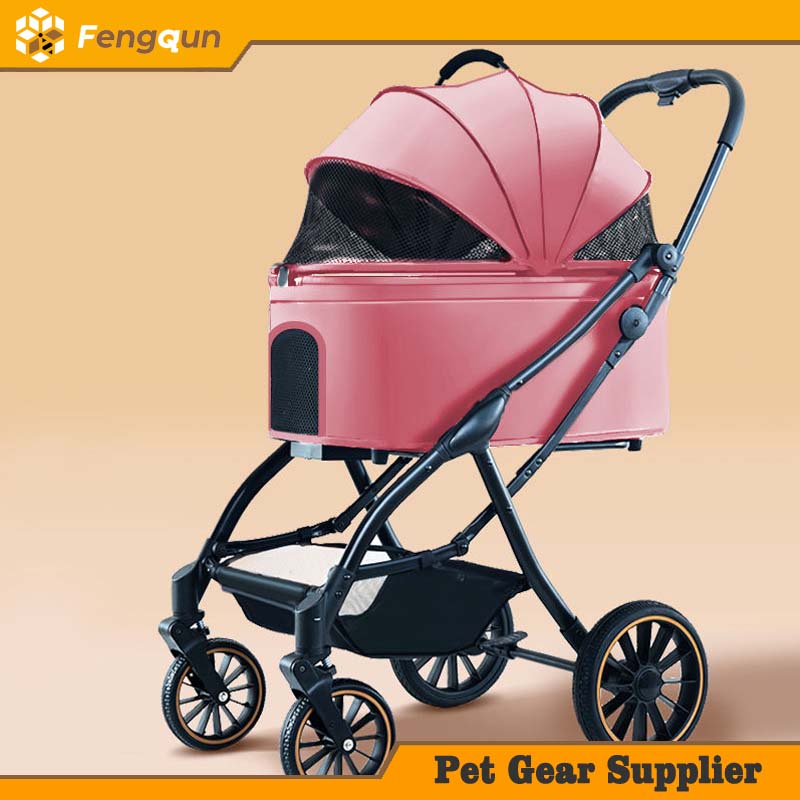
What Is the Best Foldable Pet Stroller?
The quest for the optimal foldable pet stroller requires systematic evaluation across multiple engineering dimensions, including folding mechanism design, structural integrity, material science, wheel systems, and safety engineering. This technical article establishes an evidence-based framework for identifying superior foldable pet strollers through analysis of patent documentation, customer feedback data, product specifications, and professional reviews. By examining the technical characteristics that differentiate exceptional products from inadequate ones, this analysis provides pet owners with the analytical tools necessary to make informed purchasing decisions. The conclusion presents a synthesis of critical selection criteria that define "best" across diverse usage scenarios and canine requirements.

1. Introduction: The Engineering Challenge of Foldability
The foldable pet stroller represents a sophisticated compromise between structural rigidity during use and geometric compactness during storage. This engineering challenge demands innovative solutions in mechanical design, material selection, and manufacturing precision. The fundamental question—"What is the best foldable pet stroller?"—cannot be answered with a universal recommendation, as optimal configuration varies with canine anthropometrics, owner physical capabilities, and primary usage environments. However, by establishing objective technical criteria derived from engineering principles and empirical performance data, this analysis provides a systematic methodology for identifying superior products.
Patent documentation reveals ongoing innovation in this domain, with recent filings describing retractable, detachable, and portable configurations that enhance user convenience. One such patent discloses a stroller body detachably connected to a basket, incorporating multiple locking mechanisms that enable independent basket use while maintaining structural integrity during transport. This technical approach allows the basket to be disassembled and folded separately from the frame, achieving more flexible and convenient outcomes when users travel with pets. Such innovations exemplify the engineering progression toward improved foldability without compromising functionality.
2. Folding Mechanism Engineering
2.1 One-Hand Operation vs. Multi-Step Processes
The folding mechanism constitutes the primary interface between user and stroller, and its design profoundly influences daily usability. Superior products incorporate one-click or one-hand folding systems that reduce physical effort and cognitive load during operation. Technical analysis of available products reveals significant variation in folding mechanism sophistication.
Advanced folding systems enable stroller compaction with minimal user intervention, typically through a button-activated release on the handlebar. This approach, characterized as "Smart-Fold" in some product descriptions, allows the stroller to collapse into a flat configuration for convenient storage without requiring the user to bend, manipulate multiple latches, or remove components. The engineering principle underlying such systems involves coordinated linkage mechanisms that simultaneously release multiple pivot points while controlling the folding trajectory to prevent pinching or uncontrolled collapse.
Comparative analysis of user feedback indicates that folding mechanism complexity correlates strongly with user satisfaction. Products featuring intuitive, single-action folding receive consistently positive evaluations, while those requiring multi-step processes, component removal, or significant physical force generate complaints. A lightweight stroller weighing only 13.6 pounds, incorporating a "one-click folding system" operable with one hand, exemplifies the engineering ideal where reduced mass combines with mechanical advantage to minimize user effort.
2.2 Compactness Metrics and Storage Efficiency
The folded dimensions of a pet stroller determine its practicality for apartment living, automobile transport, and air travel. Superior products achieve folded profiles approximating 9-16 inches in thickness, enabling storage in narrow spaces between furniture or in vehicle trunks alongside other cargo.
Engineering analysis reveals that folded compactness depends on three factors: the original frame geometry, the folding mechanism architecture, and the degree of component disassembly required. Products achieving the most compact folded configurations typically employ "flat fold" designs where the frame collapses into a near-planar arrangement rather than a three-dimensional block. This approach maximizes storage efficiency while maintaining structural simplicity.
The trade-off inherent in foldable design involves the number of pivot points required for compaction versus the frame's rigidity during use. Each additional pivot joint introduces potential play and wear over time, potentially compromising the stroller's tracking stability and structural integrity. Superior designs optimize this balance through precision-engineered joints with minimal tolerance accumulation.
3. Structural Integrity and Weight-Bearing Engineering
3.1 Frame Materials and Mechanical Properties
The frame material fundamentally determines the stroller's strength-to-weight ratio, durability, and long-term performance. Engineering analysis identifies three primary material categories in current products:
Aluminum alloy represents the optimal balance of lightness and strength, with some frames achieving weights approximately 30-40% lighter than steel alternatives of equivalent capacity. The specific alloy composition and heat treatment significantly influence mechanical properties, with higher-grade alloys offering superior fatigue resistance for repeated folding cycles.
Steel provides maximum strength at the expense of increased weight, typically appearing in heavy-duty models designed for larger dogs or rough terrain. While steel frames offer exceptional rigidity, the weight penalty may reduce portability and user comfort during extended use.
Composite materials appear in premium products, offering weight savings comparable to aluminum with potential vibration-damping properties. However, composite frames require careful engineering to achieve adequate stiffness at joint interfaces, where stress concentrations are highest.
The mechanical performance of frame materials manifests in user-reported outcomes. One customer comparing a lightweight product to a more expensive alternative noted that the premium stroller was "100% better in every way," citing superior structural integrity when transporting a 30-pound dog. This observation highlights the importance of adequate frame stiffness to prevent sagging and maintain proper wheel alignment under load.
3.2 Weight Capacity Verification
Published weight capacity specifications require critical evaluation, as they represent theoretical maximum loads rather than comfortable operating limits. Engineering best practice suggests selecting strollers with capacity 20-30% exceeding current animal weight, providing margin for dynamic loads during movement, accessory weight, and future weight fluctuations.
Analysis of product specifications reveals capacity ranges from 35 pounds for basic models to 75 pounds for heavy-duty configurations. The higher-capacity products typically feature reinforced frame geometry, larger wheel systems, and enhanced suspension components to manage increased loads without compromising maneuverability or stability.
Notably, customer feedback indicates that advertised capacities may overstate practical utility, with one reviewer noting that a stroller rated for 30-pound dogs exhibited significant carrier sag when loaded with an animal at the capacity limit. This observation underscores the importance of evaluating structural performance under actual load conditions rather than relying solely on published specifications.
4. Wheel System Engineering and Terrain Capability
4.1 Wheel Construction and Material Science
The wheel system constitutes the stroller's interface with the environment and critically influences ride quality, maneuverability, and durability. Technical analysis of wheel construction reveals substantial variation in material quality and engineering sophistication.
Superior wheel systems utilize polyurethane (PU) or ethylene-vinyl acetate (EVA) foam construction, materials that combine durability with shock absorption while remaining flat-free. These materials maintain consistent performance across temperature ranges and provide adequate traction without excessive rolling resistance. Products featuring "never-flat" tire construction receive positive user evaluations for eliminating maintenance requirements and puncture concerns.
Inferior wheel systems employ basic plastic construction lacking tread patterns or shock-absorbing properties. Customer feedback documents multiple complaints regarding "completely plastic" wheels that "slide all over with no traction." Such wheels compromise safety on wet surfaces and provide an uncomfortable ride due to inadequate vibration dampening.
The presence of sealed ball bearings in wheel hubs indicates higher manufacturing quality, enabling smooth rotation with minimal maintenance. Front wheel bearing quality proves particularly important for maneuverability, as bound bearings prevent proper swiveling and force the user to overcome excessive rolling resistance.
4.2 Suspension Systems and Ride Quality
Shock absorption engineering directly influences passenger comfort, particularly during outdoor use on uneven surfaces. Advanced strollers incorporate dedicated suspension components—either spring-based or elastomeric—that isolate the pet compartment from wheel-induced vibration.
Products described as featuring "multi-terrain suspension systems" or "shock absorbers for a smoother ride" demonstrate engineering attention to passenger comfort. These systems prove particularly valuable for:
Elderly dogs with arthritis or joint sensitivity
Postsurgical patients requiring motion restriction without impact
Puppies with developing musculoskeletal systems
Transport over brick pavers, gravel paths, or grass
The suspension tuning represents a complex engineering compromise: excessive compliance allows body roll during cornering, while insufficient compliance transmits irregularities directly to the passenger. Superior designs match suspension characteristics to intended usage environments, with firmer tuning for smooth urban surfaces and softer tuning for mixed terrain.
4.3 Wheel Configuration and Maneuverability
The stroller's wheel count and arrangement fundamentally influence handling characteristics:
Four-wheel configurations provide maximum stability, particularly for heavier loads or larger dogs. The typical arrangement features two fixed rear wheels and two swiveling front wheels, enabling tight turning radius while maintaining directional stability. Front wheel locking mechanisms allow conversion to fixed operation for rough terrain or straight-line travel.
Three-wheel configurations offer enhanced maneuverability through reduced turning radius and improved obstacle negotiation. User feedback indicates that three-wheel designs receive praise for "smooth steering and enhanced maneuverability," particularly in crowded environments or tight spaces. However, three-wheel designs may exhibit reduced lateral stability compared to four-wheel alternatives, particularly during cornering at speed.
The optimal configuration depends on primary usage patterns. Urban users navigating crowded sidewalks and retail environments may prefer three-wheel agility, while rural users traversing uneven terrain may benefit from four-wheel stability.
5. Safety Engineering and Containment Systems
5.1 Restraint Architecture
Effective pet containment requires redundant safety systems that prevent escape while permitting comfortable positioning. Technical analysis identifies three essential restraint components:
Internal attachment points (typically D-rings or O-rings) provide anchor locations for tether attachment. Superior designs incorporate at least two attachment points, enabling simultaneous restraint of multiple pets or single-pet attachment with backup redundancy. The attachment point location should allow tether connection without forcing the pet into unnatural positions.
Adjustable tethers attach to the pet's harness (never collar) and limit movement range within the cabin. Length adjustability proves essential for accommodating different pet sizes and allowing controlled movement without permitting escape when the canopy is opened.
Structural barriers including zippered mesh enclosures and rigid cabin walls provide primary containment. Zipper quality proves critical, with heavy-duty construction resisting forced opening by determined occupants. Customer feedback specifically notes plastic zipper components as potential failure points, suggesting that all-metal zipper construction indicates higher quality.
5.2 Braking System Engineering
Stationary security requires braking systems capable of preventing unintended movement on inclined surfaces. Technical analysis identifies two primary brake configurations:
Rear wheel single-action brake bars engage both rear wheels simultaneously through a single pedal or lever, ensuring symmetrical braking force and preventing rotation around the vertical axis. This configuration represents the safest approach, as independent wheel brakes may be applied unevenly, creating a tipping hazard.
Individual wheel brakes provide redundancy but require deliberate application to both wheels. User error in applying only one brake creates a hazard, as the pet stroller may pivot around the locked wheel when parked on slopes.
The brake mechanism should provide positive engagement with clear visual or tactile indication of lock status. Spring-loaded mechanisms that default to disengaged prevent accidental engagement during folding but require deliberate user action for parking.
5.3 Canopy and Ventilation Engineering
Thermal management during transport depends critically on ventilation design and canopy architecture. Superior products incorporate:
Multiple mesh panels distributed across front, sides, and rear to facilitate cross-ventilation. Minimum ventilation area should exceed 50% of cabin surface area to prevent heat accumulation during solar exposure.
Canopy designs that roll up rather than folding down into the cabin preserve interior space while providing sun protection. One product description specifically notes that the canopy "folds up under the canopy hood instead of into the pet compartment giving your pet more space," highlighting the ergonomic advantage of thoughtful canopy engineering.
Zip-open windows allow selective ventilation and visual access while maintaining containment. Dual-zipper configurations enable opening from either side, improving access convenience.
6. Material Quality and Durability Assessment
6.1 Fabric and Padding Specifications
The cabin materials directly influence passenger comfort, cleaning ease, and long-term durability. Technical analysis identifies critical material properties:
Oxford cloth construction provides abrasion resistance and dimensional stability while remaining lightweight. Higher denier fabrics offer increased durability at modest weight penalty.
Removable, machine-washable padding enables hygiene maintenance without requiring whole-stroller cleaning. "Thick poly-filled" or memory foam padding enhances passenger comfort, particularly during extended use or for dogs with orthopedic conditions.
Anti-slip waterproof pads on the cabin floor prevent pet sliding during movement while protecting underlying materials from accidents.
6.2 Component Wear Patterns
Longitudinal durability assessment reveals common failure modes requiring engineering attention:
Zipper failure represents the most frequently reported issue, with plastic zippers degrading after repeated use cycles. Metal zipper construction significantly extends service life.
Wheel bearing degradation manifests as increased rolling resistance and noise over time. Sealed bearing systems resist contamination and maintain performance longer than unsealed alternatives.
Folding mechanism wear produces increasing play and potential collapse hazards. Precision-engineered joints with minimal tolerance accumulation maintain performance through thousands of folding cycles.
Frame joint loosening allows progressive deterioration of structural rigidity. Locking mechanisms that maintain compression through positive engagement rather than friction alone resist vibration-induced loosening.
7. User Experience Engineering
7.1 Handle Ergonomics and Adjustability
The push handle constitutes the primary user interface, and its design significantly influences comfort during extended use. Technical considerations include:
Height adjustability accommodates users of different statutes and walking styles, preventing back strain from improper working height. Adjustable handles with secure locking mechanisms provide versatility without compromising structural integrity.
Kick space behind the rear wheels, described in some products as "Smart-Reach," allows natural walking stride without striking the stroller frame. This ergonomic consideration proves particularly important for taller users or those with longer stride lengths.
Integrated organizers with cup holders, phone slots, and secure compartments enhance utility by keeping essentials accessible during outings. Magnetic closure compartments provide convenient access while preventing accidental opening.
7.2 Assembly Requirements
Initial assembly complexity affects user satisfaction and correct configuration. Superior products feature:
Tool-free assembly requiring only wheel attachment and canopy installation. Clear, illustrated instructions significantly improve assembly success, as customer feedback frequently criticizes "absolutely horrible" instructions that impede proper assembly.
Pre-assembled components that minimize user error. Products arriving with frames partially assembled reduce opportunities for incorrect configuration.
Intuitive design that makes correct assembly obvious even without detailed instruction reference.
8. Selection Framework: Defining "Best" for Individual Needs
8.1 Canine Anthropometric Matching
The primary selection criterion must be dimensional compatibility with the intended passenger. Essential measurements include:
Length: From nose to base of tail, plus 4-6 inches clearance for position adjustment
Height: From floor to top of head or ears when standing, plus 2-3 inches canopy clearance
Width: Widest dimension across shoulders or hips
For reference, a cabin measuring 26 inches in length accommodates dogs up to approximately 24 inches in body length, suitable for medium breeds. Multiple small dogs require proportional width and length increases.
8.2 Usage Scenario Analysis
Primary usage patterns dictate optimal feature prioritization:
Urban commuting: Prioritizes compact fold, lightweight construction, and maneuverability through crowds. Three-wheel configurations may offer advantages.
Suburban walking: Emphasizes ride comfort, adequate storage, and durability for regular use. Four-wheel stability may be preferred.
Travel and air transport: Requires maximum fold compactness and lightweight construction, potentially accepting reduced capacity or features.
Medical transport: Prioritizes easy access, smooth ride, and security features over fold compactness or weight.
8.3 Quality Indicator Checklist
Objective quality assessment should evaluate:
Frame material and joint precision
Wheel material and bearing quality
Zipper construction (metal preferred)
Restraint attachment points (minimum two)
Brake system design and engagement
Fabric weight and cleaning instructions
Folding mechanism smoothness and lock security
9. Conclusion
The question "What is the best foldable pet stroller?" resolves not to a single product recommendation but to a systematic evaluation framework matching engineering characteristics to individual requirements. Superior foldable pet strollers demonstrate excellence across multiple technical dimensions: intuitive folding mechanisms that reduce user effort while maintaining structural integrity; wheel systems engineered for appropriate terrain with adequate suspension and traction; safety systems providing redundant containment and secure parking; and material quality sufficient for long-term durability.
Critical analysis of available products reveals that advertised specifications require verification against actual performance, with particular attention to weight capacity realism, wheel quality, and folding mechanism durability. The "best" stroller for any given application is one whose engineering characteristics align with the specific needs of the canine passenger and human operator, providing safe, comfortable transport with minimal compromise between structural integrity during use and geometric compactness during storage.
By applying the technical framework presented herein, pet owners can navigate the diverse product landscape with confidence, identifying the optimal foldable pet stroller for their unique circumstances without reliance on brand names or marketing claims. The engineering principles governing these devices—from material science to mechanical design to safety engineering—provide objective criteria for distinguishing exceptional products from inadequate alternatives.
For more about What Is the Best Foldable Pet Stroller? you can pay a visit to Product - Fengqun Pet Gear stroller for more info.