The Ultimate Travel Companion: Engineering the Perfect Foldable and Lightweight Double Dog Stroller
The bond between humans and their canine companions has never been stronger, and increasingly, that bond extends to travel and adventure. For multi-dog households, the idea of a family outing, weekend getaway, or even navigating a crowded urban environment presents a unique logistical challenge. Enter the specialized double dog stroller: a piece of pet tech that has evolved from a novelty to a necessity for many. However, when travel—be it by car, plane, or public transit—is part of the equation, the standard stroller falls short. The true innovation lies in the foldable and lightweight double dog stroller, a marvel of modern pet-centric design that balances robust functionality with unparalleled portability. This article delves into the technical engineering, material science, and design principles that make these strollers not just possible, but an optimal solution for the mobile pet parent.
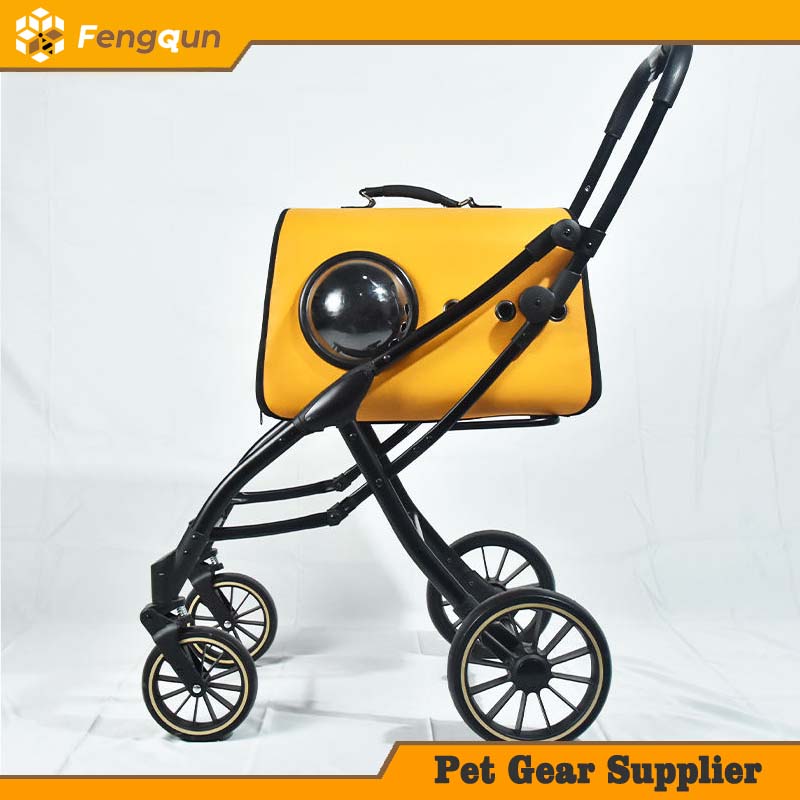
1. The Core Challenge: Balancing Strength, Weight, and Volume
Designing any foldable and lightweight double dog stroller is an exercise in structural engineering. It must support the dynamic, shifting weight of two animals (which can range from 15 to 35 lbs each in a typical model), withstand vibrations and impacts from varied terrain, and provide a sense of security. The traditional solution is a steel frame—strong, but prohibitively heavy and rigid.
The travel-oriented mandate adds two critical constraints:
Minimal Folded Dimensions: The stroller must collapse into a shape compact enough for airline overhead bins, car trunks, or tight storage spaces.
Minimal Mass: Every pound saved is crucial for lifting into vehicles, carrying up stairs, and complying with airline weight limits.
This creates the fundamental design triad: Strength vs. Weight vs. Folded Size. Optimizing for all three requires a multi-faceted approach.
2. Materials Science: The Foundation of Lightweight Durability
The battle for weight reduction is won at the material level. Advanced alloys and composites have revolutionized this category.
Aircraft-Grade Aluminum Alloys (e.g., 6061-T6): This is the industry standard for premium lightweight frames. It offers an excellent strength-to-weight ratio, high corrosion resistance (crucial for all-weather use), and good malleability for forming complex tube shapes. Compared to steel, it can reduce frame weight by 40-50% without sacrificing structural integrity.
Carbon Fiber Composites: For ultra-high-end models, carbon fiber is appearing in key stress-bearing components. Its tensile strength surpasses that of most metals at a fraction of the weight. However, its cost and specific failure modes (brittle fracture versus aluminum's bending) make it less common for full frames, often reserved for axle assemblies or support arms.
High-Density Polyethylene (HDPE) and Reinforced Nylon: These polymers are used for non-load-bearing structural panels, storage baskets, and the stroller's "body." Glass-fiber reinforced nylon offers incredible impact strength and rigidity, allowing for thinner, lighter wall sections in the cabin construction.
3. The Folding Mechanism: Engineering the Transformative Hinge
The folding system is the stroller's party trick and its most complex mechanical component. A double stroller cannot simply fold in half; it must collapse in three dimensions. Two primary mechanisms dominate:
Central Collapse System: Inspired by high-end baby strollers, this uses a single, robust latch on the handlebar. Pulling the latch releases a series of interconnected scissor hinges along the central chassis. The frame compresses downward and inward simultaneously, with the front and rear wheels often drawing together. This system prioritizes speed and one-handed operation. Engineering challenges include ensuring perfect alignment upon re-deployment and preventing pinch points for paws and fingers.
Multi-Step Sequential Fold: Some models opt for a more manual, two or three-step process: remove the cabins, fold the canopy, then fold the frame laterally. While slightly less "magical," this system is often simpler, more reliable, and allows for a flatter, more compact final package, as components can be packed separately. It reduces stress on a single, complex latch mechanism.
Key technical features within the fold include:
Automatic Side-Locking Hinges: These ensure that when the frame is opened, joints click and lock automatically into position, preventing accidental collapse.
Cable Management: Internal routing for brake cables must accommodate the folding action without kinking or excessive wear, often using flexible sheathing and oversized loops at hinge points.
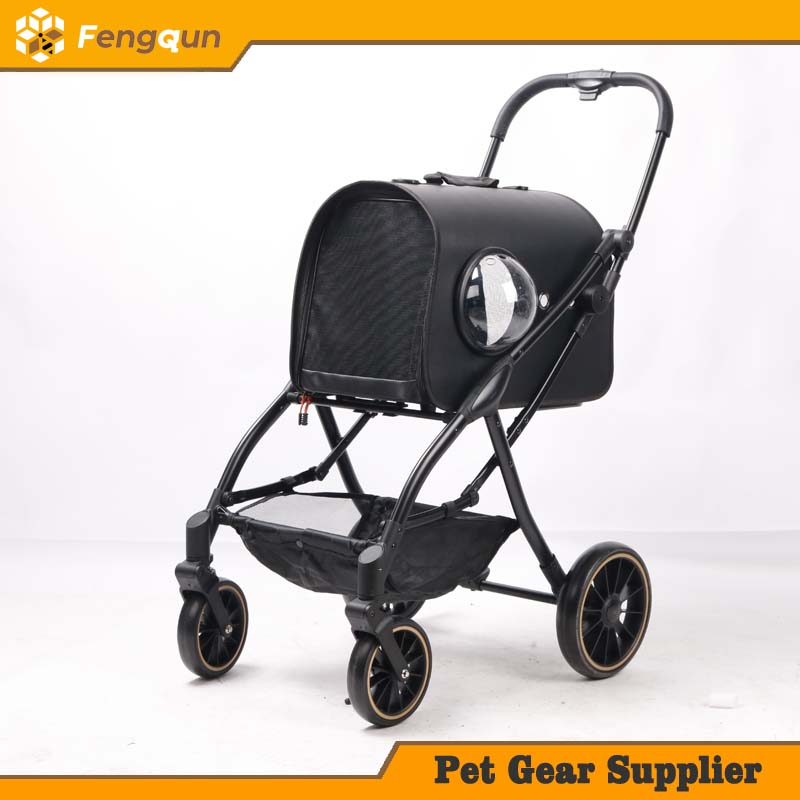
4. Cabin and Comfort: A Secure, Breathable Environment
The cabins are the primary interface for the canine passengers. Their design must prioritize safety, comfort, and observation.
Modular, Removable Cabins: For travel, the ability to detach the soft-sided cabins is a game-changer. They can serve as standalone carriers (often airline-compliant when used with a base), allowing dogs to remain settled from car to stroller to hotel room without disruption. This is achieved through robust clip-in buckles or slide-and-lock mechanisms onto the frame.
Ventilation Topography: Mesh panels are not merely cut-outs. They are engineered for maximum airflow with minimal loss of structural integrity. This involves using ultra-fine, high-tenacity polyester mesh (like those used in premium hiking backpacks) in large, continuous panels, often with a "roll-down" weather cover for protection.
Suspension Systems: To dampen vibrations from uneven pavement, many models incorporate basic suspension. This is typically a simple but effective elastomer polymer suspension at the rear axle—a rubber block that compresses and rebounds—or coil springs over the wheels. This protects joints of older dogs and provides a smoother ride for all.
5. Wheels and Mobility: From Pavement to Park Trails
Travel implies varied surfaces. The wheel assembly must be versatile yet simple.
Size and Composition: Larger wheels (7-8 inches) roll more easily over cracks and bumps. They are typically made of puncture-free EVA foam or non-pneumatic rubber. Foam wheels are ultra-lightweight and maintenance-free, while rubber offers slightly better shock absorption and traction.
Swivel-Lock Mechanism: Front swivel wheels are essential for maneuverability in crowded airports or shops. A simple press-button or flip-lever lock converts them to fixed wheels for straight-line stability and safety on inclines.
Bearings: Sealed, precision ball bearings within the wheel hubs are critical for ensuring smooth, quiet, and effortless rolling, reducing the force required to push a loaded stroller.
6. Travel-Optimized Features: Beyond the Basic Stroller
The "for travel" suffix demands specialized add-ons:
Integrated Storage: A large, tear-resistant under-seat basket is non-negotiable. It must hold travel essentials: collapsible bowls, water bottles, leashes, and a daypack.
Weather Systems: A full, 5-point canopy with peek-a-boo windows and a linked, waterproof rain cover is standard. Advanced models might use hydrophobic and UV-reflective fabrics.
Safety and Security: A parking brake (acting on the rear wheels) is essential for stability on slopes. Tether straps inside each cabin attach to a harness, preventing dogs from jumping out. Reflective piping and a built-in LED safety light enhance visibility during early morning or evening walks.
Carry Bag: A dedicated, durable carry bag with backpack straps is the ultimate travel accessory, protecting the folded stroller and making it a truly portable piece of luggage.
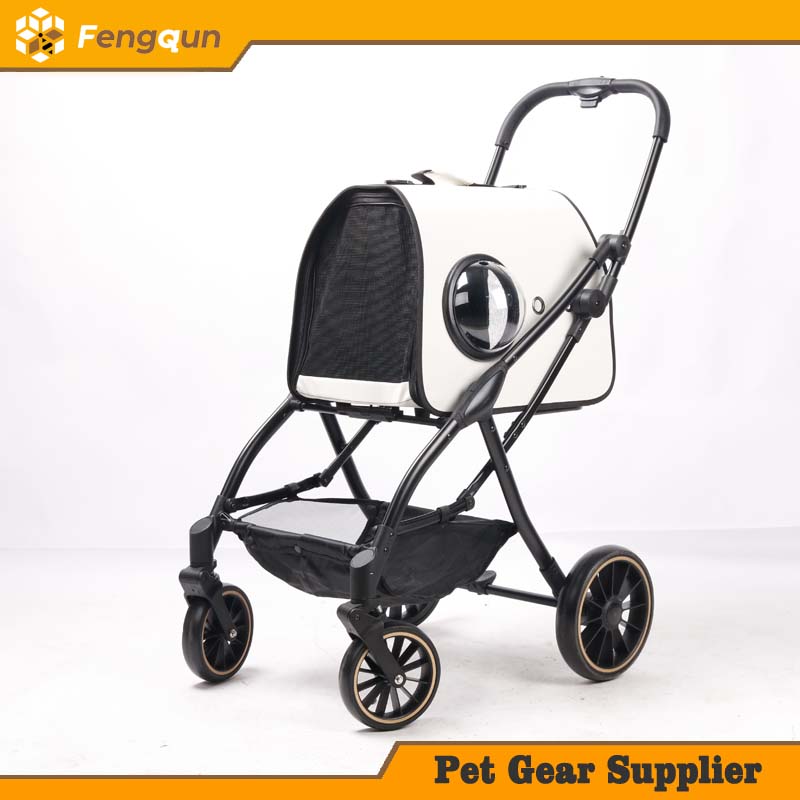
Conclusion
The modern foldable and lightweight double dog stroller is a testament to user-centric engineering. It is no longer a bulky, cumbersome apparatus but a sophisticated tool that synthesizes aerospace materials, intuitive industrial design, and a deep understanding of canine and human needs.
For the traveling pet parent, it solves a multitude of problems: it extends the range of adventures with senior or small-breed dogs, provides a safe haven in overwhelming environments, simplifies multi-modal transit, and ensures that both pets and their owners can explore the world together with comfort and ease. By mastering the trade-offs between strength, weight, and compactness through smart material choices and innovative mechanical design, these strollers have redefined what it means to be mobile with your furry family. They are not merely a product, but a passport to a shared life of discovery. As technology advances, we can expect even lighter composites, smarter folding mechanisms, and perhaps integrated tech like GPS or environmental monitors, further cementing the foldable double dog stroller as an indispensable icon of contemporary, companion-oriented travel.
For more about the ultimate travel companion: engineering the perfect foldable and lightweight double dog stroller, you can pay a visit to FengQun Pet Gear Supplier for more info.






