Regarding the Dual-Pet Compartment Design of the Twins Pets Stroller
The modern pet care industry has evolved beyond simple leashes and bowls, embracing innovation that mirrors the sophistication of products for human infants. Among these advancements, the multi-pet stroller, exemplified by designs like the Twins Pets Stroller, represents a pinnacle of functional engineering for urban pet owners with two dogs or cats. At the heart of its utility and safety lies a critical feature: the internal partition that creates dual compartments. This partition is not merely a fabric divider; it is a structural component whose load-bearing limit and anti-compression performance are paramount to the product's integrity, pet safety, and user confidence. This article delves into the engineering parameters, material science, and practical implications of these crucial characteristics.

The Imperative of the Internal Partition: Beyond Simple Separation
The primary function of the internal partition in a dual-pet stroller is to provide safe, separate spaces for two animals. This serves multiple purposes: preventing squabbles during transit, reducing stress for pets that prefer personal space, accommodating animals of different sizes, and containing potential messes. However, from an engineering standpoint, this partition assumes a much more complex role. It must:
Resist Static Loads: Support the weight and shifting movements of a pet leaning, pressing, or lying against it.
Resist Dynamic Loads: Withstand sudden impacts or pushes from a pet standing up, changing position, or reacting to an external stimulus.
Maintain Structural Integrity: Prevent collapse or significant deformation that could lead to compartment merging, entrapment, or injury.
Contribute to Overall Stroller Rigidity: Act as a semi-structural element that can enhance the chassis's torsional stability.
Failure in any of these areas compromises animal welfare and product reliability, making the specification of its mechanical parameters non-negotiable.
Defining the Parameters: Load-Bearing Limit
The load-bearing limit (or maximum working load) of the internal partition refers to the maximum force it can sustain perpendicular to its surface before experiencing permanent deformation (yield point) or catastrophic failure (ultimate failure). This is typically measured in kilograms or pounds-force.
1. Determinants of Load-Bearing Capacity:
Material Composition: The core determinant. Common materials include:
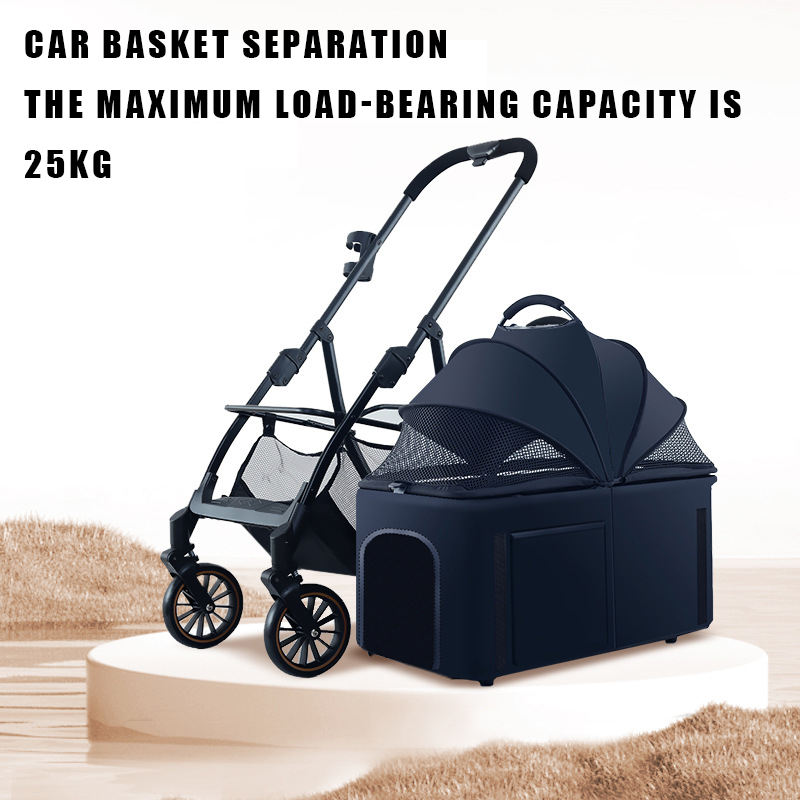
Rigid Polymers (e.g., Polypropylene, ABS): Molded plastic panels offer high inherent rigidity and a clear load-bearing limit (e.g., 15-25 kg per panel). They are often used in removable, solid partitions.
Reinforced Fabrics (e.g., Polyester with PVC backing or laminated mesh): These require a supportive framework. Their load capacity is directly tied to the tension applied and the strength of their attachment points.
Flexible but Resilient Materials (e.g., Dense Foam Paddings): While not structural on their own, they distribute load when combined with a supportive frame.
Structural Framework: Most partitions integrate a frame. This can be:
Internal Skeleton: Fiberglass or aluminum rods sewn into fabric sleeves, providing a semi-flexible, arcing support.
Perimeter Frame: Rigid plastic or lightweight metal (aluminum alloy) frames that define the partition's border, with fabric or mesh spanning the interior. This design typically offers the highest load capacity.
Attachment Mechanism: The partition's strength is only as good as its connection to the stroller body. Secure, multi-point attachments—using clips, screws, or rails—distribute the load into the main chassis. Poor attachment turns the partition into a weak, unsupported membrane.
2. Quantitative Parameters and Testing:
A responsibly designed stroller like the Twins Pets Stroller would subject the partition system to standardized tests. These might involve:
Static Load Test: Applying a calibrated, increasing weight (e.g., sandbags) to the center of the partition until a predefined deflection limit (e.g., 2 inches) is reached or until failure. The safe working load is set significantly below the failure point, often with a safety factor of 2-3x. For example, if a partition fails at 30 kg, its rated limit might be 10-15 kg.
Dynamic Fatigue Test: Simulating repeated loading/unloading cycles (e.g., 10,000 cycles with a 5kg weight) to ensure the partition and its attachments do not weaken or fail from pet movement over time.
3. Practical Implications for the User:
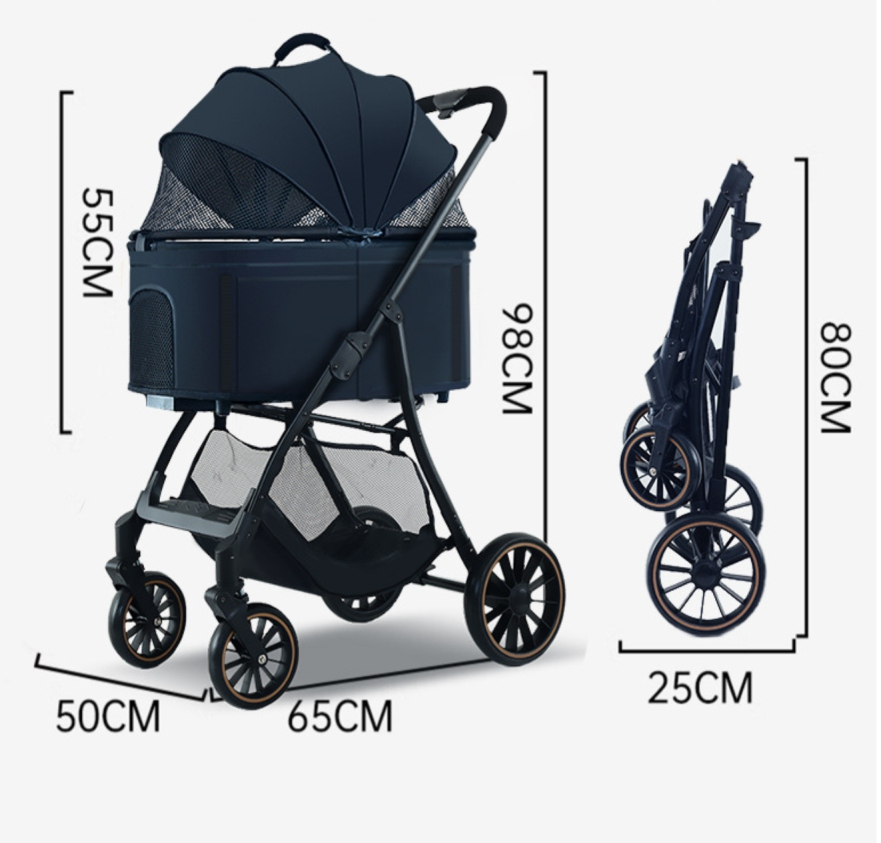
The manufacturer’s stated load-bearing limit for each compartment, and by extension the partition, dictates the maximum combined weight and size distribution of pets. If a partition is rated for 10 kg, placing a 12 kg dog constantly pressing against it risks gradual deformation, attachment failure, or a sudden collapse. This parameter directly informs the stroller’s sizing guidelines (e.g., "for two pets up to 7 kg each").
Defining the Parameters: Anti-Compression Performance
While load-bearing limit deals with direct, perpendicular force, anti-compression performance is a broader metric encompassing the partition's ability to resist flattening, buckling, or collapsing under multi-directional force, particularly from the sides. It is a measure of structural resilience and shape retention.
1. Key Aspects of Anti-Compression Design:
Lateral Stability: This is crucial. The partition must not easily fold if pets on both sides press against it simultaneously. Framed designs excel here, as the rigid perimeter resists bending.
Shock Absorption and Load Distribution: In a moving stroller, forces are not purely static. Bumps and jolts create compression waves. Materials like sandwiched foam or tensile mesh can absorb and dissipate these energies, preventing concentrated stress points.
Geometric Design: An arched or slightly convex partition is inherently more resistant to compression than a flat one, much like an arch in architecture. This geometry helps redirect compressive forces into tensile forces along the frame.
Material Resilience: The ability of the materials (both frame and spanning material) to return to their original shape after a deforming force is removed. High-resilience foam and spring-tempered alloys exhibit excellent anti-compression performance.
2. Testing for Anti-Compression:
Bi-Directional Compression Test: Applying force from both sides of the partition simultaneously to simulate two pets pushing against it, measuring the reduction in compartment space.
Torsion and Shear Testing: Evaluating how the partition behaves under twisting forces or forces applied parallel to its plane, which could occur if a pet tries to climb over it.
Synthesis: Interplay in the Dual-Pet Ecosystem
In a real-world scenario, these parameters do not work in isolation. Consider a Twins Pets Stroller carrying a 6 kg terrier and an 8 kg spaniel. The partition must:
Bear the static load of the spaniel sleeping against it (a constant ~8 kg force).
Resist dynamic compression when the terrier suddenly jumps up against the other side (an impulsive force perhaps equivalent to12-15 kg).
Maintain its shape and attachment integrity when the stroller goes over a curb, a scenario combining vertical shock (increasing load on lower attachments) and potential lateral sway.
A well-engineered partition manages these forces through a composite approach: a rigid perimeter frame defines the load-bearing limit, while a tensioned, resilient mesh panel provides the anti-compression performance, allowing for slight, safe deformation that absorbs energy before springing back.
Conclusion
The internal partition in a dual-pet stroller is a silent guardian. Its specified load-bearing limit and anti-compression performance are the quantitative expressions of a promise to the pet owner: a promise of safety, order, and reliability. For manufacturers of products like the Twins Pets Stroller, rigorously defining, testing, and transparently communicating these parameters—through clear weight limits and design explanations—is essential. It transforms the product from a simple convenience into a trusted piece of pet-care infrastructure.
For the discerning consumer, understanding these concepts is equally vital. It moves the purchasing decision beyond aesthetics and superficial features, prompting questions about material quality, construction, and the true meaning of "heavy-duty" or "escape-proof" marketing claims. In the end, the efficacy of the dual-compartment design hinges on this invisible architecture of strength, ensuring that every journey is as safe as it is enjoyable for both pets and their people.
For more about regarding the dual-pet compartment design of the twins pets stroller, you can pay a visit to FengQun Pet Gear Supplier for more info.






