Pet Stroller for Cat vs Dog Stroller: Which One is Perfect for Your Indoor Cat?
March 29, 2026
Indoor cats represent a unique engineering challenge for pet mobility devices. Unlike dogs, which often tolerate harness walks and exhibit forward-propelled gaits suited to larger, open-terrain strollers, domestic felines—particularly apartment-dwelling adults—display heightened startle responses, superior vertical leaping capability (up to 5–6 times their body length), and a preference for elevated vantage points combined with low-profile concealment. A pet stroller must therefore function as a mobile micro-environment: stable under variable urban or park loads, vibration-damped to protect delicate feline musculoskeletal systems, and engineered with full-perimeter mesh permeability to satisfy exploratory instincts without escape risk. This technical comparison dissects the structural, kinematic, aerodynamic, and biomechanical distinctions between strollers traditionally engineered for canine users versus those optimized for feline physiology. The goal is to determine which configuration best aligns with the needs of a typical 8–15 lb indoor cat, where weight distribution, thermal regulation, and rapid folding mechanics directly impact both animal welfare and operator ergonomics.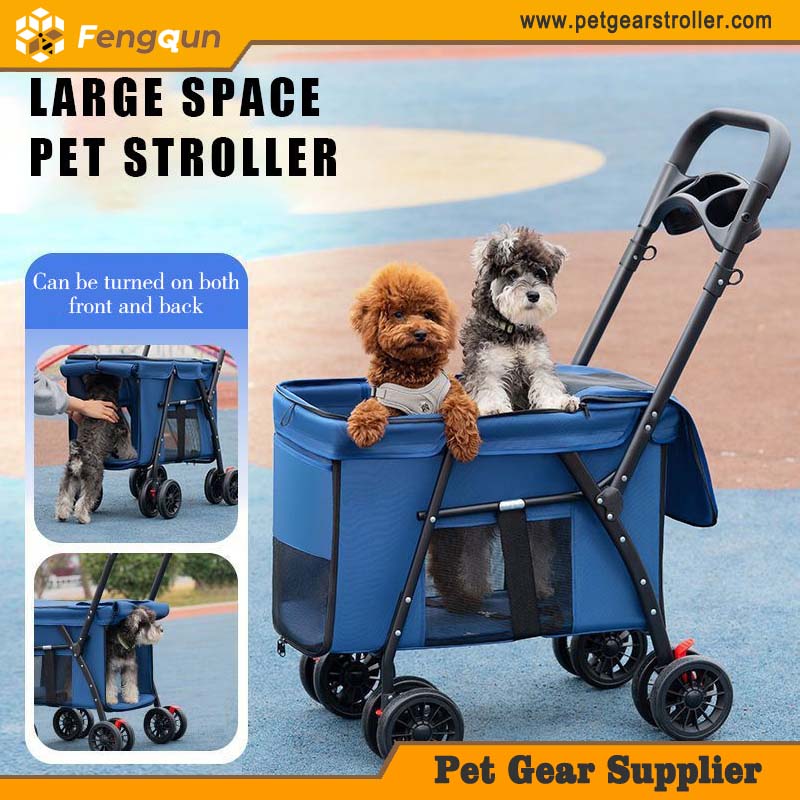
At the foundational level, every pet stroller comprises four primary subsystems: the chassis frame, wheel-and-suspension assembly, enclosed cabin (basket or pod), and restraint-harness interface. The chassis is typically fabricated from lightweight aluminum alloy tubing (6061 or 7005 series equivalents) or powder-coated steel for higher-load models. Rigidity is quantified by torsional stiffness—measured in Nm/deg—to resist twisting on uneven sidewalks. Canine-oriented designs prioritize higher payload ratings (often 40–75 lb dynamic capacity) with wider track widths (18–24 inches) to accommodate broader thoracic builds and trotting gaits. Feline-focused variants employ narrower footprints (14–18 inches) and lower center-of-gravity baskets (seat height 8–12 inches from ground) to minimize tip-over moments during sudden directional changes, reflecting cats’ lower mass and lateral agility.Wheel systems reveal the most pronounced divergence. Dog strollers frequently incorporate three-wheel configurations—dual rear fixed wheels paired with a single 360° swivel front wheel—optimized for jogging kinematics. Front wheel diameters range from 8 to 12 inches, often air-filled or high-density EVA foam with Shore A durometer ratings of 60–70 for shock absorption. Integrated suspension employs coil-over dampers or elastomeric bushings calibrated to a natural frequency below 2 Hz, attenuating road-induced vibrations (typically 5–15 Hz from pavement cracks) that could transmit to a canine’s spine during sustained forward motion. Braking systems feature rear drum or disc-style locks with one-handed actuation, rated for static holds on 15–20° inclines. In contrast, cat-oriented strollers favor four-wheel layouts with all-swivel casters (6–8 inch diameters) to enable tight-radius turns in crowded spaces. Suspension here prioritizes micro-vibration isolation via viscoelastic foam pads or leaf-spring equivalents, because feline vestibular systems are more sensitive to high-frequency oscillations; prolonged exposure above 8 Hz correlates with elevated cortisol in stress-prone cats. Larger dog wheels provide superior all-terrain performance (e.g., gravel or grass traversal with 30–40 % less rolling resistance), yet they transmit more vertical displacement to lighter occupants unless heavily damped—potentially unsettling for an indoor cat unaccustomed to motion.Cabin enclosure engineering further differentiates the two categories. Dog strollers often feature semi-open canopies with large front mesh panels (polyester or nylon mesh at 200–400 denier) providing 60–80 % open area for panoramic visibility and convective cooling. Ventilation is rated informally by air exchange rates; a typical canine model might achieve 150–250 cubic feet per minute (CFM) under 5 mph forward speed via Bernoulli-driven flow through side and rear vents. However, these designs assume a dog’s willingness to remain seated or prone. Cat strollers elevate enclosure integrity: full 360° double-layer mesh (inner fine-weave 0.5–1 mm apertures to block insects, outer UV-stabilized 1000+ denier for durability) with reinforced zippered or latch-sealed access points. Mesh permeability is engineered higher—often exceeding 300 CFM—to counteract feline thermoregulation challenges. Cats lack efficient sweat glands and rely on panting or conductive heat loss; internal cabin temperatures can spike 5–8 °C above ambient within 10 minutes without adequate airflow, risking heat stress. Many feline designs incorporate adjustable sunshades with UPF 50+ ratings and removable rain covers (hydrostatic head >2000 mm), plus padded, machine-washable liners with antimicrobial coatings to manage dander and odor—critical given cats’ fastidious grooming and higher shedding rates indoors.Safety restraint subsystems must address species-specific escape behaviors. Canine strollers rely on simple leash tethers clipped to a D-ring harness anchor, with tensile strengths of 200–400 lb to restrain pulling forces up to 3–4 times body weight during excitement. Feline variants integrate dual-point or three-point harness anchors sewn into the cabin floor, often with quick-release buckles and secondary safety straps rated to 150 lb static load. The tether length is deliberately limited (6–10 inches) to prevent launch attempts; cats can generate peak vertical forces exceeding 4–5 body weights in a single bound. Brake and parking mechanisms are identical in principle—rear wheel locks with audible engagement—but cat strollers emphasize redundant front swivel locks to eliminate unintended rolling when parked on slopes, as felines may shift weight unpredictably during grooming or observation.Portability metrics become decisive for indoor cat owners living in multi-story buildings or using public transit. Folding kinematics vary: dog strollers commonly employ a one-step umbrella-fold or scissor mechanism collapsing to 30–36 inches long when stored, with overall packed volume around 2.5–3.5 cubic feet. Cat strollers optimize for ultra-compactness—many achieve a folded length under 28 inches and weight under 15 lb—using aircraft-grade aluminum hinges and quick-release pins. Frame weight directly affects maneuverability; a 2 lb difference in empty mass translates to 15–20 % higher push force required on inclines for the operator. Storage basket capacity (typically 10–20 lb undercarriage) is comparable, yet feline models position it lower to preserve the low center of gravity.From a biomechanical standpoint, indoor cats present distinct demands. Feline resting metabolic rates and joint loading differ markedly from canines. An 12 lb cat’s spine experiences compressive forces amplified by any unsprung vibration; studies in comparative orthopedics indicate that repeated 0.5–1 g accelerations (common on standard sidewalks) accelerate degenerative changes in senior cats already prone to osteoarthritis. Dogs, with more robust musculature and shock-absorbing pads, tolerate higher peak loads. Behaviorally, cats exhibit neophobia—novel motion or sounds trigger freeze-or-flee responses—necessitating cabins with 270–300° visual fields through mesh to provide environmental predictability without overload. Thermal comfort thresholds are narrower: optimal cabin temperature 68–75 °F versus dogs’ broader 60–80 °F tolerance. Consequently, a dog stroller’s larger volume and open design may induce draft-induced anxiety or escape attempts in a cat, while its higher seat height could feel precarious.Quantitative performance criteria for evaluation include:Maneuverability index: Turning radius (target <36 inches for urban cat use) and push force (ideally <8 lb on flat concrete).
Vibration transmission: Measured via accelerometer as RMS acceleration at the cabin floor (<0.3 g target for feline comfort).
Ventilation efficiency: Air velocity at pet level (>0.5 m/s at 3 mph walking speed).
Durability cycles: Frame fatigue tested to 5000 km equivalent rolling distance without deformation.
Safety factor: Harness anchor load rating at minimum 5× maximum pet weight.
Pros of dog strollers for indoor cats include superior all-terrain capability on park paths or trails, higher static stability for multi-cat or combined use, and robust braking on hills. However, cons dominate: excessive interior volume encourages pacing or jumping (increasing injury risk), coarser suspension transmits more road shock, and bulkier frames reduce daily usability in elevators or cars. Cat-optimized strollers excel in compactness, precise vibration isolation, superior mesh airflow tailored to feline physiology, and escape-proof cabin geometry—yet may lack payload margin for future growth or added accessories and offer reduced rough-terrain performance.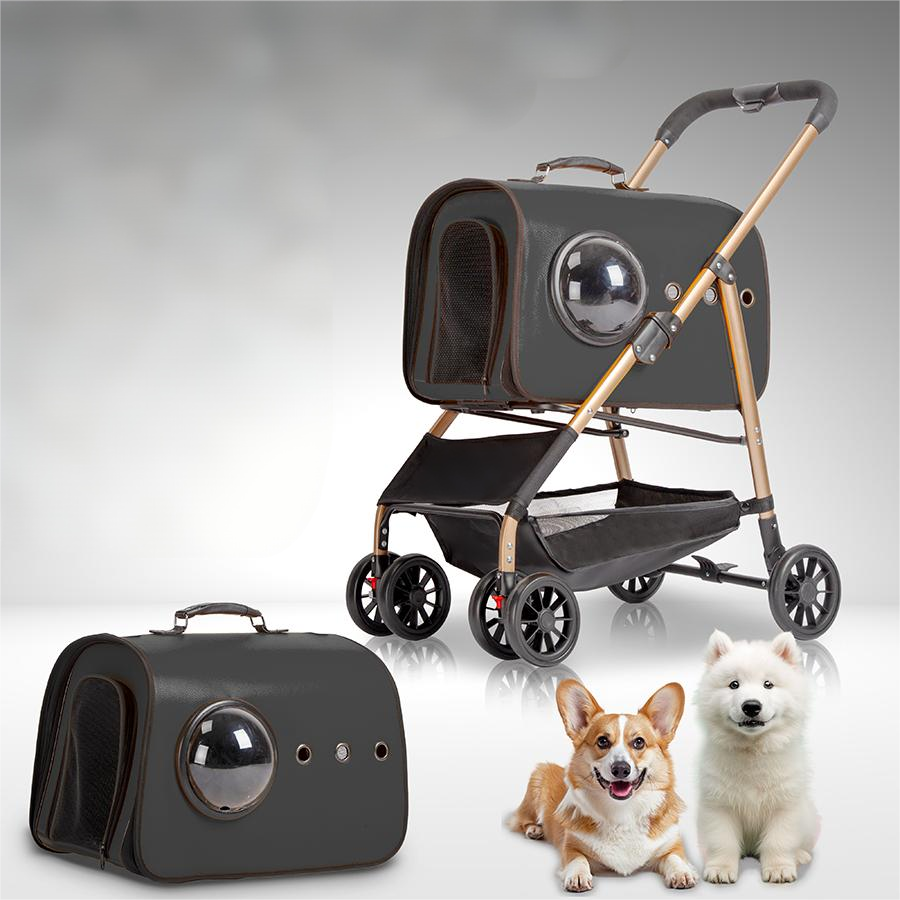
A decision framework for indoor cat owners begins with anthropometric data: measure your cat's length (nose to tail base) and weight, then select a cabin floor area at least 1.5× that dimension with 12–15 inch headroom. Prioritize four-wheel swivel layouts with sub-0.3 g vibration damping and >250 CFM mesh ventilation. Verify one-handed folding under 30 seconds and total empty weight under 18 lb for apartment practicality. Test on sample terrain: if daily routes include grass or gravel >20 % of distance, hybrid all-terrain wheels become essential; otherwise, prioritize lightweight urban casters.Ultimately, the pet stroller engineered specifically around feline biomechanics and behavior—emphasizing compact, low-vibration, high-ventilation, escape-resistant architecture—delivers the optimal balance for an indoor cat. While versatile dog-derived platforms can suffice with modifications (added padding, shortened tethers, supplemental mesh), they introduce unnecessary compromises in ergonomics and safety margins. Selecting the feline-optimized design transforms routine enrichment outings into low-stress, physiologically supportive experiences, extending both mobility and quality of life without compromising the animal’s natural caution or the owner’s convenience. For the typical indoor cat, the verdict is clear: the cat-specific stroller configuration is the technically superior, welfare-aligned choice.For more about Pet Stroller for Cat vs Dog Stroller: Which One is Perfect for Your Indoor Cat? you can pay a visit to https://www.petgearstroller.com/product/ for more info.






