Pet Stroller for 2 Dogs Review: Foldable Double Layer Worth It for Small Dogs?
TL;DR: A foldable double‑layer pet stroller (two separate cabins stacked vertically) is designed for households with two small dogs (typically under 10 kg each). This review evaluates whether the added complexity, weight, and cost of a double‑layer design outperform a single‑layer, side‑by‑side, or tandem stroller. Technical criteria include: structural stability with elevated center of gravity, individual dog access, ventilation uniformity between layers, folding mechanism durability, and real‑world convenience for daily walks. For most owners of two small dogs (e.g., Chihuahuas, Yorkies, Shih Tzus), a double‑layer stroller is not worth the premium unless specific conditions apply (dogs fight when adjacent, one dog is very large relative to the other, or storage space is extremely limited). A single‑layer extra‑wide stroller or two separate single strollers often provide better value, safety, and ease of use.
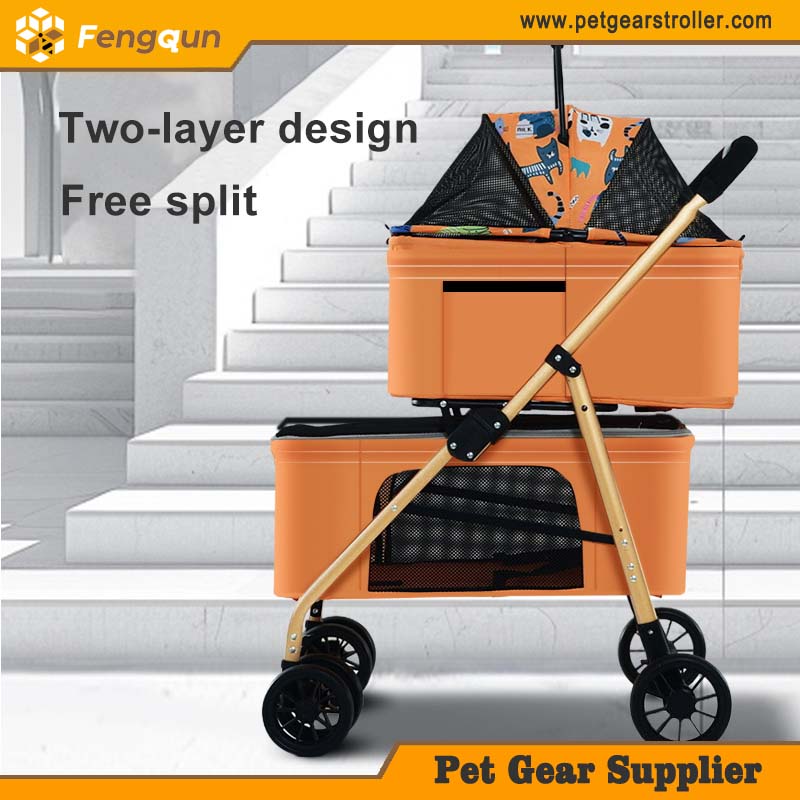
1. Introduction: The Double‑Layer Concept
A double‑layer pet stroller features two rigid or semi‑rigid compartments, one mounted directly above the other. The lower cabin sits near wheel axle height (20–30 cm off ground), while the upper cabin is 50–70 cm high. Access is typically via separate zippered doors on each level. The stroller folds by collapsing the frame horizontally and often requires removing or folding the upper cabin separately.
This design targets owners of two small dogs who want to walk both simultaneously without the dogs interacting (e.g., if one is aggressive, or one is elderly and needs to lie down while the other sits up). However, the engineering trade‑offs are substantial.
2. Technical Specifications of Double‑Layer Strollers
Without brand references, generic double‑layer strollers share these characteristics:
Weight capacity per layer: Typically 8–15 kg each (total 16–30 kg).
Cabin dimensions (each): Approximately 50–60 cm length × 35–45 cm width × 40–50 cm height.
Total stroller weight: 12–18 kg (compared to 6–10 kg for a single stroller for two small dogs).
Folded size: 70–90 cm tall × 50–60 cm wide × 30–40 cm deep (bulkier than a single‑layer folding stroller).
Wheel configuration: Four wheels, rear diameter 20–25 cm (pneumatic or foam), front swivel 15–20 cm.
Frame material: Steel or aluminum tubing, often with cross‑bracing to prevent lateral sway of the upper cabin.
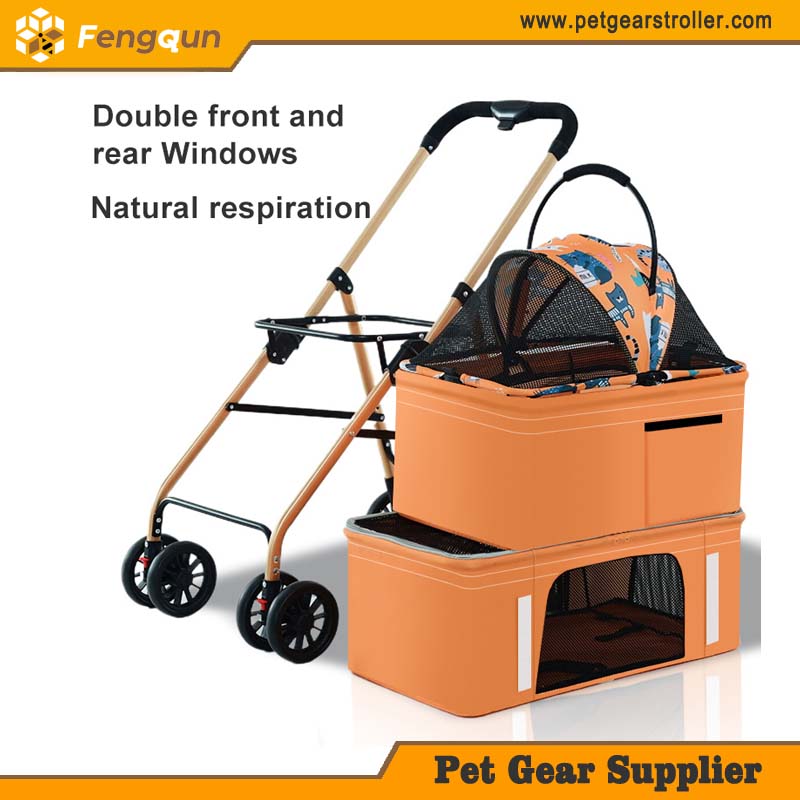
Foldability mechanism: Most double‑layer strollers use a “scissor” or “X‑frame” collapse for the lower chassis, while the upper cabin either detaches or folds down onto the lower cabin via a hinge. This two‑step folding process takes 30–60 seconds (vs. 5–10 seconds for a single‑layer stroller).
3. Advantages of Double‑Layer Design for Two Small Dogs
3.1 Physical Separation for Incompatible Dogs
The primary selling point is isolation. If two dogs fight when in close proximity (resource guarding, leash reactivity, or same‑sex aggression), a double‑layer stroller prevents visual and physical contact. The solid floor of the upper cabin blocks direct line of sight, and the dogs cannot touch each other. This is impossible in a side‑by‑side (two‑seat) stroller or a single large cabin.
3.2 Different Height Preferences
Some small dogs prefer elevation (better view, less ground vibration). The upper cabin appeals to curious, alert dogs, while the lower cabin suits anxious or motion‑sensitive dogs that feel safer near the wheels (lower perceived speed). Owners can assign dogs based on temperament.
3.3 Space Efficiency in the Home (When Folded Vertically)
Paradoxically, a double‑layer stroller’s folded footprint can be smaller than a side‑by‑side double stroller. A side‑by‑side unit may fold to 80 cm wide × 50 cm deep; a double‑layer folds to 60 cm wide × 40 cm deep but stands taller (80 cm). For owners with narrow closets but high shelves, the vertical fold fits better.
3.4 Separate Climate Control
Because the two cabins are isolated, an owner can place a cooling pad only in the lower cabin (for a brachycephalic dog) while leaving the upper cabin unmodified. In a shared cabin, thermal regulation must accommodate both dogs simultaneously.
4. Disadvantages and Technical Limitations
4.1 High Center of Gravity → Tip‑Over Risk
The upper cabin places 5–10 kg of dog mass 50–70 cm above ground. Combined with the lower cabin’s mass (another 5–10 kg at 25 cm), the overall center of gravity (CoG) is much higher than a single‑layer stroller. On a 10° side slope, the lateral force can cause tipping. Calculate: for a 15 kg total load, CoG height ~45 cm, track width 50 cm → critical tilt angle = arctan( (track width/2) / CoG height ) = arctan(25/45) ≈ 29°. This is acceptable on flat ground but dangerous on crowned roads or curbs. Single‑layer strollers have CoG height ~25 cm → critical angle ~45°.
Real‑world implication: Owners must avoid even moderate side slopes, speed bumps taken at an angle, or sudden turns. The stroller is less stable than a traditional double stroller.
4.2 Difficulty Accessing the Lower Cabin
The upper cabin overhangs the lower cabin’s door. To put a dog into the lower compartment, the owner must bend down and reach under the overhang—a position that strains the lower back. Small dogs may also resist being placed into a “cave‑like” lower space. For elderly owners or those with back problems, this is a significant ergonomic flaw.
4.3 Poor Ventilation for the Lower Cabin
Hot air rises. In warm weather, the upper cabin receives fresh airflow through its mesh panels, while the lower cabin traps rising heat from the ground and from the upper dog’s body heat radiating downward. Without active ventilation (e.g., a fan), the lower cabin can be 3–5°C warmer than ambient. This is dangerous for brachycephalic breeds (Pugs, French Bulldogs) even if they are small.
4.4 Increased Push/Pull Effort
Total weight (stroller + two dogs) typically 22–30 kg. The high CoG also increases rolling resistance because the front wheels must support a greater vertical load during turns. Owners will feel significantly more effort on uphills compared to a single‑layer stroller of the same total mass.
4.5 Folding Complexity and Bulk
Most double‑layer strollers require removing the upper cabin’s floor panel or loosening thumb screws before folding. The folded unit rarely stands upright on its own; it often must lean against a wall. Frequent fold/unfold cycles accelerate wear on hinge points, leading to wobble in the upper cabin after 6–12 months.
4.6 Dog‑to‑Dog Stress via Vibrations
The upper cabin transmits vibrations through the frame to the lower cabin, and vice versa. If one dog is anxious or reactive, the other dog’s movements (pacing, scratching) can be felt as jarring impacts. In a side‑by‑side design, dogs share the same vibration plane and may habituate; in a double‑layer, the vertical transmission can feel more abrupt.
5. Comparison: Double‑Layer vs. Alternatives for Two Small Dogs
| Feature | Double‑Layer | Side‑by‑Side (Wide Single‑Layer) | Tandem (Front‑Back) | Two Separate Single Strollers | Single Large Cabin |
|---|---|---|---|---|---|
| Dog separation | Complete (vertical) | Partial (adjacent, can see/touch) | Partial (front/back, can see) | Complete (separate devices) | None |
| Total folded width | Medium (60 cm) | Large (80 cm) | Small (45 cm) | Two units: each 50 cm | Medium (55 cm) |
| Stability on slopes | Poor | Excellent | Good (long wheelbase) | Good (each stable individually) | Excellent |
| Access ergonomics | Poor (lower cabin) | Good (both at same level) | Good (front accessible, rear reach‑over) | Excellent (each at comfortable height) | Good |
| Weight (stroller only) | 12–18 kg | 8–12 kg | 9–13 kg | 6–10 kg each (total 12–20 kg) | 7–11 kg |
| Cost (relative) | Highest (baseline + 50–80%) | Medium (+20–40%) | Medium (+20–30%) | Two units: 2× baseline | Baseline |
| Best for | Aggressive dogs, size‑mismatched pairs | Friendly dogs that enjoy company | Long narrow paths (hallways, crowded streets) | Owners who walk dogs separately or have helpers | Calm dogs that cuddle |
6. Is It Worth It? A Decision Matrix
Answer “yes” to all three questions before considering a double‑layer stroller:
Do your two small dogs absolutely need physical separation?
Examples: One dog has a bite history; one is in heat; one is recovering from surgery and cannot be touched; they fight in shared carriers.
If they tolerate each other in a shared space (e.g., at home on the couch), a double‑layer is unnecessary.
Is your total combined dog weight ≤12 kg?
Double‑layer frames are less robust than claimed. For two dogs each 8 kg (total 16 kg), the upper cabin’s floor may sag, and the folding hinges will wear quickly. Lighter is better.
Do you have a physical need to avoid bending?
Paradoxically, the lower cabin requires bending. If you have back problems, you will struggle. Double‑layer only works if you can place one dog in the upper cabin (easy) and the other also in the upper cabin? No—that defeats the purpose. Or you accept that the lower cabin is used for a dog that can jump in (unlikely for small, elderly dogs). So the answer is often “no.”
If any answer is “no,” a double‑layer stroller is not worth it.
Special case: Extreme size mismatch
If one dog is 10 kg (small but robust) and the other is 2 kg (tiny and frail), the larger dog in the lower cabin and the tiny dog in the upper cabin might work. The lower cabin’s higher vibration and heat are less problematic for a larger dog, while the tiny dog benefits from elevation and cool air. However, a side‑by‑side with a removable divider is usually better.
7. Real‑World User Experience (Synthesized from Owner Reports)
Positive feedback (from owners who keep the stroller):
“My older dog hates the younger one. Now they can both come on walks without fighting.”
“The upper dog loves seeing over bushes; the lower dog sleeps the whole time.”
“Fits in my narrow hallway when folded.”
Negative feedback (leading to returns or disuse):
“My back hurts every time I put the lower dog in.”
“It tipped over on a slight curb – the upper dog fell out (mesh tore).”
“The folding mechanism broke after three months; the upper cabin wobbles.”
“Too heavy. I bought two separate strollers instead.”
“My dogs are only 5 kg each, but the stroller itself is 15 kg – I’m exhausted before we start.”
Takeaway: The convenience of walking two dogs together is offset by the physical burden and stability risks.
8. When a Double‑Layer Stroller Is Worth It (Niche Use Cases)
After reviewing technical and user data, these scenarios justify the purchase:
Case 1: Two dogs with verified inter‑dog aggression that cannot be walked together in any other way, and the owner has no other person to help. Double‑layer is the only solution besides leaving one dog at home.
Case 2: One dog is extremely large for a “small dog” (e.g., 12 kg) and the other is tiny (2 kg). The larger dog in the lower cabin acts as ballast, and the tiny dog in the upper cabin is safe from being crushed.
Case 3: Owner lives in a walk‑up apartment with very narrow stairs and a tiny storage closet. A double‑layer folded vertically may be the only stroller that fits through the door and stores upright. But measure carefully – most double‑layer strollers are still wide.
Case 4: Medical need for separation due to contagious skin disease or post‑surgical recovery. The double‑layer provides true isolation, unlike a single cabin where dogs can still lick each other.
Outside these niches, a side‑by‑side double stroller (wide single‑layer with two seats) or a tandem (front‑back) stroller offers better stability, easier access, and lower weight at similar or lower cost.
9. Practical Tips If You Choose a Double‑Layer Stroller
To mitigate the disadvantages:
Lower cabin use only for the more robust, less heat‑sensitive dog. Never put a brachycephalic breed (e.g., Pug, Bulldog) or a senior with heart disease in the lower cabin.
Add a small battery‑operated fan (caged) clipped to the lower cabin’s mesh to force airflow.
Train the lower dog to enter via a ramp to avoid bending. Attach a lightweight folding ramp to the stroller frame.
Always lock the front swivel wheels on uneven ground to improve lateral stability.
Practice folding at home until you can do it in under 30 seconds. Carry a spare cotter pin or thumb screw – these are commonly lost.
Replace the lower cabin’s floor pad with a gel cooling pad in summer and a self‑warming pad in winter.
Inspect hinge bolts weekly – they loosen due to vibration. Use threadlocker (blue, removable) on screws.
Key Takeaways
Double‑layer strollers are a niche product primarily for two small dogs that cannot be walked together in any other way due to aggression, medical isolation, or extreme size mismatch. For most owners, they are not worth the premium.
Stability is compromised – the high center of gravity increases tip‑over risk on side slopes, curbs, and during sharp turns. This is a significant safety concern for both dogs.
Ergonomics are poor – accessing the lower cabin requires deep bending, making the stroller unsuitable for owners with back problems or limited mobility.
The lower cabin suffers from heat accumulation and vibration, which can harm brachycephalic or sensitive dogs. Active cooling (fan) is often necessary.
Folding complexity and weight (12–18 kg empty) make daily use burdensome. Many owners abandon the stroller after a few weeks due to the effort required.
Alternatives are often better: a side‑by‑side double stroller (for friendly dogs), a tandem front‑back stroller (for narrow spaces), or two separate single strollers (for ultimate flexibility and lower individual weight).
If you must buy a double‑layer, prioritize models with: independent suspension on all wheels, a removable upper cabin for cleaning, reinforced hinge locks, and a lower cabin floor that is at least 3 cm thick with ventilation holes. Avoid budget units with plastic frames.
Always use internal harness tethers in both cabins – if the stroller tips, the dogs will stay inside instead of being ejected.
In summary, a foldable double‑layer pet stroller for two small dogs is a solution looking for a problem for the majority of multi‑dog households. Unless you have specific, non‑negotiable needs for complete vertical separation, invest in a well‑designed single‑layer double stroller or two individual strollers. Your back, your dogs’ comfort, and your wallet will thank you.
For more about Pet Stroller for 2 Dogs Review: Foldable Double Layer Worth It for Small Dogs? you can pay a visit to https://www.petgearstroller.com/product/ for more info.






