Pet Gear Large Dog Stroller: A Technical Deep Dive into High Weight Capacity, and Rear Safety Brakes
The modern pet parent’s repertoire has evolved far beyond leashes and bowls. For senior dogs, recovering patients, or urban-dwelling large breeds, the humble dog stroller has transitioned from novelty to necessity. However, not all strollers are created equal. When your companion is a Labrador, German Shepherd, or similarly substantial friend, standard models fall short. This is the domain of the heavy-duty large dog stroller—a category defined by robust engineering, exceptional weight capacity, and critical safety features like rear safety brakes. This article provides a technical examination of these specialized transport systems, focusing on the engineering principles that make them safe, durable, and indispensable for owners of larger canines.
The Engineering Challenge: Beyond Human Infant Designs
At first glance, a pet gear large dog stroller may resemble a beefed-up baby stroller. This is a fundamental misconception. Human infants are relatively uniform in weight distribution and posture. A large dog, however, presents a unique set of engineering challenges:
Dynamic Loads: A dog shifts weight, stands, lies down, and may lunge. These dynamic forces impose stress far exceeding a static weight rating.
Center of Gravity: A dog’s center of gravity is higher and more variable than an infant’s, affecting stability, especially during turns or on inclines.
Claw and Chew Resistance: Materials must withstand scratching, digging, and potential chewing.
Thermal and Ventilation Management: Dogs regulate temperature differently, requiring superior airflow without security compromises.
Addressing these challenges requires a dedicated design philosophy, one that prioritizes structural integrity above all else.
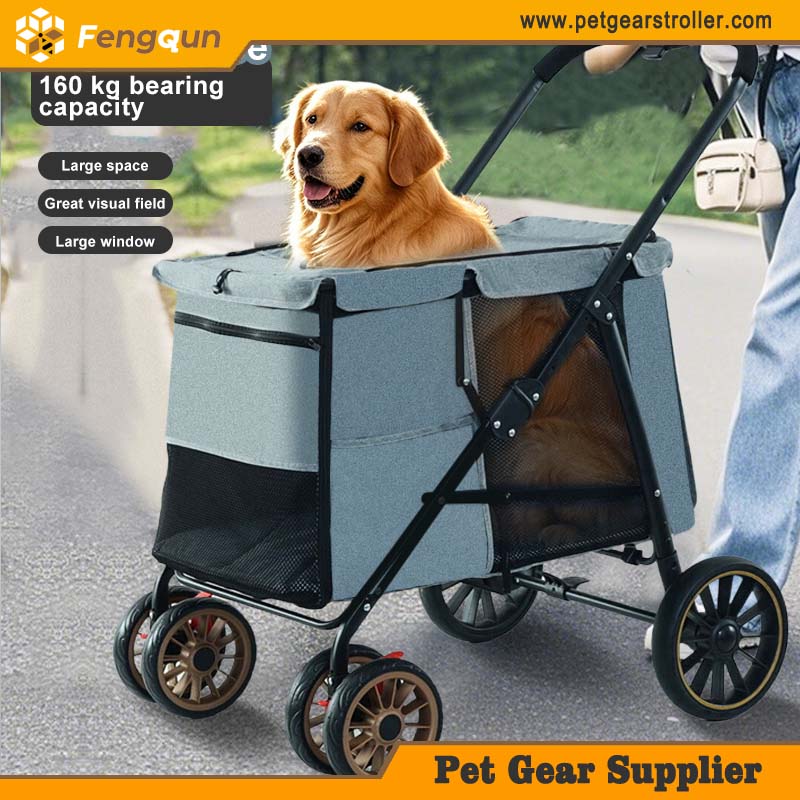
Deconstructing Heavy-Duty: Frame and Chassis Engineering
The term "heavy-duty" is more than a marketing slogan; it’s a specification born from material science and mechanical design.
1. Frame Materials and Geometry:
Aircraft-Grade Aluminum Alloys: The gold standard. Alloys like 6061-T6 offer an excellent strength-to-weight ratio, high corrosion resistance, and good weldability. They provide rigidity to prevent frame flex under load while keeping the stroller maneuverable.
Reinforced Steel Tubing: Used in the highest weight-capacity models (e.g., 150 lbs+). Steel provides ultimate tensile strength and durability, though it adds significant weight. Key stress points—joints, axle mounts, and folding mechanisms—are often reinforced with gussets or double-walled tubing.
Triangular Bracing: Engineers employ triangular truss structures in the frame design. Triangles are inherently rigid geometric shapes that distribute loads evenly, preventing parallelogram-style deformation.
2. Wheel and Suspension Systems:
Wheel Diameter and Material: Large wheels (8-12 inches) with pneumatic (air-filled) or polymer foam tires are essential. Pneumatic tires offer superior shock absorption, crucial for arthritic dogs, by dampening vibrations from uneven terrain. Foam tires eliminate puncture risk. The wheel hubs should feature sealed bearings for smooth, long-rolling rotation with minimal maintenance.
Suspension Design: High-end models incorporate independent coil-spring or elastomer suspension on the rear wheels. This system isolates the cabin from road shocks, providing a smoother ride. The suspension must be tuned to the expected load range—too soft, and it bottoms out; too hard, and it’s ineffective.
High Weight Capacity: A Systems Approach
A stroller’s weight capacity is not determined by a single component but by the weakest link in a system. A true high-capacity stroller (typically 75-200 lbs) ensures every element is rated accordingly.
1. The Load-Bearing Hierarchy:
Axles and Wheel Mounts: These are the primary load bearers. They must be constructed from thick-gauge steel or alloy, with robust bolt-through or welded connections. Stub axles are a point of failure; through-axles are far superior.
Chassis and Floor Panel: The cabin floor cannot be a flexible fabric sling. It must be a rigid, reinforced plastic or composite panel, often textured for paw grip. This panel distributes the dog’s weight across the entire frame base.
Fabric and Seams: The cabin fabric is typically a high-denier (a unit of fiber thickness), ripstop polyester or oxford nylon. Critical seams are double- or triple-stitched with heavyweight bonded nylon thread. Stress points, like where the fabric attaches to the frame, are reinforced with bar-tacking (a dense zig-zag stitch pattern) or polymer webbing.
2. Dynamic vs. Static Weight Rating:
A reputable manufacturer will rate for dynamic weight—the weight the pet gear large dog stroller can safely handle while in motion over bumps and curbs. This is a more conservative and honest figure than a static weight rating. A 100-lb dynamic rating implies a significant safety margin for static loads.
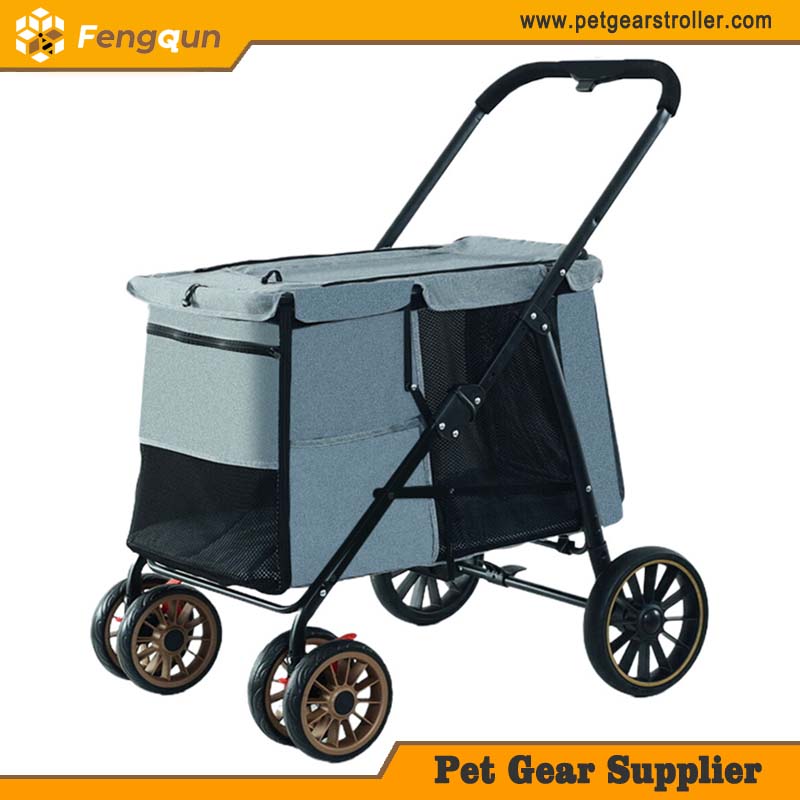
The Critical Role of Rear Safety Brakes: A Technical Analysis
While parking brakes are common, rear safety brakes are a defining feature of serious large-dog strollers. Their function is not merely to park, but to provide active safety during loading, unloading, and on inclines.
1. Mechanism Types:
Drum-style Brakes: Often found on the rear wheel hub. A lever on the handlebar pulls a cable, causing internal brake shoes to press outward against the drum attached to the wheel. These offer strong, progressive braking power and are less affected by wet conditions than disc brakes.
Disc Brakes: A small rotor attached to the wheel hub is clamped by a caliper. While less common, they offer very precise modulation and excellent heat dissipation, useful for long descents.
Positive-Lock Parking Brakes: These are usually a separate system, often a metal tab that physically locks a wheel from rotating. They are binary—on or off.
2. Functional Imperatives:
Anti-Rollback on Inclines: The most crucial function. When stopped on a hill, gravity acts on the combined mass of the stroller and dog. The rear brake holds the stroller in place, preventing a dangerous backward roll that could injure the dogor cause a loss of control.
Stability During Entry/Exit: A large dog entering or exiting can shift its weight dramatically. Applying the rear brake anchors the stroller, preventing it from tipping forward or rolling away, which is especially vital for dogs with mobility issues.
Redundancy: A safety brake acts as a redundant system to the primary "parking" brake, a key principle in safety-critical design.
Integrated Safety and Comfort Features
The heavy-duty framework enables other features that enhance safety and comfort for large breeds.
Five-Point Safety Harness: An automotive-style harness inside the cabin secures the dog, preventing them from jumping out unexpectedly. The attachment points must be anchored to the frame, not just the fabric.
Roll Cage and Tip-Resistant Design: The extended wheelbase (distance between front and rear axles) and a low center of gravity are calculated for stability. The frame itself acts as a roll cage in the unlikely event of a tip-over.
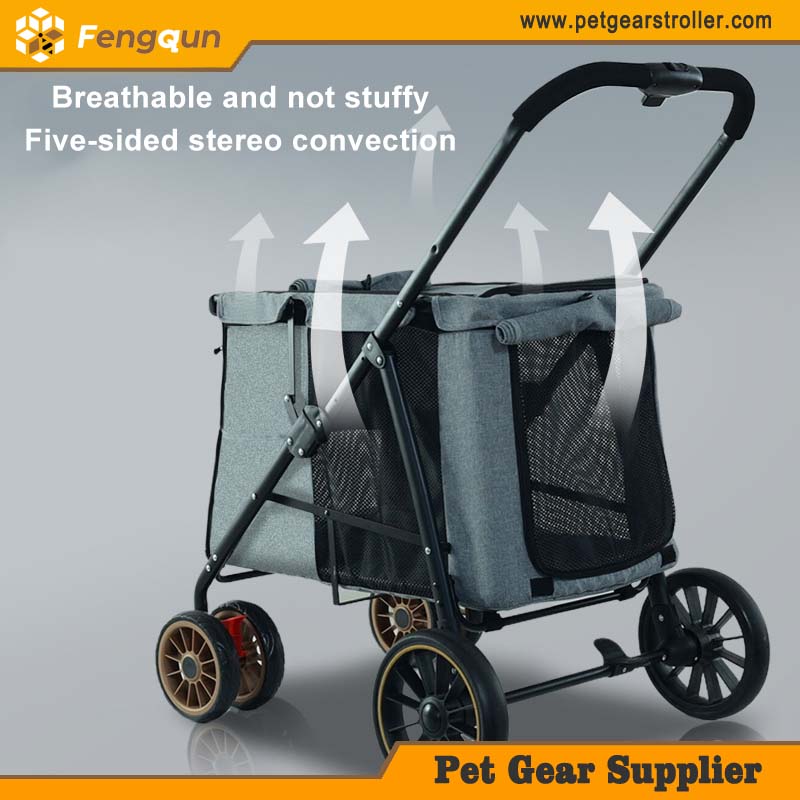
Ventilation and Visibility: Multiple mesh panels (often on three sides and the top) provide cross-ventilation. The mesh must be a durable, fine weave to contain claws. Large, peek-a-boo windows reduce anxiety by allowing the dog to see out.
Ergonomic Handle and Maneuverability: A telescoping, padded handle accommodates users of different heights. Front swivel wheels with locking mechanisms provide agility in stores and stability on straight paths. The turning radius is a key specification for navigating tight spaces.
Use Case Scenarios: Where Engineering Meets Necessity
This specialized equipment serves vital roles:
Canine Rehabilitation: Post-surgical dogs (e.g., ACL repair, spinal surgery) require strict exercise restriction. A stroller allows controlled outdoor mental stimulation without physical strain.
Geriatric Care: Elderly dogs with arthritis, hip dysplasia, or general weakness can enjoy extended outings without pain or exhaustion.
Urban Mobility: Navigating crowded sidewalks, hot asphalt in summer, or broken glass-laden areas is safer and less stressful in a stroller.
Special Events & Travel: Dog-friendly festivals, airports, or large parks become accessible without overexerting the dog.
Selection Guide: Technical Specifications to Scrutinize
When evaluating a Pet Gear Large Dog Stroller or its equivalents, move beyond marketing and examine the spec sheet:
Frame Material: "Aircraft-grade aluminum" or "reinforced steel" are good indicators.
Wheel Type & Size: Look for 10"+ pneumatic or all-terrain foam tires.
Weight Capacity: Ensure it's a dynamic rating with a 25-30% margin over your dog's weight.
Braking System: Specifically check for "rear safety brake" or "hill brake," not just a parking lock.
Floor: Must be a rigid, wipe-clean panel.
Dimensions: Internal cabin length and height must allow your dog to sit, turn, and lie comfortably.
Conclusion
The modern heavy-duty large dog stroller is a testament to applied engineering in the service of animal welfare. It is not a luxury item but a mobility aid that extends quality of life, facilitates healing, and deepens the bond between owner and pet by removing barriers to shared experiences. From the stress calculations in its alloy frame to the positive engagement of its rear safety brake, every design choice is ultimately in service of one goal: providing a safe, secure, and comfortable mobile haven for our large canine companions. For the responsible owner of a big dog, investing in such a technically sound piece of equipment is an act of foresight and care, ensuring adventures together can continue for years to come.
For more about the pet gear large dog stroller: A technical deep dive into high weight capacity, and rear safety brakes, you can pay a visit to FengQun Pet Gear Supplier for more info.






