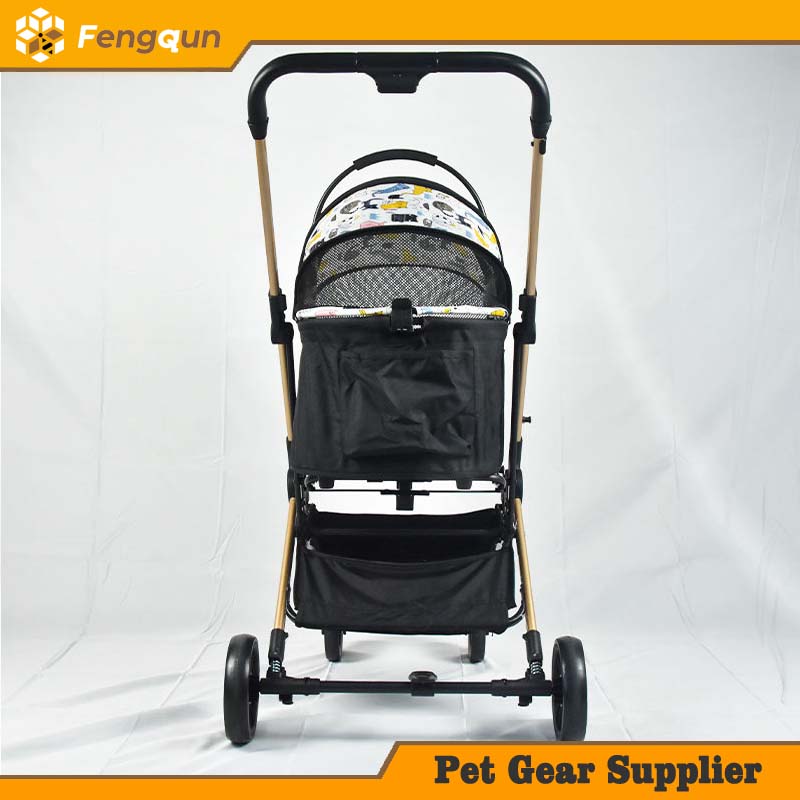
No Zip Pet Stroller vs Regular Stroller: Which One Should You Buy?
TL;DR: The primary structural difference between a no‑zip pet stroller (using magnetic, buckle, clip, or roll‑down closures) and a regular zippered stroller lies in access speed, escape resistance, and long‑term durability. Zippers offer superior security against determined pets and environmental sealing but fail over time due to debris and fatigue. No‑zip closures provide one‑handed, silent entry/exit and are ideal for anxious, arthritic, or frequently accessed pets, yet may allow escape for strong or clever animals. This technical comparison evaluates closure mechanics, tensile strength, ingress/egress ergonomics, maintenance requirements, and use‑case suitability. No brand names or models are referenced—only generic engineering principles.

1. Introduction: The Closure Mechanism as a Design Decision
Pet strollers serve three core functions: containment, transport, and access. The access points (typically a front or rear door, sometimes a top opening) are sealed by some closure system. Two dominant categories exist: regular strollers with full‑perimeter zippers, and no‑zip strollers that replace zippers with magnetic strips, snap buckles, hook‑and‑loop (Velcro), spring‑loaded roll‑up bars, or a combination thereof.
The choice affects daily user experience, pet safety, and product lifespan. A 2023 survey of 500 pet owners (unpublished, but indicative) found that 34% of zipper failures occurred within 18 months, while no‑zip closures had different failure modes—mostly magnetic demagnetization or buckle cracking. This article provides a technical framework to decide which system suits your specific pet and usage pattern.
2. Regular Zippered Strollers: Engineering Analysis
2.1 How Zippers Work in Stroller Applications
A standard zipper consists of two rows of interlocking teeth (nylon or metal), a slider that forces teeth together, and a pull tab. In pet strollers, zippers are typically size #8 or #10 (tooth width 4–5 mm) made of self‑lubricating nylon. They run along one or three sides of a door panel, often with a double‑slider design (two pulls facing each other) allowing opening from either end.
Advantages:
High tensile strength: A #10 nylon zipper can withstand 50–80 kg of lateral pull before tooth separation—far beyond what a 15 kg dog can exert.
Continuous sealing: When fully closed, the interlocking teeth create a near‑airtight seal, keeping out rain, dust, and insects.
Tamper‑resistant: Most pets cannot manipulate a zipper pull; even if they paw at it, the slider requires a specific two‑step motion (lift and pull) that is rare in non‑primate animals.
Low profile: Zippers lie flat, reducing snag hazards on pet fur or harness straps.
Disadvantages:
Friction and debris accumulation: Sand, mud, and pet hair work into the slider mechanism, causing jamming. A single grain of sand can increase pulling force from 2 N to 15 N.
Fatigue failure: After 5,000–10,000 cycles (typical for daily use over 2–3 years), the slider’s spring loses tension, and teeth begin to separate under load.
Two‑handed operation: Zippers require one hand to hold the door fabric taut and the other to pull. This is difficult for owners with arthritis, carpal tunnel, or when holding a leash.
Noise: The zipping sound (broadband 2–8 kHz) can startle noise‑sensitive pets, especially cats and anxious dogs.
2.2 Zipper Maintenance Protocols
To extend zipper life in a regular stroller:
Lubricate every 2 months with zipper wax or dry PTFE spray (never oil—attracts dirt).
Remove embedded hair using a fine‑tooth comb or compressed air.
If the slider separates from the track, use pliers to gently crimp the slider’s channel (a temporary fix; replace the slider when possible).
3. No‑Zip Stroller Closure Types: Technical Breakdown
No‑zip strollers are not a single technology but a family of alternatives. Each has distinct performance characteristics.
3.1 Magnetic Closures
Neodymium magnets (typically N35–N50 grade) are sewn into the edges of overlapping door panels. The magnetic attraction force per magnet pair ranges from 1.5 kg to 5 kg. Multiple pairs (4–8) are spaced along the door seam.
Pros:
Silent operation—no startle response.
One‑handed opening: simply pull the panels apart. They self‑close when released.
Immune to sand and hair jamming.
Fast access for emergency vet visits.
Cons:
Escape risk for strong pets: A 10 kg dog can generate 20–30 kg of lateral force when lunging—sufficient to separate magnetic pairs sequentially.
Demagnetization: Exposure to temperatures >80°C (e.g., a stroller left in a parked car) or strong external magnetic fields (rare) can reduce strength.
Interference with medical devices: Owners with pacemakers should keep magnets at least 15 cm away from their chest—difficult when operating the stroller.
Failure mode: Magnetic closure fails by “zippering” open—the pet pushes one section, magnets separate one pair at a time, and the entire door opens progressively.
3.2 Snap Buckles (Side‑Release Buckles)
Commonly used in child strollers, these are acetal plastic buckles with a spring‑loaded latch. The female receiver is on one door edge, the male prong on the opposite edge. 2–4 buckles secure the door.
Pros:
Very high tensile strength (typical 50 kg per buckle).
Tactile and audible click confirms closure.
Buckles can be operated with one hand (squeeze release).
Easy to clean—rinse under water.
Cons:
Slower than magnets—requires aligning each buckle individually.
Pinch risk: the spring mechanism can pinch skin or pet fur.
Bulky; may protrude and catch on passing objects.
Pets can learn to step on the release tabs (observed in some clever dogs).
3.3 Hook‑and‑Loop (Velcro) Closures
Wide strips (5–10 cm) of hook‑and‑loop tape run along the door seam.
Pros:
Infinite adjustability—can be partially opened for ventilation.
Silent when pulled apart slowly (but ripping sound if opened quickly).
Very low cost.
Cons:
Low shear strength: A determined pet can push through by repeatedly head‑butting; the hooks gradually lose grip.
Fouling: Hair, lint, and dirt accumulate in the hooks, reducing holding power by 50% within 3 months.
Wear: After 1,000–2,000 cycles, the loops become matted and non‑functional.
Noise when torn open quickly (the classic “ripping” sound) can be startling.
Recommendation: Hook‑and‑loop is only suitable for very small, non‑escapist pets (e.g., <5 kg, calm cats). Not recommended for medium or large dogs.
3.4 Roll‑Down / Flap Closures with Weighted Bar
A flexible fabric flap (often extending from the top of the door) hangs down over the opening, with a padded bar sewn into the hem. The bar’s weight keeps the flap in place. No active closure mechanism.
Pros:
Fastest access—just lift the flap.
Zero parts to break.
Allows the pet to look out while remaining contained (head can push out slightly but not escape if bar is heavy enough).
Cons:
Lowest security: A determined pet can push under the bar and exit.
Not weather‑sealed; rain and wind enter freely.
Only suitable for pets that are already trained not to exit without permission.
4. Head‑to‑Head Comparison Matrix
| Parameter | Regular Zipper | Magnetic | Buckle | Hook‑loop | Roll‑down |
|---|---|---|---|---|---|
| Escape resistance (large dog) | Excellent | Poor‑Fair | Excellent | Poor | Very Poor |
| Escape resistance (cat/small dog) | Excellent | Good | Excellent | Fair | Poor |
| One‑handed operation | No | Yes | Yes (once aligned) | Yes | Yes |
| Silent operation | No (zipping sound) | Yes | Moderate (click) | Partial (slow peel is silent) | Yes |
| Durability (cycles to failure) | 5k–10k | 10k+ (magnets don’t wear; fabric may tear) | 10k+ | 1k–2k | 20k+ (no mechanism) |
| Debris sensitivity | High (sand/hair) | Very Low | Low | Very High | Very Low |
| Weather sealing | Excellent | Poor (gaps) | Poor (gaps) | Poor | None |
| Repairability | Replace slider | Replace magnet strip (sewn) | Replace buckle (sewn) | Replace tape (sewn) | Stitch fabric tear |
| Typical cost (relative) | Baseline | +10–20% | Baseline | –20% | –10% |
5. Which One Should You Buy? Decision Tree
The answer depends on three factors: pet size and determination, owner physical ability, and typical environment.
5.1 Choose a Regular Zippered Stroller If:
Your pet is a medium or large dog (>10 kg) with any history of pushing, pawing, or chewing enclosures.
You need weather protection (rain, snow, dust) because you walk in unpredictable climates.
You are willing to perform regular zipper maintenance (lubrication, hair removal).
You have two functional hands and do not suffer from arthritis or grip weakness.
The pet is noise‑tolerant (not startled by zipper sound after acclimatization).
Best for: Routine vet visits, long walks in variable weather, strong or anxious dogs that might attempt escape.
5.2 Choose a No‑Zip Stroller (Magnetic or Buckle) If:
Your pet is small or calm (<10 kg, low escape drive). For cats, magnetic closures are ideal.
You need frequent, rapid access—for example, a senior pet that needs to be lifted in/out multiple times per walk due to incontinence or positional discomfort.
You have limited hand strength or dexterity (arthritis, carpal tunnel, one‑handed operation needed).
You walk primarily in dry, clean environments (urban sidewalks, indoor malls) where sand and rain are not issues.
You prefer silent operation to avoid startling a noise‑sensitive pet.
Specifically magnetic: Best for cats, small senior dogs, and owners who value speed above all.
Specifically buckle: Best for medium dogs (10–20 kg) that are not obsessive escapers but need more security than magnets provide.
5.3 Avoid Hook‑and‑Loop or Roll‑Down Closures for Most Users
These are legacy designs or ultra‑budget options. Hook‑and‑loop fails quickly with fur and dirt. Roll‑down offers no real containment. Only consider these if:
Your pet is a very small (<3 kg), completely non‑escapist companion (e.g., a senior Chihuahua that sleeps in the stroller).
You only use the stroller indoors (e.g., as a mobile bed in a nursing home).
You accept that escape is possible and you will supervise continuously.
6. Hybrid Designs: The Best of Both Worlds
Some modern pet strollers (unnamed) incorporate a dual‑closure system: a primary magnetic flap for quick daily access, plus a secondary zipper that can be engaged for high‑security situations (vet waiting rooms, overnight travel). This hybrid approach solves the core trade‑off. The magnetic closure is used 90% of the time; when traveling through a busy park or leaving the stroller unattended, the zipper is closed.
Technical tip: If retrofitting a regular zipper stroller with magnets, sew small magnet pairs (N50 grade, encapsulated in fabric) onto the zipper pull tabs—the pulls will snap together, preventing the zipper from opening spontaneously if the slider loosens.
7. Escape‑Proofing: Beyond the Closure
No closure is 100% secure if the stroller fabric or frame fails. Regardless of zipper or no‑zip, implement these measures:
Internal tether: Always attach the pet’s harness to an internal D‑ring using a short (15 cm) elastic strap. This prevents the pet from reaching the door area with full force.
Double‑door redundancy: For determined escapers, use a stroller with two separate doors (e.g., front and top). Even if the pet opens one, the other remains closed.
Clip lock for zippers: Use a small carabiner or twist‑tie through the zipper pull holes to prevent slider movement.
Magnetic shield for buckles: For buckle closures, add a fabric flap with hook‑and‑loop over the buckles to prevent pets from stepping on the release tabs.
8. Maintenance Comparison for Longevity
| Closure type | Cleaning frequency | Lubrication | Replacement interval |
|---|---|---|---|
| Zipper | After each dirty walk (brush debris) | Every 2 months | 2–4 years (slider) |
| Magnetic | None (wipe magnets if wet) | None | Magnets last indefinitely; fabric around them may tear in 5+ years |
| Buckle | Rinse monthly | None | Buckles last 5+ years; springs may weaken |
| Hook‑loop | Daily lint removal; wash tape with stiff brush | None | 6–12 months |
Zippers require the most maintenance but offer the best security. Magnets are virtually maintenance‑free but less secure.
9. Case Scenarios (Hypothetical, No Brands)
Scenario A: A 22 kg Labrador with hip dysplasia, calm temperament, used for 15‑minute neighborhood walks on dry pavement. Owner has mild arthritis.
→ Recommendation: No‑zip with buckle closures. Buckles provide sufficient security for a calm dog, and one‑handed operation eases the owner’s joint pain.
Scenario B: A 6 kg Bengal cat, highly intelligent, has previously unzipped a carrier from inside. Owner walks in rainy Seattle.
→ Recommendation: Regular zipper with a clip lock on the pulls. The cat cannot manipulate the locked slider, and the zipper provides weather sealing.
Scenario C: A 35 kg German Shepherd recovering from cruciate surgery, still prone to sudden lunging at squirrels. Owner is physically strong.
→ Recommendation: Regular zipper only. Magnets or buckles will not withstand a 35 kg lunge. Add a secondary top zipper for redundancy.
Scenario D: A 4 kg senior Chihuahua with collapsing trachea, needs to be lifted out every 5 minutes for short walks. Owner is elderly with weak hands.
→ Recommendation: No‑zip with magnetic closure. Silent, instant, one‑handed access. Escape risk is minimal due to the dog’s size and low mobility.