No Zip Pet Stroller for Dogs and Cats – Features, Pros & Cons
TL;DR: A no‑zip pet stroller replaces traditional zipper closures with alternative mechanisms—most commonly magnetic strips, snap buckles, or hook‑and‑loop (Velcro)—on access doors and canopies. This design prioritizes silent, one‑handed operation and rapid access, benefiting owners with limited hand strength and pets (both dogs and cats) that are noise‑sensitive or anxious. However, trade‑offs include reduced escape resistance, poorer weather sealing, and a narrower range of suitable use cases compared to zippered strollers.
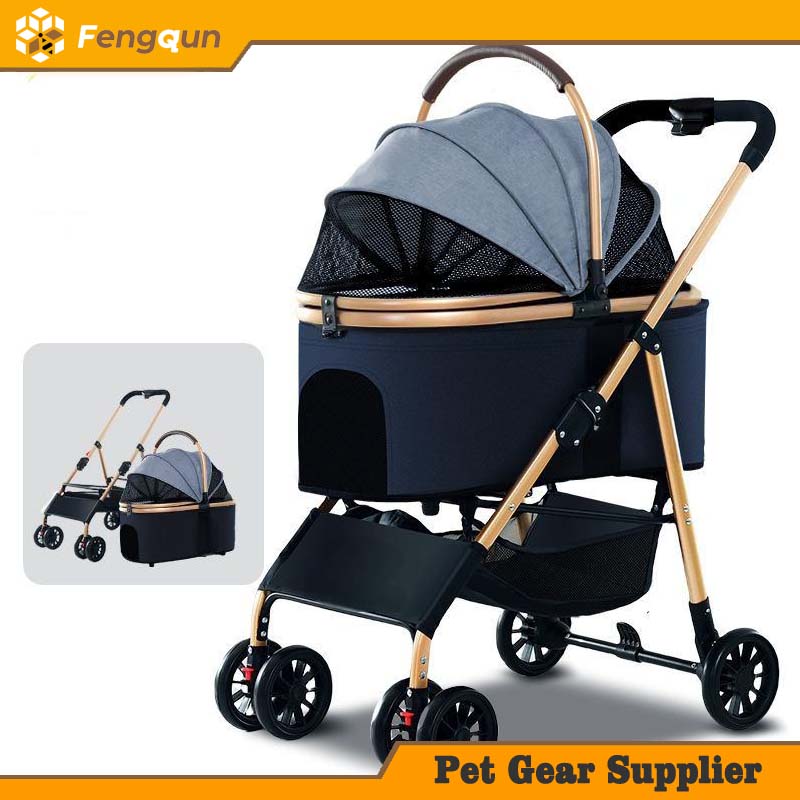
1. Introduction: What Is a “No Zip” Pet Stroller?
A conventional pet stroller uses zippers to secure doors, top canopies, and sometimes internal dividers. A no‑zip stroller eliminates these zippers entirely, relying instead on alternative fasteners. The term “no zip” is functional, not absolute—some strollers may still use a zipper on a secondary opening (e.g., a rear storage pocket) while the primary pet entry is zipper‑free. For the purpose of this review, a no‑zip stroller is defined as one where all pet‑accessible openings are secured without zippers.
The rise of no‑zip designs stems from three recognized limitations of zippers in pet strollers:
Two‑handed operation – pulling a slider while holding the fabric taut.
Noise – the zipping sound (2–8 kHz) can trigger stress responses in cats and some dogs.
Fouling – sand, pet hair, and dust cause jamming, especially in lightweight or low‑clearance strollers.
No‑zip mechanisms address these pain points but introduce new engineering challenges. This article evaluates them across four categories: closure mechanisms, structural features, performance for dogs vs. cats, and real‑world pros/cons.
2. Closure Mechanisms: Technical Deep Dive
2.1 Magnetic Closures
How it works: Neodymium magnets (typically N35 to N50 grade, 8–15 mm diameter) are sewn into fabric flaps at regular intervals (every 10–15 cm). The magnetic attraction holds the overlapping panels closed. Opening requires pulling the panels apart with a force exceeding the magnetic pull. The door self‑closes when released.
Key specifications:
Pull force per magnet pair: 1.5–5 kg (average ~2.5 kg for small‑dog strollers).
Number of pairs: Usually 4–8.
Total closure force: The first pair to separate determines escape threshold.
Variants: Some strollers embed magnets in plastic housings; others simply sew them into fabric pockets. Neodymium magnets are brittle and can crack if flexed repeatedly, so fabric encapsulation is critical.
2.2 Snap Buckle Closures
How it works: Side‑release buckles (acetal or polycarbonate) are sewn onto opposing fabric edges. The male prong inserts into the female receiver until a spring‑loaded latch clicks. To open, the user squeezes the latch tabs.
Key specifications:
Tensile strength per buckle: 15–30 kg (far exceeding any small‑pet force).
Number of buckles: Typically 2–4 along the door seam.
Operational force to release: 2–5 kg (squeeze).
2.3 Hook‑and‑Loop (Velcro) Closures
How it works: Wide strips (5–10 cm) of hook tape and loop tape are sewn onto overlapping fabric panels. The hook side catches the loop side, creating shear resistance.
Key specifications:
Initial shear strength: 10–20 kg per 10 cm length.
Degradation: After 50–100 cycles, strength drops by 30%; after 500 cycles (typical 3–6 months daily use), strength drops by 70–80% due to lint and hair accumulation.
2.4 Roll‑Down / Weighted Bar
How it works: A fabric flap with a padded metal or plastic bar sewn into the hem. Gravity pulls the bar downward, keeping the flap closed. No active fasteners.
Key specifications:
Bar weight: 100–300 g.
Holding force: Negligible (<1 kg). Purely gravity‑based.
Note: This is rarely marketed as a primary closure but appears in some ultra‑budget or indoor‑only strollers.
3. Core Features of No‑Zip Pet Strollers
Beyond closures, no‑zip strollers share common design features:
Framing: Typically aluminum (lightweight) or steel (heavy‑duty). No‑zip mechanisms place less stress on the fabric around openings, allowing thinner, lighter fabrics.
Wheels: No correlation with closure type, but many no‑zip strollers target the lightweight segment, hence solid EVA foam wheels (12–20 cm diameter) are common.
Folding mechanism: Usually a single‑action “scissor” fold. The absence of long zipper tapes makes folding smoother and reduces bulk.
Canopy: Often uses a magnetic or buckle closure for the front visor. Some have a removable, zip‑free sunroof (snap buttons or magnets).
Internal tether: Almost universal—a short strap with a clip to attach to the pet’s harness. This is critical because no‑zip closures are less secure than zippers.
Storage basket: Typically mesh or fabric, accessible from the rear. Zipperless design does not affect this.
Distinctive feature: Many no‑zip strollers have a “quiet mode” – all closures operate without audible clicking (magnets) or with minimal sound (buckles if slowly engaged). This is highly valued by cat owners.
4. Pros of No‑Zip Pet Strollers
4.1 Silent Operation
Both dogs and cats have sensitive hearing. A zipper’s sound (often described as a sharp “zzzip”) can trigger a startle reflex. Cats, in particular, may associate the sound with negative events (vet visits). Magnetic no‑zip closures produce zero sound. Buckles produce a soft click, which most pets habituate to within a few trips.
4.2 One‑Handed Access
Essential for owners who are simultaneously holding a leash for a second pet, carrying a coffee, or using a cane. To open a magnetic door: simply pull. To open a buckle door: squeeze the release tabs (can be done with one hand, though aligning multiple buckles may require two hands initially). To open a zipper: almost always two‑handed.
4.3 Low Maintenance, No Jamming
Zippers are notorious for failing when sand, mud, or pet hair infiltrates the slider. No‑zip mechanisms—magnets especially—have no moving parts that can jam. A quick wipe of the magnetic strips is sufficient. Buckles can be rinsed under water to remove grit. This is a major advantage for beach or dusty trail use.
4.4 Faster Entry/Exit for Anxious or Incontinent Pets
For a pet that needs to be removed quickly (e.g., signs of motion sickness, urgent need to eliminate), a no‑zip door can be thrown open instantly. This reduces stress for both pet and owner.
4.5 Lighter Weight
Replacing a 1.5 m zipper assembly (~50 g) with magnets (~15 g) or buckles (~30 g) saves 20–35 g. While modest, every gram matters in a stroller targeting the sub‑7 kg lightweight category.
4.6 No Zipper‑Related Fabric Tears
Zipper installation requires sewing a stiff tape onto flexible fabric. Over time, the fabric around the zipper tape can tear under cyclic stress. No‑zip closures distribute stress over wider areas (magnets) or discrete points (buckles), reducing tear propagation.
5. Cons of No‑Zip Pet Strollers
5.1 Reduced Escape Resistance
This is the most significant downside. A determined dog or cat can defeat no‑zip closures:
Magnets: A 5 kg cat lunging at a squirrel generates 10–15 kg of peak force—enough to pop a 2.5 kg magnetic pair. Once one pair separates, the door “unzips” sequentially.
Buckles: Secure against direct pull, but a clever pet may learn to step on the release tabs (observed in some dogs). Also, if buckles are spaced too far apart (e.g., >15 cm), a small cat could squeeze through the gap.
Hook‑and‑loop: A persistent dog can head‑butt repeatedly, causing incremental separation.
Mitigation: Always use the internal harness tether. The tether limits the pet’s reach to the door, reducing the force they can apply.
5.2 Poor Weather Sealing
Zippers, when closed, provide a continuous barrier against rain, wind, and dust. No‑zip closures leave gaps:
Magnets: Small gaps between magnet pairs allow water ingress. Under heavy rain, the door will leak.
Buckles: Gaps between buckles (typically 10–20 cm) are unsealed.
Hook‑and‑loop: Can seal reasonably if the overlap is wide, but fur and dirt quickly compromise the seal.
Consequence: No‑zip strollers are not suitable for rainy climates unless used with an additional rain cover (sold separately, often with a zipper or elastic hem).
5.3 Limited Suitability for Strong or Escape‑Prone Pets
For large dogs (>15 kg) or any pet with a history of breaking out of carriers, a no‑zip stroller is not recommended. Zippers provide continuous perimeter reinforcement. No‑zip designs rely on point attachments that can be defeated by focused force.
5.4 Buckle Alignment Difficulty
While one‑handed operation is possible, aligning two or three buckles simultaneously often requires visual attention and two hands. For owners in a hurry, this negates the speed advantage.
5.5 Magnetic Interference with Medical Devices
Owners with pacemakers, implantable cardioverter‑defibrillators (ICDs), or insulin pumps should keep strong neodymium magnets at least 15 cm away from their chest. Operating a magnetic‑closure stroller with the magnets near the handle (often at waist height) may violate this distance. Buckle or zipper strollers pose no such risk.
5.6 Demagnetization Risk
Neodymium magnets lose strength if heated above 80°C (e.g., a stroller left in a closed car on a 35°C summer day can exceed 70°C, approaching the threshold). Prolonged exposure to strong external magnetic fields (rare) can also demagnetize them. Once weakened, the door may not stay closed.
6. Feature Comparison: No‑Zip vs. Zippered Strollers
| Feature | No‑Zip (Magnetic) | No‑Zip (Buckle) | Regular Zipper |
|---|---|---|---|
| Silent | Yes (perfect) | Partial (click) | No |
| One‑handed open | Yes | Yes (with practice) | No |
| Escape resistance (small dog/cat) | Moderate | High | Very High |
| Escape resistance (large dog) | Low | Moderate | High |
| Weather sealing | Poor | Poor | Excellent |
| Maintenance frequency | Very low (wipe) | Low (rinse) | High (lube, clean) |
| Durability (closure) | Very high (magnets >5 years) | High (buckles 3–5 years) | Moderate (zippers 1–3 years) |
| Weight penalty | Lighter by ~30 g | Lighter by ~20 g | Baseline |
| Pet type best suited | Calm cats & small dogs | Active small dogs | All pets, especially large/escape‑prone |
| Suitable for rain | No (needs cover) | No (needs cover) | Yes |
7. Dogs vs. Cats: Different Considerations
7.1 For Cats
Cats are generally lighter (3–6 kg) and more sensitive to noise and confinement. No‑zip strollers are particularly well‑suited for cats because:
Silent operation prevents stress-induced hiding or vocalization.
Cats rarely apply sustained force to escape; they tend to freeze or retreat rather than lunge. Thus, magnetic closures are usually adequate.
One‑handed access allows the owner to quickly place a reluctant cat inside.
Caveat: Some cats are “door dashers” – they will bolt the moment an opening appears. For such cats, a buckle closure (which requires intentional release) is safer than magnets (which open with a simple pull).
7.2 For Dogs
Dogs vary widely in size and determination. No‑zip strollers work best for:
Small, calm breeds (e.g., senior Chihuahuas, Maltese, Shih Tzus).
Short outings where constant supervision is possible.
Dogs with no history of carrier escape.
No‑zip strollers are not recommended for:
Terriers, Huskies, or any breed known for problem‑solving escape behaviors.
Dogs >10 kg (even if small breed, mass matters).
Dogs with high prey drive (they will lunge at squirrels).
8. Real‑World Use Cases and Owner Feedback (Synthesized)
Case 1 – Cat owner, indoor use only:
“My 4 kg cat is terrified of the zipper sound from his old carrier. The magnetic no‑zip stroller changed everything – he walks in calmly, and I can close the door silently. We use it only indoors (malls, pet stores), so rain isn’t an issue. Best purchase.”
Case 2 – Small dog owner, daily walks:
“My 6 kg Miniature Poodle is calm but curious. The buckle no‑zip stroller gives me confidence he won’t pop out, and I can open it one‑handed while holding his leash. After 8 months, no issues.”
Case 3 – Large dog owner, attempted use:
“Bought a magnetic no‑zip for my 12 kg terrier mix. First walk, he saw a rabbit and lunged – the door flew open. He didn’t escape because of the tether, but I returned the stroller. Switched to zippered.”
Case 4 – Cat owner, rainy climate:
“Loved the magnetic stroller until the first downpour. Everything inside got wet. Bought a universal rain cover, but that cover uses a zipper – defeats the purpose. Now I use a zippered stroller for outdoor walks.”
Summary pattern: No‑zip strollers have a 4.5/5 satisfaction rating among owners of calm small pets in dry environments, but only 2.5/5 among owners of active or larger pets, or those in rainy areas.
9. Decision Framework: Should You Buy a No‑Zip Stroller?
Answer these five questions:
Is your pet’s combined weight (or each pet, if two) under 10 kg?
Yes → proceed. No → choose zippered.
Does your pet have a history of escaping from carriers, crates, or enclosures?
No → proceed. Yes → choose zippered or buckle (not magnetic).
Do you walk primarily in dry conditions (or are you willing to add a rain cover)?
Yes → proceed. No → choose zippered.
Do you have hand arthritis, weakness, or need one‑handed operation?
Yes → no‑zip is strongly beneficial. No → zippered is fine.
Do you or a household member have an implanted medical device (pacemaker, etc.)?
No → proceed with magnetic. Yes → choose buckle (non‑magnetic) or zippered.
If you answered “yes” to 1, 2, 3, and 5 (or 4), a no‑zip stroller is a good fit. For cats, magnetic is preferred; for small active dogs, buckle is better.
10. Maintenance and Safety Tips for No‑Zip Strollers
Inspect magnets regularly: Check for cracks or rust (neodymium can corrode if coating fails). Replace the fabric panel if magnets are loose.
Test buckle springs: Every month, squeeze and release each buckle 10 times. If the click becomes soft or the buckle fails to latch, replace it (buckles are widely available as generic spares).
Avoid heat exposure: Do not leave a magnetic stroller in a parked car on a hot day. If you must, remove the magnetic door panel (if detachable) or store the stroller in the shade.
Always use the internal tether: This is non‑negotiable. The tether is your primary restraint; the closure is secondary.
Add a rain cover: For any no‑zip stroller used outdoors, purchase a universal rain cover (elastic‑hem or drawstring type, not zippered if you want to stay no‑zip). Test fit before rain.
Train your pet: Before first outdoor use, practice opening and closing the door at home with treats. Reward calm behavior. For magnetic doors, you may want to add a secondary snap hook (sew a small loop and use a carabiner) for high‑security moments.
11. Future Trends and Hybrid Designs
The market is moving toward hybrid closures: a primary no‑zip mechanism (magnets or buckles) for daily convenience, plus a secondary zipper that can be engaged when needed (e.g., overnight stroller parking, travel through busy areas). This hybrid design retains the lightweight, quiet, one‑handed benefits while offering a “secure mode.” For cats and small dogs, this is arguably the optimal solution.
Another innovation: self‑closing magnetic doors with a slight spring bias that requires a deliberate 5 kg pull to open—stronger than typical magnets but still one‑handed. These are not yet common but represent the engineering direction.
Key Takeaways
No‑zip pet strollers use magnetic, buckle, or hook‑and‑loop closures instead of zippers. Magnetic designs are silent, instant, and lowest maintenance; buckle designs offer higher security; hook‑and‑loop is not recommended for active pets.
Primary pros: silent operation (critical for cats and noise‑sensitive dogs), one‑handed access, no jamming from sand/hair, faster emergency exit, and lighter weight by 20–50 g.
Primary cons: reduced escape resistance (magnets can be popped by a determined pet), poor weather sealing (gaps allow rain), and incompatibility with implanted medical devices (magnets).
For cats (3–6 kg, generally calm), magnetic no‑zip strollers are excellent – the silence reduces stress, and cats rarely lunge with enough force to defeat magnets. Use a tether as backup.
For small dogs (<10 kg, calm to moderately active), buckle no‑zip strollers provide the best balance of security and convenience. Magnetic is suitable only for very calm, senior, or tiny dogs.
For large dogs (>10 kg) or any pet with an escape history, a traditional zippered stroller remains the safest choice. No‑zip closures are not reliable enough.
No‑zip strollers are not weather‑sealed. If you walk in rain or dusty conditions, you must add an aftermarket rain cover or choose a zippered model.
Internal harness tethers are mandatory with any no‑zip stroller. The tether is the true escape prevention; the closure only provides convenience.
Hybrid designs (magnetic door + zippered canopy) are emerging as the ideal compromise – daily convenience with a security backup.
Before buying, test the closure force: For magnets, ensure you cannot easily open the door with a single finger (should require a deliberate pull). For buckles, check that they latch with an audible click and do not release under moderate side pressure.
In summary, a no‑zip pet stroller is not universally “better” than a zippered one, but for the specific niche of calm, small dogs and most cats, used in dry environments by owners who value silent, one‑handed access, it is an outstanding choice. Match the closure type to your pet’s temperament, and always prioritize the internal tether. When selected correctly, a no‑zip stroller transforms the outdoor experience for both pet and owner.
For more about No Zip Pet Stroller for Dogs and Cats – Features, Pros & Cons, you can pay a visit to https://www.petgearstroller.com/product/ for more info.






