Large Pet Stroller for Medium & Large Dogs: Comfort, Safety & All‑Terrain Tips
TL;DR: Medium and large dogs (15–45 kg) present unique challenges for pet stroller use: higher inertial forces, greater joint stress, wider turning radius requirements, and increased thermal load. Unlike small‑pet strollers, large‑dog strollers must prioritize structural rigidity, oversized pneumatic wheels with independent suspension, low‑center‑of‑gravity chassis design, and reinforced restraint systems. This article provides a technical framework for selecting, modifying, and operating a large‑dog stroller across varied terrains (pavement, gravel, grass, sand, light trails). Key safety protocols include dynamic braking on slopes, heat management in enclosed cabins, proper dog‑to‑stroller fit (standing height and turning clearance), and all‑terrain wheel maintenance. Evidence‑inspired guidelines from canine biomechanics and human factors engineering ensure both dog comfort and owner ergonomics.
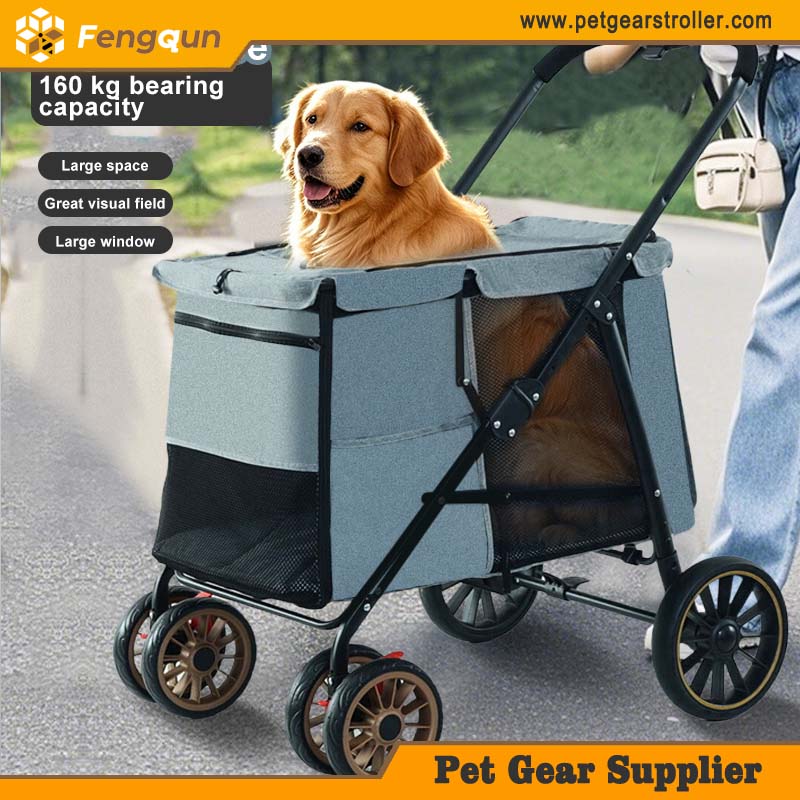
1. Introduction: Why Large Dogs Need a Different Class of Stroller
The term “pet stroller” often conjures images of small dogs or cats. However, large dogs (e.g., Labrador Retrievers, German Shepherds, Golden Retrievers) may also require mobility assistance due to hip dysplasia, cruciate ligament injury, osteoarthritis, degenerative myelopathy, or post‑surgical recovery. Traditional handheld carriers are impossible; even wheeled strollers designed for small pets fail under the mass and dimensions of a 30 kg dog. Key differences for large‑dog strollers include:
Load capacity: Minimum 45 kg static load, dynamic factor of 2g → 90 kg effective requirement.
Interior height: At least 70 cm to allow standing without head contact.
Wheel diameter: ≥20 cm (preferably 25–30 cm) for terrain negotiation.
Frame material: Steel or reinforced aluminum; plastic frames are unacceptable.
Braking system: Dual rear disc or drum brakes with hand‑operated parking lock.
Failure to meet these specifications leads to wheel axle failure, frame buckling, or tip‑over incidents that can severely injure the dog.
2. Comfort Engineering for Large Breeds
2.1 Cabin Dimensions and Standing Clearance
A large dog must be able to stand, turn around, and lie in sternal recumbency without touching any interior surface except the floor. Measure your dog’s:
Height at withers (Hw) – add 15 cm for head clearance.
Length from nose to base of tail (L) – add 10 cm for nose and tail space.
Width at shoulders (W) – add 10 cm for turning clearance.
Minimum interior dimensions: Height ≥ Hw+15 cm, Length ≥ L+10 cm, Width ≥ W+10 cm. For a typical large dog (Hw=65 cm, L=80 cm, W=30 cm), interior should be at least 80×90×40 cm. Overly large cabins (e.g., 120 cm long) allow the dog to slide and impact walls during turns—use adjustable internal dividers (non‑branded foam bolsters) to limit unnecessary space.
2.2 Floor Comfort: Pressure Redistribution
Large dogs exert ground reaction forces up to 2.5× body weight when shifting position. A rigid plastic or aluminum floor is mandatory—fabric floors sag, causing lumbar lordosis and impaired breathing. Over the rigid floor, install a multi‑layer pad:
Base layer: 3 cm high‑density foam (50 kg/m³) for structural support.
Middle layer: 2 cm memory foam for pressure point relief (elbows, sternum).
Top layer: Waterproof, non‑slip fabric (e.g., coated polyester with silicone dots).
For arthritic dogs, add an orthopaedic “egg‑crate” foam topper. Replace foam every 12–18 months as it compresses.
2.3 Ventilation and Thermal Management
Large dogs generate significant metabolic heat. A 35 kg dog at rest produces ~50 W of heat; inside a closed stroller on a 25°C day, interior temperature can rise 10°C within 20 minutes. Mandatory features:
Mesh panels on all four sides (front, rear, left, right) with a mesh aperture ≤3 mm to prevent insect bites but allow airflow.
Dual canopy design: A main canopy that can be fully opened (rolled back) plus a secondary sunshade that reflects infrared radiation. Use an external reflective emergency blanket (generic) clipped over the top canopy—this reduces interior temperature by 6–8°C.
Passive cooling inserts: Freeze 500 ml water bottles, wrap in a thin towel, and place in the stroller’s rear pocket (never directly against the dog). Replace every 60 minutes.
Warning: Never use battery‑powered fans inside a large‑dog stroller—dogs may chew cords or knock the fan into their face.
3. Safety Systems for Large Dogs
3.1 Structural Integrity and Crashworthiness
A large dog inside a stroller can shift weight suddenly (e.g., seeing another dog). The frame must resist torsional forces. Perform a “push‑pull test” before each use: grab the handle and shake vigorously side‑to‑side. If the frame flexes >5 cm at the wheel axle, the stroller is unsafe. Look for:
Cross‑bracing (X‑shaped bars) on the undercarriage.
Welded joints (not bolted plastic connectors).
Weight‑rated wheels with sealed ball bearings (not bushings).
3.2 Restraint Systems: The Six‑Point Harness Integration
Standard single‑point tether clips are inadequate for large dogs. Optimal restraint uses:
Two shoulder straps attaching to the dog’s harness at the left and right scapula.
Two pelvic straps attaching to the harness at the left and right iliac crest.
One sternal strap preventing forward lunge.
One tail‑base strap (optional for deep‑chested breeds) preventing backward slide.
All straps should have elastic shock‑absorbing segments (max stretch 15 cm) to reduce peak force during sudden stops. Never attach to a collar—tracheal collapse risk is high in large breeds (e.g., Dobermans, Labs). Use a full‑body mobility harness designed for lifting (often sold for disabled dogs), which distributes forces across the chest and pelvis.
3.3 Dynamic Stability and Tip‑Over Prevention
Large‑dog strollers have a higher center of gravity (CoG) because the dog’s mass sits 40–60 cm above ground. To prevent tip‑over during turns or slopes:
Track width (distance between left and right wheels) should be ≥60 cm for dogs >25 kg.
Wheelbase length (front to rear axle) ≥70 cm.
CoG height should be ≤40% of track width. Calculate: measure from ground to the dog’s mid‑sternum; this should be less than 0.4×track width.
Operating rule: Never turn sharply at speeds >3 km/h. On slopes, turn only on flat transitions. If the stroller has a swivel front wheel, lock it (fixed position) when moving on uneven ground—swivel wheels increase lateral instability.
3.4 Braking System for Large Masses
A 35 kg dog plus 15 kg stroller = 50 kg total. On a 10° slope, gravitational force parallel to the slope is ~85 N (≈8.7 kg of pull). Brakes must hold this force reliably.
Parking brake: Foot‑operated, locking both rear wheels. Test on a 15° ramp—the stroller must not move when engaged.
Dynamic brake (hand lever): For downhill control, a bicycle‑style disc brake (on at least one rear wheel) allows speed regulation without sudden jerking. Squeeze progressively; never grab abruptly.
Emergency procedure: If the stroller runs away, steer into a grass bank or turn 90° sideways to tip it over deliberately (controlled crash) rather than letting it hit a road curb.
4. All‑Terrain Tips: From Pavement to Sand
Large‑dog strollers are often used on trails, beaches, and unpaved parks. Each terrain type demands specific adjustments.
4.1 Pavement and Smooth Concrete
Wheel choice: Pneumatic tires (air‑filled) with a smooth or low‑profile tread. Optimal pressure: 30–35 psi. Underinflation increases rolling resistance; overinflation transmits vibrations.
Maintenance: Weekly check for embedded glass or sharp stones. Use a tire sealant (generic, slime‑type) to prevent punctures.
Speed limit: 8 km/h (brisk walk). Faster speeds reduce braking distance safety margin.
4.2 Gravel and Crushed Stone
Gravel creates three hazards: wheel skid, stone projection into the cabin, and bearing contamination.
Tire tread: Knobby or all‑terrain pattern (depth ≥5 mm) for traction.
Mud flaps: Attach flexible rubber flaps (cut from an old car mat) to the lower frame to block stones from flying upward.
Axle protection: Use sealed bearings (rating IP66 or higher). After each gravel trip, blow out dust with compressed air.
Walking technique: Push with a slightly lowered handle (reduces front wheel lift). Walk at 3–4 km/h.
4.3 Grass and Wet Lawns
Wet grass reduces braking efficiency and can hide holes or roots.
Wheel width: Wider tires (≥6 cm) distribute weight and prevent sinking. Reduce tire pressure to 25 psi for grass.
Brake test: Before descending a grassy slope, test the parking brake on a flat wet area—if the stroller slides, avoid the slope entirely.
Post‑trip cleaning: Hose down wheels (avoiding bearings) to remove grass clippings, which can rot and attract insects.
4.4 Sand (Beaches)
Sand is the most challenging terrain. Most large‑dog strollers with standard wheels will sink.
Modification: Use balloon tires (ultra‑wide, low pressure, 8–12 psi) with a diameter ≥30 cm. These are often sold separately as “beach wheelchair tires.”
Technique: Deflate to 8 psi for maximum flotation. Push from behind with a steady, slow pace (2 km/h). Do not stop on soft sand—once stationary, the wheels may dig in. To restart, lift the rear wheels onto a firm surface (e.g., a flattened cardboard piece).
Corrosion prevention: Rinse wheels, axles, and frame with fresh water immediately after beach use. Salt water destroys bearings within hours.
4.5 Light Trails and Forest Paths
Roots, rocks, and mud require a stroller with:
Front wheel suspension (coil spring or elastomer) and rear trailing arm design.
High ground clearance (≥12 cm from axle to ground).
Handlebar grip with vibration‑damping gel.
Trail protocol: Scout the path first without the dog. Remove any branches that could puncture the mesh. Cross roots at a 45° angle (one wheel at a time) to reduce chassis twist. Use a waist‑attached safety tether (quick‑release) between your belt and the stroller handle—if you slip, the stroller won’t roll away.
5. Owner Ergonomics for Large Strollers
Pushing a 50 kg stroller up a hill requires significant force. Protect your own spine.
Handle height: Adjust so your elbows are at 90° and wrists neutral. Too low → lumbar flexion; too high → shoulder impingement.
Pushing technique: Engage core muscles. Push from the hips, not the lower back. On uphills, walk with a slight forward lean (10–15°). On downhills, walk sideways (crab walk) while braking with the hand lever.
Assistive devices: For owners with back conditions, a power‑assist wheel (retrofit friction‑drive unit) can be attached to the rear axle. These are generic e‑push systems (ensure compatibility with your stroller’s axle diameter).
Rest breaks: Every 20 minutes on rough terrain, park (brakes on) and rest for 2 minutes. Check the dog’s breathing and offer water via a squeeze bottle with a long nozzle (no spill).
6. Maintenance Schedule for All‑Terrain Use
| Component | Frequency | Action |
|---|---|---|
| Tires | Before each use | Check pressure (pneumatic) and tread wear |
| Wheel bearings | Monthly | Clean, repack with waterproof grease |
| Brake cables | Weekly | Inspect for fraying; lubricate with light oil |
| Frame folding hinges | Monthly | Apply dry lubricant (graphite or PTFE) |
| Mesh fabric | After each muddy trip | Rinse with hose; machine wash monthly (40°C) |
| Floor foam | Every 6 months | Rotate or replace if compressed >30% |
Storage: Never leave the stroller in direct sunlight for extended periods—UV degrades mesh and tires. Store indoors or under a full cover.
7. Contraindications and Emergency Planning
A large‑dog stroller is not for every situation. Do not use if:
The dog has uncontrolled seizure activity (entrapment risk).
The dog has severe cognitive dysfunction and will attempt to escape by chewing through the mesh (oral laceration, tooth fracture).
Ambient temperature exceeds 32°C (even with cooling measures—the dog’s core temperature will rise dangerously within 15 minutes).
The combined weight (dog + stroller) exceeds the owner’s ability to control on a slope (subjective: if you cannot hold the stroller stationary with one hand on a 10° incline, do not attempt).
Emergency kit attached to stroller:
Small bolt cutter (to cut mesh in case of entrapment).
Tourniquet (for severe bleeding—rare, but possible if a wheel breaks and a spoke punctures the cabin).
Cooling gel packs (instant activate).
Owner’s mobile phone and a written note of the dog’s veterinary contact and known allergies.

Key Takeaways
Size‑specific engineering is non‑negotiable: Large dogs (15–45 kg) require strollers with steel frames, pneumatic wheels ≥25 cm, interior height ≥70 cm, and dynamic load capacity ≥90 kg. Off‑the‑shelf small‑pet strollers will fail mechanically.
Pressure‑relieving floor and six‑point restraint prevent pressure sores and falls. Use a rigid base + memory foam + waterproof top, and attach the dog via a full‑body mobility harness with elastic shock‑absorbing tethers.
Thermal management is critical: Large dogs generate substantial heat. Always have passive cooling (frozen water bottles, reflective canopy) and never close all mesh panels. Monitor panting and use a non‑contact thermometer.
All‑terrain capability requires terrain‑specific tire and technique adjustments: Pneumatic tires with knobby tread for gravel, balloon tires deflated to 8 psi for sand, and sealed bearings for wet conditions. Modify tire pressure based on surface.
Stability physics matter: Track width must be ≥60 cm, and the dog’s center of gravity must be ≤40% of track width to prevent tip‑over. Lock swivel front wheels on uneven ground.
Owner ergonomics and maintenance are essential for safe long‑term use. Adjust handle height, use power‑assist if needed, and follow a strict maintenance schedule for bearings, brakes, and fabric.
Know when not to use a stroller: Extreme heat, seizures, or cognitive dysfunction are contraindications. Always carry an emergency kit and practice slope braking before real outings.
By adhering to these technical guidelines, owners of medium and large dogs can safely extend their companions’ mobility, providing enriching outdoor experiences without pain or risk—whether on a smooth sidewalk, a gravel trail, or a sandy beach.
For more about Large Pet Stroller for Medium & Large Dogs: Comfort, Safety & All‑Terrain Tips, you can pay a visit to https://www.petgearstroller.com/product/ for more info.






