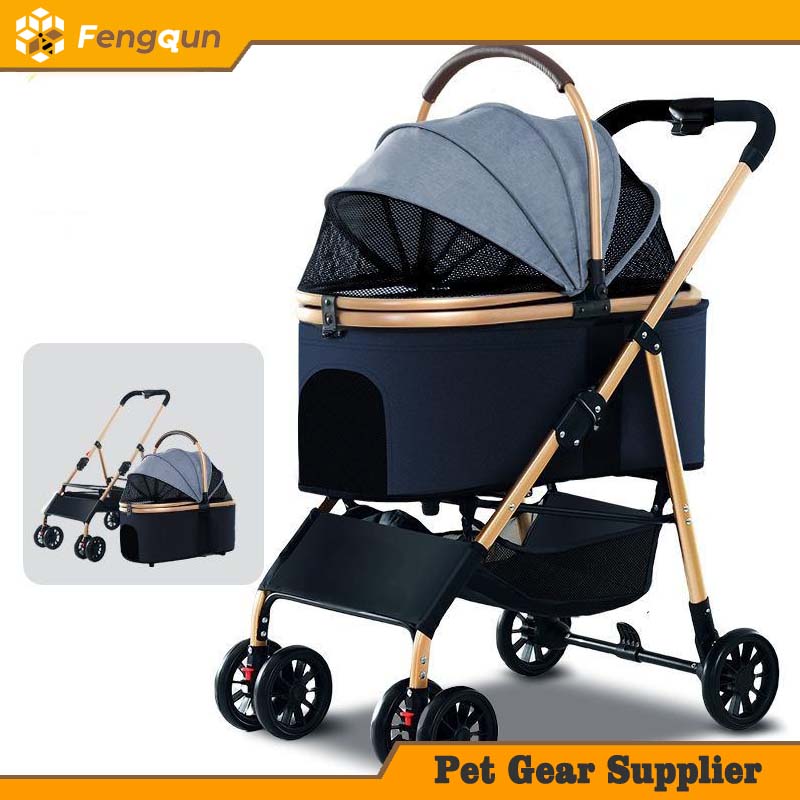
Is the Fabric on a Pet Gear Stroller Durable, Sag or Tear? A Technical Material Analysis
When investing in a pet stroller, the primary concern for any pet owner is whether the product will withstand daily use. While wheels and frames often dominate the discussion, the fabric durability of the pet compartment is arguably the most critical factor for your pet's safety and comfort. This technical article examines the material composition, structural integrity, and real-world performance of pet gear stroller fabrics, addressing the persistent question: will the bottom sag or tear?

1. Material Specifications: Understanding the Fabric
Manufacturers utilize different fabric grades across their product lines, with material selection directly impacting durability.
600-601 Denier Polyester and Nylon
The majority of pet strollers feature 600 Denier polyester or 601 Denier nylon construction. In textile terminology, "denier" refers to the thickness and weight of the fibers—higher denier indicates heavier, potentially more durable material. The 600D classification places these fabrics in the medium-to-heavyweight category, commonly used in luggage and outdoor gear.
Strollers designed for active users often list "600 Denier water-resistant material" in their specifications, with additional mesh panels for ventilation. Similarly, all-terrain models may utilize 601 Denier nylon combined with plastic and mesh components. These materials undergo standard industry testing for tensile strength and tear resistance before production.
Water-Resistant Properties
Many modern pet strollers advertise water-resistant fabric capabilities. This is achieved through either a coating applied to the base fabric or tight weave construction that resists moisture penetration. The water-resistant treatment serves dual purposes: protecting your pet during light rain and making cleanup easier when accidents occur.
Frame Material Integration
The fabric's durability cannot be evaluated in isolation—it depends heavily on its attachment to the frame. Manufacturers employ metal framing (either aluminum or steel) depending on the model. Aluminum frames, found in higher-end models, offer lightweight strength, while steel frames provide robust support at the cost of additional weight.
2. Failure Point Analysis: Where and Why Fabric Fails
Examining user reports reveals consistent failure patterns that deserve technical scrutiny.
The Bottom Seam Problem
Multiple users report that the bottom fabric tears or separates after relatively short usage periods. One verified purchaser documented: "The fabric came apart less than 2 months of use, my dog is 11 lbs... The fabric came apart in the bottom back." Another review states: "Used stroller 3 times on short walk with a 2 lb yorkie and the bottom of seat is roped back."
These failures typically occur at seam junctions—where fabric panels are stitched together—or at attachment points to the frame. The mechanical stress concentrates at these junctions during normal use, particularly when the pet shifts weight or during turns.
Load Distribution Issues
A critical engineering consideration is how the fabric distributes the pet's weight. The bottom panel functions as a tensioned membrane suspended within the frame. When properly designed, the frame bears the majority of the load through reinforced attachment points. However, if the fabric lacks adequate support or the tensioning is insufficient, all stress transfers to the stitching.
One reviewer's observation is particularly telling: the replacement pad they purchased was rectangular while "the base of the stroller is more egg-shaped," causing the fabric to sag at the sides. This geometric mismatch creates stress concentrations at non-reinforced areas.
Weight-to-Durability Ratio
The stated weight capacities range from 22 pounds for standard models to 75 pounds for models designed for larger dogs. However, user reports indicate failures occurring well below these limits. A 16-pound Lhasa Apso caused seam failure after approximately 15 uses, and an 11-pound dog triggered bottom tearing within two months.
This suggests that either the safety margins are inadequate, or the fabric attachment methodology cannot sustain repeated dynamic loading even at fractions of the rated capacity.
Mesh Ventilation Weakness
The mesh panels, while essential for ventilation, represent another potential failure point. One user noted that "the mesh window is flimsy and prone to TEARING." Mesh materials typically have lower tear resistance than solid fabric due to their open construction, making them vulnerable to claw damage or stress tears at the perimeter stitching.
3. Comparative Material Analysis: Polyester vs. Nylon
Material selection varies by manufacturer and model, with both polyester and nylon appearing across different product lines.
Polyester (600D)
Advantages: Better UV resistance, lower water absorption, maintains shape well
Limitations: Slightly lower tensile strength than nylon, can degrade with prolonged sun exposure
Common applications: Jogger-style strollers, standard models
Nylon (601D)
Advantages: Higher tensile strength, better abrasion resistance, more flexible in cold temperatures
Limitations: Absorbs more water, can stretch when wet, UV degradation faster than polyester
Common applications: All-terrain series
Both materials receive water-resistant treatments and are specified for outdoor use. The choice between them typically balances cost, weight, and intended use case rather than representing a clear durability hierarchy.
4. Structural Engineering: Why Fabric Support Matters
The fabric's longevity depends significantly on the underlying support structure—a principle that applies across many material science applications. Just as switchable smart film technology relies on precisely engineered polymer layers to maintain optical clarity during countless switching cycles, pet stroller fabric requires carefully designed support systems to maintain integrity through repeated loading cycles.
The Support System Components
Modern pet strollers incorporate several features to support the fabric:
Frame Geometry: The metal frame creates the primary load path. Wider frames distribute stress more effectively but increase overall width—a trade-off noted by users who appreciate the double stroller's spacious interior but struggle with its 30+ pound weight and wide profile.
Attachment Mechanisms: The method of securing fabric to frame—whether through pockets, hook-and-loop fasteners, or rigid clips—determines stress distribution. No-zip technologies, while primarily designed for access convenience, also eliminate zipper-related failure points along closure seams.
Bottom Reinforcement: Some models include a waterproof tray or rigid insert beneath the fabric pad. This creates a hybrid structure where the rigid component bears weight while the fabric provides cushioning and aesthetics.
The Sagging Phenomenon
Sagging occurs when the fabric stretches beyond its designed tension or when attachment points loosen. One reviewer described the phenomenon precisely: the fabric "sagged a bit on the sides" when a non-original pad was installed. This indicates that the fabric panel itself may not be self-supporting—it requires the correct pad shape to maintain proper tension.
Prolonged sagging accelerates failure because:
The fabric experiences bending stresses not accounted for in design
Pets shift toward the low point, concentrating weight
Seams at the sagging edges experience cyclic loading during movement
5. Maintenance Protocols for Fabric Longevity
Proper care significantly extends fabric life. Official maintenance instructions from manufacturers provide specific guidance.
Cleaning Procedures
Frame cleaning: Wipe with lightly oiled cloth
Fabric cleaning: Spot clean with dry cleaning fluid or mild soap and warm water
Prohibited products: No detergents or abrasives, as these degrade water-resistant coatings and weaken fibers
Environmental Considerations
Storage: Always store in clean, dry place
Avoid: Beach use (sand accelerates abrasion)
Loading: Do not put heavy items on top of stroller
Inspection Frequency
Manuals recommend regularly checking for loose parts, but fabric inspection deserves equal attention. Users should examine:
Seam integrity monthly
Attachment point security
Signs of stretching or permanent deformation
Mesh panel condition
6. The Engineering Trade-Off: Weight vs. Durability
All pet stroller manufacturers face the same engineering challenge: balancing weight against durability. Lightweight designs (as low as 11.5 pounds) require thinner materials and minimal reinforcement. Heavier models (up to 32 pounds) can incorporate more robust fabric and support structures.
This trade-off mirrors material selection challenges across industries. When designing products that must be both portable and durable, engineers must prioritize based on intended use. The pet stroller application is particularly demanding because:
The product must be lightweight enough to lift and transport
It must withstand dynamic loads from moving animals
It faces outdoor environmental exposure
It must remain comfortable for the pet
Modern materials science offers potential solutions. Advanced composites and engineered fabrics could provide better strength-to-weight ratios, though at increased cost. The integration of rigid support panels with breathable fabric—similar to how high-end pet carriers are constructed—could address the sagging issue without significant weight penalty. This approach to layered functionality echoes the principles behind switchable smart film, where multiple material layers work in concert to achieve properties no single layer could provide alone.
7. Usage-Based Durability Assessment
Different stroller types show varying durability characteristics based on their target use cases.
Jogger-Style Models
Weight capacity: Up to 75 pounds
Fabric: 600D water-resistant material
Tire type: Air-filled or gel-filled tires
Durability factors: Larger frame distributes load; intended for active use suggests reinforced construction
All-Terrain Models
Fabric: 601 Denier nylon
Terrain capability: All-terrain designation implies more robust construction
User feedback: Generally positive regarding sturdiness
Standard/Lightweight Models
Weight capacity: 22-35 pounds
Frame material: Steel or metal
Durability factors: Lighter construction may use thinner fabric; suitable for occasional use but potentially less durable for daily walking
Double Strollers
Weight capacity: Up to 90 pounds
User feedback: "The netting is heavy enough that the dogs can't push through or damage it"
Considerations: Heavier construction allows more substantial materials
8. Recommendations for Consumers
Based on the technical analysis of pet stroller fabric durability, consider the following when purchasing:
Match Model to Usage Intensity
Daily walkers: Invest in jogger or all-terrain models with higher denier ratings and reinforced construction
Occasional use: Standard models may provide adequate durability at lower cost
Multiple pets: Double strollers offer reinforced fabric appropriate for higher total weight
Inspection Protocol
Before each significant use:
Examine bottom panel seams for stress signs
Check attachment points where fabric meets frame
Verify mesh panels are intact with no loose threads
Test the fabric tension—excessive sagging indicates wear
Preventive Measures
Stay within weight limits with margin (a 15-pound pet in a 22-pound capacity stroller experiences less stress than a 20-pound pet)
Distribute weight evenly when carrying items in storage basket
Avoid overloading the under-seat basket, which can deform the bottom panel
Clean according to manufacturer specifications to maintain water resistance and fiber integrity
Warranty Consideration
Some users report fabric failures within weeks of purchase. Document issues immediately and contact manufacturer customer service—while replacement parts availability varies, products under warranty may qualify for replacement.
Conclusion
The durability of pet gear stroller fabric varies significantly by model and usage intensity. While the 600-601 denier materials represent industry-standard specifications, the documented seam failures and sagging issues indicate that attachment methodology and support structure deserve as much attention as the fabric itself.
For consumers, the key insight is that fabric durability depends on the entire system—frame geometry, connection points, and proper maintenance work together to determine longevity. By selecting a model appropriate for your usage intensity, inspecting regularly, and following maintenance protocols, you can maximize the service life of your pet stroller and ensure your pet travels safely and comfortably.
For more about Switchable Smart Film: The Evolution of Adaptive Glass Technology in Modern Architecture and Design. Everything you need to know, you can pay a visit to Product - Fengqun Pet Gear stroller for more info.