How to Reinforce the Structure of An All-Terrain Pet Stroller to Adapt to Complex Terrain?
In an era where pets are increasingly considered family members, the demand for outdoor adventures that include our furry companions has surged. All-terrain pet strollers have emerged as essential gear for pet owners who refuse to leave their dogs or cats behind when exploring challenging environments. These strollers are designed to navigate beyond smooth urban sidewalks, tackling rugged paths, uneven surfaces, and inclement weather with ease. Whether hiking through mountainous trails or trudging across snowy fields, all-terrain pet strollers provide a safe, comfortable ride for pets while offering convenience for their human counterparts.
At the heart of these strollers' adaptability lies the engineering of their frames and wheels. Reinforced structures, such as truss-inspired designs, ensure the frame can withstand the stresses of complex terrains without compromising portability. Meanwhile, the 360-degree swivel-locking function of the front wheels plays a pivotal role in maintaining stability and control, particularly in demanding scenarios like mountains and snow. This article explores the technical aspects of frame reinforcements commonly used in all-terrain pet strollers, drawing on examples from leading manufacturers, and delves into how the innovative wheel mechanisms enhance handling. By understanding these features, pet owners can make informed choices to ensure safe and enjoyable outings, ultimately extending the lifespan of the stroller and the well-being of their pets.
The rise of all-terrain pet strollers reflects broader trends in pet care, with the global pet stroller market projected to grow significantly due to increasing pet humanization and outdoor activities. Brands like Ibiyaya, Pet Gear, and WonderFold have pioneered designs that prioritize durability, with frames capable of supporting weights up to 50kg or more, suitable for large dogs or multiple small pets. These strollers often incorporate lightweight yet robust materials to balance strength and ease of transport, making them ideal for terrains where traditional strollers would falter. As we examine the reinforced structures, it's clear that innovations like hybrid frames draw from engineering principles seen in bicycles and outdoor gear, adapting them for pet mobility.
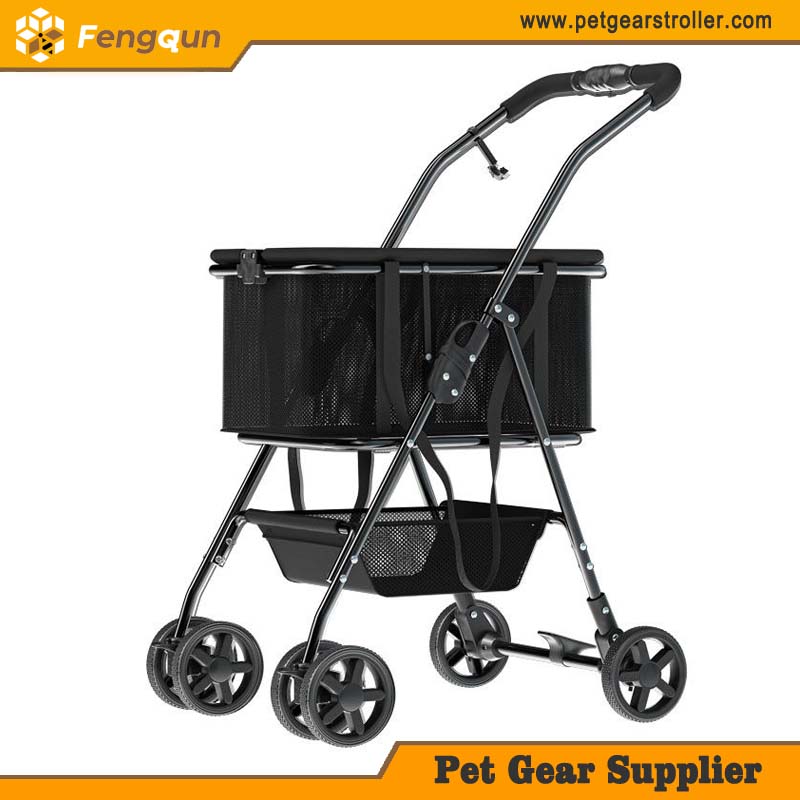
Reinforced Structures for Frames in All-Terrain Pet Strollers
The frame of an all-terrain pet stroller serves as its backbone, providing structural integrity against the forces encountered on uneven, demanding surfaces. Complex terrains—such as rocky mountain paths, muddy trails, or snow-covered grounds—impose significant stresses, including torsion, impact, and vibration. To counter these, manufacturers employ reinforced structures that enhance rigidity, distribute weight evenly, and absorb shocks, preventing deformation or failure over time.
One of the most prevalent reinforced designs is the truss structure, inspired by architectural and engineering principles used in bridges and aircraft. Truss frames consist of interconnected triangular units, which offer exceptional strength-to-weight ratios by efficiently distributing loads. In pet strollers, this manifests as tubular frames with cross-bracing or diagonal supports, often made from high-strength materials like aluminum alloys or steel hybrids. For instance, the Ibiyaya Hercules Heavy-Duty Pro Pet Stroller features a reinforced aluminum tube frame combined with steel elements, creating a truss-like network that supports up to 50kg while remaining lightweight at around 10-15kg. This design minimizes flexing on bumpy terrains, ensuring the cabin remains stable and pets are not jostled excessively.
Aluminum alloys are a staple in these frames due to their corrosion resistance and low density, making them ideal for outdoor use in varying weather conditions. Reinforced with internal gussets or external braces, these frames can handle the dynamic loads of mountainous hikes, where inclines and declines test torsional stability. The Ibiyaya BigBuddy Pet Stroller exemplifies this with its aluminum-steel hybrid frame, where steel provides tensile strength for high-impact areas like the base, while aluminum keeps the overall weight down for portability. Such hybrids are particularly effective in snowy terrains, where the frame must resist the added weight of accumulated snow without buckling.
Steel frames, often reinforced with powder-coated finishes for rust protection, are favored for their unparalleled durability in extreme conditions. Models like those from Petique incorporate reinforced steel trusses, which excel in load-bearing capacity for larger pets or multiple animals. However, pure steel can be heavier, so manufacturers mitigate this by integrating truss geometries that optimize material use—triangular bracing reduces the need for excess metal while maintaining rigidity. In complex terrains, this reinforcement prevents frame twisting, which could otherwise lead to uneven wheel alignment and reduced traction.
Beyond trusses, other reinforced structures include box frames and monocoque designs. Box frames, seen in the WonderFold Pet Series, use rectangular tubing with welded reinforcements at stress points, offering a balance of strength and simplicity. These are particularly useful in mountainous areas, where the frame must endure lateral forces from side slopes. Monocoque frames, borrowing from automotive engineering, integrate the chassis and body into a single reinforced shell, as in some Pet Gear models, providing seamless strength distribution. Reinforced with carbon fiber elements in premium variants, these structures enhance vibration damping, crucial for pet comfort on rocky or icy paths.
Material selection plays a critical role in reinforcement efficacy. Aluminum 6061-T6 alloy, commonly used, offers high yield strength (around 240 MPa) and is often anodized for environmental resistance. In truss configurations, this allows for frames that flex minimally under load, absorbing impacts through geometric design rather than material deformation. For snowy grounds, where low temperatures can embrittle materials, reinforced frames incorporate elastomeric joints or shock absorbers integrated into the truss nodes, preventing cracks.
Testing standards underscore the importance of these reinforcements. Many strollers comply with SGS or ASTM guidelines, simulating terrain stresses through drop tests and fatigue cycles. For example, the Ibiyaya Gentle Giant features a reinforced frame tested for 50,000 cycles, ensuring longevity in repeated use on complex terrains. In practice, pet owners report that truss-reinforced frames reduce the risk of tipping on inclines, with the triangular bracing providing inherent stability.
Hybrid reinforcements also address portability, a key concern for all-terrain use. Foldable designs, like those in the Tavo Roscoe Stroller Frame, use collapsible truss elements that lock rigidly when deployed, combining compactness with strength. This is vital for transporting the stroller to remote mountainous sites. Moreover, reinforcements extend to attachment points for accessories, such as bike trailers, ensuring the frame can handle multi-modal adventures without compromise.
In summary, truss structures and their variants dominate all-terrain pet stroller frames due to their optimal balance of strength, weight, and adaptability. By distributing forces efficiently, these reinforcements enable safe navigation of complex terrains, protecting both pet and equipment.
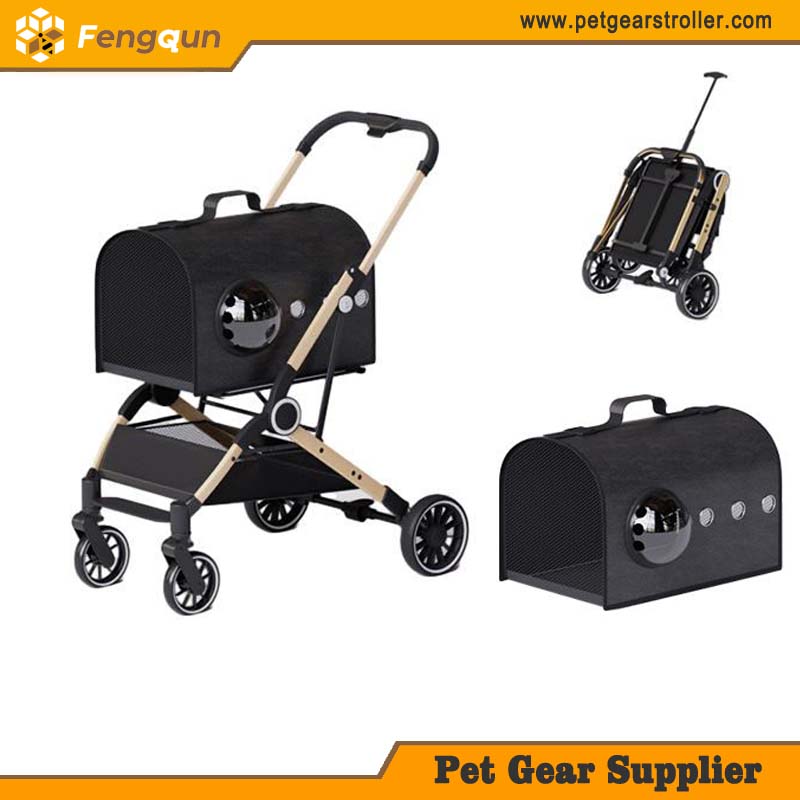
The 360-Degree Swivel-Locking Function of Front Wheels and Its Impact on Handling Stability
The wheels of an all-terrain pet stroller are the direct interface with the ground, and the 360-degree swivel-locking front wheel system represents a breakthrough in handling dynamics. This dual-function mechanism allows the front wheel(s) to rotate fully for agile maneuvering or lock into a fixed position for enhanced stability, adapting seamlessly to varying terrains.
In scenarios like mountainous areas and snowy grounds, this feature significantly improves control, reduces the risk of tipping, and ensures a smoother ride for pets.
Fundamentally, the swivel mode enables 360-degree rotation, facilitating tight turns and easy navigation in confined spaces, such as winding mountain trails. Models like the Carlson all-terrain Pet Stroller incorporate this with soft rubber wheels, allowing effortless pivoting without lifting the stroller. However, on rough or unstable surfaces, unrestricted swiveling can lead to instability, as wheels may catch on obstacles, causing wobbling or veering.
This is where the locking function shines. By fixing the front wheel in a forward position, the system increases the effective wheelbase, enhancing directional stability and resistance to lateral forces. In mountainous areas, characterized by steep inclines, rocky outcrops, and uneven paths, locking prevents the wheel from swiveling unpredictably, which could amplify torque from slopes and lead to tipping. For instance, the Gen7Pets Regal Plus Stroller's lockable swivel ensures straight tracking uphill, reducing operator fatigue and maintaining balance. This is crucial for pet safety, as sudden shifts could distress animals or cause injury.
In snowy grounds, the benefits are even more pronounced. Snow's low friction and compressible nature can cause wheels to sink or slide, exacerbating instability in swivel mode. Locking the wheel promotes a straight-line path, distributing weight more evenly and preventing the stroller from fishtailing. The Richell Easy Collapsible Jogging Pet Stroller demonstrates this, with its lock preventing side-to-side wobbling in soft snow, improving traction. Combined with air-filled or rubber tires, this function mimics ski-like tracking, allowing pet owners to push through powder without constant corrections.
Engineering-wise, the mechanism often includes a simple lever or button near the wheel hub, enabling quick switches between modes. In high-end models like the HPZ Pet Rover, bearings reduce vibration, ensuring smooth transitions. For mountains, where terrain shifts rapidly from flat to steep, this adaptability allows users to swivel for navigating switchbacks and lock for descents, optimizing stability.
Snowy scenarios benefit from the lock's ability to engage suspension systems more effectively. When fixed, the wheel aligns with rear brakes, creating a unified chassis response to bumps. Pet owners in winter climates report fewer incidents of stroller bogging down, as the locked position prevents wheels from digging in sideways.
Real-world applications highlight these advantages. In the Rocky Mountains, users of the Mountain Buggy Terrain stroller praise the lock for stability on icy slopes, where swivel could lead to slips. Similarly, in snowy Nordic trails, the function aids in maintaining momentum without veering off-path.
Overall, the 360-degree swivel-locking system transforms all-terrain pet strollers into versatile tools, balancing agility and stability for safe adventures in mountains and snow.

Conclusion
All-terrain pet strollers, with their reinforced truss-like frames and innovative wheel systems, empower pet owners to conquer complex terrains confidently. These features not only enhance durability and handling but also prioritize pet comfort, fostering unbreakable bonds through shared explorations. As technology advances, expect even more refined designs to push the boundaries of outdoor pet mobility.
For more about how to reinforce the structure of an all-terrain pet stroller to adapt to complex terrain, you can pay a visit to FengQun Pet Gear Supplier for more info.






