How to Choose the Right Pet Stroller for 2 Dogs: 2026 Complete Buying Guide
TL;DR: Choosing a pet stroller for two dogs requires balancing three core configurations: wide single‑cabin (best for friendly dogs, easy folding, senior‑friendly), double‑tier (ideal for dogs that need separation, but poor stability and access), and tandem front‑back (good for narrow spaces). This guide provides a technical decision framework based on combined dog weight (under 30 kg total for most strollers), temperament (aggressive vs. friendly), age (senior needs low entry and padding), terrain, storage space, and frequency of use. Key specifications to verify: weight capacity (add 30% safety margin), wheel type (pneumatic for outdoor), entry height (≤20 cm for seniors), internal tethers (mandatory), and folded dimensions. No brand or model names are referenced. For 80% of multi‑dog households, a wide single‑cabin double stroller offers the best value and safety.
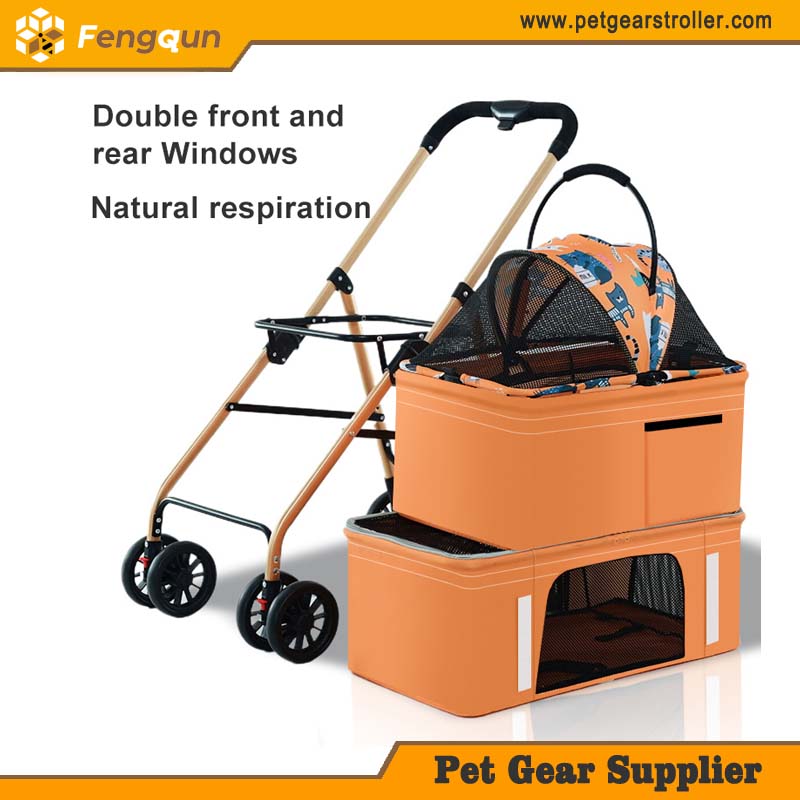
1. Introduction: The Three Configurations for Two Dogs
When you need to transport two dogs simultaneously, pet strollers fall into three distinct design categories. Each has unique engineering trade‑offs.
Wide single‑cabin (side‑by‑side): One large, rectangular cabin (typically 70–90 cm wide × 50–60 cm deep × 55–70 cm high). Both dogs share the same interior space. The stroller folds as a single unit. Weight capacity usually 35–50 kg total.
Double‑tier (two‑deck, vertical stack): Two separate cabins, one mounted above the other. Each cabin has its own door. The stroller folds either by collapsing the frame and folding down the upper cabin, or by detaching one or both cabins. Total weight capacity 16–30 kg (8–15 kg per tier).
Tandem (front‑back): Two cabins arranged one behind the other on a single chassis. The front cabin may be slightly lower. Folding is similar to single‑cabin designs. Weight capacity typically 30–45 kg total.
This guide helps you select among these based on your dogs’ specific needs, your physical capabilities, and your environment.
2. Critical Pre‑Purchase Assessments
Before looking at any product, gather these data points:
Dog‑related:
Individual weights and combined weight (measure on a scale).
Temperament: Do they fight, play, or ignore each other in close quarters?
Age and mobility: Any senior dogs with arthritis, or puppies that need confinement?
Escape history: Has either dog ever pushed open a door or jumped out of a carrier?
Owner‑related:
Do you have any hand, back, or strength limitations? (Affects folding and lifting.)
Where will you store the stroller? Measure closet, car trunk, or hallway space.
How often will you use it? Daily vs. weekly affects durability expectations.
Environment‑related:
Typical terrain: Pavement, gravel, grass, sand, or mixed?
Climate: Rainy, dusty, or dry? (Affects closure type and need for rain cover.)
Distance: Short neighborhood walks (<2 km) or long outings?
Write down these answers. They directly map to the configuration choice.
3. Deep Dive: Wide Single‑Cabin Double Strollers
How They Work
A single, spacious enclosure with one large door (front, rear, or both). Two dogs enter through the same opening. Some models include a removable center divider that converts the cabin into two separate zones.
Technical Specifications to Look For
Internal width: At least 70 cm for two small dogs (<10 kg each); 80–90 cm for medium dogs (10–15 kg each). Measure your dogs’ shoulder width side‑by‑side while lying down.
Floor area: Both dogs must be able to lie down simultaneously without overlapping. Minimum 0.25 m² for two small dogs; 0.4 m² for two medium dogs.
Entry height (ground to floor): ≤20 cm for senior dogs; up to 25 cm is acceptable for younger, agile dogs.
Harness tethers: At least two attachment points (left and right sides) to prevent dogs from crowding the door.
Internal divider (optional): Useful if dogs tolerate each other but occasionally squabble. The divider should be removable and padded.
Weight capacity: Must exceed combined dog weight by at least 30%. For two 10 kg dogs (total 20 kg), look for capacity ≥26 kg.
Advantages
Stability: Low center of gravity (dogs sit near wheel level) → minimal tip‑over risk.
Easy access: Both dogs enter at the same low height. No bending or lifting required.
Senior friendly: One low entry serves both dogs. Plenty of space to lie down.
Simple folding: Most fold in one motion (scissor or book fold) in under 10 seconds.
Better ventilation: Single large space with mesh on all sides prevents heat buildup.
Disadvantages
No separation: If dogs fight, they cannot be isolated without a divider. Even with a divider, they can still see and smell each other.
Limited individual carrier function: Most wide cabins are not detachable. You cannot easily take one dog out while leaving the other inside the stroller (unless you carry the whole stroller).
Wide folded width: Even folded, width is typically 60–80 cm – may not fit narrow car trunks or closets.
Best For
Two friendly dogs that coexist peacefully.
At least one senior dog.
Daily walks on pavement or gravel.
Owners with back problems (no lifting).
Those who prioritize folding speed and stability.
Avoid When
Dogs have a history of fighting in shared spaces.
You need to transport dogs separately by car frequently.
Your storage space is extremely narrow (under 60 cm wide).
4. Deep Dive: Double‑Tier (Two‑Deck) Strollers
How They Work
Two separate cabins stacked vertically. The lower cabin sits near wheel level (20–30 cm off ground). The upper cabin is 50–70 cm high. Each has its own door. Some models allow each cabin to detach as a standalone carrier.
Technical Specifications
Per‑cabin dimensions: Typically 50–60 cm length × 35–45 cm width × 40–50 cm height. Measure your largest dog against these – many double‑tier cabins are too small for dogs over 10 kg to stand or turn comfortably.
Weight per tier: Usually 8–15 kg. Never exceed per‑tier limit even if total is under the combined limit.
Entry height (lower cabin): 20–30 cm – acceptable.
Entry height (upper cabin): 50–70 cm – requires lifting the dog. Impossible for senior or heavy dogs.
Detachability: If you need separate carriers, verify that both cabins detach (some only detach the upper).
Folding mechanism: Most require two steps – collapse frame, then fold or remove upper cabin. Time: 20–40 seconds.
Advantages
Complete physical separation: Dogs cannot see, touch, or smell each other if cabins are solid‑floored. Essential for aggressive pairs or medical isolation.
Detachable carriers: Often both cabins can be removed, turning into two independent carriers for car travel or vet visits.
Narrow folded width: When folded, double‑tier strollers are often only 50–60 cm wide – good for tight storage.
Disadvantages
Poor stability: High center of gravity (upper dog mass at 50–70 cm) increases tip‑over risk on side slopes. Critical tilt angle is much lower than wide cabin.
Poor senior dog compatibility: Upper cabin is inaccessible. Lower cabin often has limited headroom and traps heat.
Difficult lower cabin access: The upper cabin overhangs, forcing you to bend deeply to reach the lower door.
Heat buildup in lower cabin: Hot air rises; the lower cabin becomes 3–5°C warmer than ambient – dangerous for brachycephalic breeds.
Complex folding: Two‑step process is cumbersome for daily use. Hinges and latches wear faster.
Best For
Two dogs that cannot be walked together in a shared space (aggression, contagious illness, post‑surgery recovery).
Owners who frequently need to transport each dog separately by car.
Very small dogs (<8 kg each) where upper cabin lifting is manageable.
Those with very narrow storage but sufficient vertical space.
Avoid When
Any dog is senior, arthritic, or over 10 kg.
You walk on uneven ground, slopes, or curbs.
You have back problems (lower cabin access requires bending).
You live in a warm climate (lower cabin heat).
5. Deep Dive: Tandem (Front‑Back) Strollers
How They Work
Two cabins arranged linearly, one behind the other, sharing the same chassis. The front cabin is often slightly lower or has a different door orientation. The pet stroller pushes like a single‑cabin unit.
Technical Specifications
Total length: Typically 100–120 cm (much longer than wide or double‑tier).
Cabin dimensions: Each cabin similar to a single small stroller (approx. 50 cm length each).
Turning radius: Much larger than other configurations due to long wheelbase.
Entry: Front cabin usually has a front door; rear cabin has a rear or side door.
Weight capacity: 30–45 kg total.
Advantages
Narrow width: Typically 45–55 cm – fits through standard doorways and narrow hallways.
Good stability: Long wheelbase prevents forward/backward tipping. Center of gravity is low.
Some separation: Dogs are not side‑by‑side; they cannot easily see or reach each other (depending on cabin design).
Moderate folding complexity: Similar to wide single‑cabin.
Disadvantages
Poor maneuverability in tight spaces: The long length makes turning in elevators, shops, or crowded sidewalks difficult.
Rear cabin access: Reaching the rear dog can be awkward – you must go around to the back or reach over the front cabin.
Not suitable for senior dogs in rear cabin: If the rear door is low, fine; but many tandems have side doors that require bending.
Less common: Fewer options available; design quality varies widely.
Best For
Extremely narrow living spaces (apartment hallways, narrow doorways) where width is the primary constraint.
Two dogs that are calm but need a bit of separation.
Owners who walk primarily in straight lines (parks, long paths) rather than crowded urban areas.
Avoid When
You need to navigate tight turns (e.g., supermarket aisles, elevators).
One dog needs frequent attention (rear cabin access is inconvenient).
You have a very small car trunk (the folded length may still be large).
6. Key Specifications to Verify (All Configurations)
Regardless of which type you consider, check these technical parameters:
Weight Capacity
Never trust the advertised number alone. Calculate: (dog A weight + dog B weight) × 1.3 = minimum required capacity. If the stroller’s capacity is exactly your dogs’ combined weight, reject it – you need a safety margin for dynamic loads (bumps, curbs).
Wheel Type and Diameter
Pneumatic (air‑filled) tires: Best for outdoor use, vibration damping, and senior dogs. Diameter: ≥20 cm for pavement; ≥25 cm for gravel/grass.
Solid EVA foam: Lightweight, no flats, but harsh ride. Only acceptable for indoor or very smooth pavement, and dogs under 15 kg total.
Number of wheels: 4‑wheel is standard. 3‑wheel offers better maneuverability but slightly lower stability.
Suspension
Look for coil springs or elastomer dampers on each wheel. Without suspension, every crack and pebble transmits directly to your dogs’ joints. Mandatory for senior or arthritic dogs.
Brakes
Foot‑operated, locking at least two wheels (preferably rear). Test on a 15° incline – the stroller must not move.
Folded Dimensions
Measure your car trunk and home storage area before buying. For wide single‑cabin: expect folded width 60–80 cm, height 70–90 cm, depth 30–40 cm. For double‑tier: height often exceeds 90 cm. For tandem: length often exceeds 100 cm folded.
Harness Tethers
Mandatory for all configurations. You need at least one tether per dog. For wide cabins, two side tethers are better. Tethers must be short enough (15–20 cm) that the dog cannot reach the door. Elastic tethers reduce jerk.
Floor Padding
Minimum 3 cm of high‑density foam, plus a removable, washable cover. Memory foam (2 cm additional) is ideal for seniors.
Entry Height
For any senior dog: ground‑to‑floor height ≤20 cm. Measure this with the stroller on a flat surface. Some strollers list “step‑over height” – that’s the number you need.
Canopy
Should be adjustable, removable, and offer UPF 50+ protection. A reflective inner lining reduces heat.
7. Scenario‑Based Decision Matrix
| Your Situation | Recommended Configuration | Why |
|---|---|---|
| Two friendly small dogs (<10 kg each), one senior | Wide single‑cabin | Low entry, space to lie down, stability |
| Two dogs that fight or need medical isolation | Double‑tier (with detachable carriers) | Complete separation; separate carriers for vet trips |
| Very narrow apartment hallway and car trunk | Tandem (front‑back) | Narrowest width; fits through tight spaces |
| One large dog (15 kg) and one small dog (5 kg), both friendly | Wide single‑cabin (with optional divider) | Large enough for both; divider can separate if needed |
| Daily walks on gravel trails | Wide single‑cabin with pneumatic tires ≥25 cm | Best stability and comfort for mixed terrain |
| Frequent car travel with separate vet visits | Double‑tier with detachable carriers | Each carrier functions independently |
| Owner has back problems (cannot lift or bend) | Wide single‑cabin | No lifting; low entry; one‑handed fold |
| Two very active small dogs that love to look around | Wide single‑cabin with large mesh windows | Both dogs share the view; easy to monitor |
| Two cats (or cat + small dog) | Wide single‑cabin or double‑tier – depends on compatibility | Cats often prefer wide cabin; double‑tier if they fight |
| Any dog over 15 kg | Wide single‑cabin (double‑tier cabins are too small) | Double‑tier per‑cabin capacity rarely exceeds 15 kg |
8. Red Flags – Do Not Buy
No internal harness tethers – The stroller is unsafe. You cannot add reliable tethers to all models.
Plastic wheels under 15 cm diameter – Will break or jam on first curb.
Folding mechanism that requires tools – You will never fold it.
Weight capacity exactly equal to your dogs’ combined weight – No safety margin; frame may fail on bumps.
Hook‑and‑loop (Velcro) as primary door closure – Will fail within months.
Upper cabin of double‑tier stroller rated for dogs over 10 kg – Check the per‑tier limit; many are overrated.
No brake on at least two wheels – Dangerous on any incline.
Floor is flexible fabric – Causes spinal strain; must be rigid.
9. Maintenance Tips for Double Dog Strollers
Wheel bearings: Clean and repack with waterproof grease every 3 months if used outdoors.
Pneumatic tires: Check pressure weekly (25–35 psi typical). Underinflated tires increase rolling resistance and wear.
Folding hinges: Lubricate with dry PTFE spray every 2 months. Never use oil (attracts dirt).
Fabric and mesh: Machine wash monthly (30°C, gentle cycle). Air dry.
Harness tethers: Inspect clips and stitching every month. Replace if frayed.
Brake cables (if present): Lubricate lightly every 6 months.
10. Final Recommendation
For the majority of two‑dog households – where dogs are friendly or at least tolerant, combined weight under 30 kg, and you walk on pavement or light trails – the wide single‑cabin double stroller is the best choice. It offers the best stability, easiest folding, lowest entry height (critical for aging dogs), and simplest operation.
Choose a double‑tier stroller only if you absolutely need physical separation (aggression, medical isolation) and your dogs are small enough (under 10 kg each) that lifting the upper dog is not a burden. Accept the trade‑offs: higher tip‑over risk, more difficult folding, and poor senior compatibility.
Choose a tandem stroller only if your primary constraint is extreme narrowness (e.g., a 55 cm wide hallway or car trunk) and you do not need to make tight turns.
Do not buy any stroller without first measuring your dogs’ combined weight, your storage space, and your typical terrain. And always, always use the internal harness tethers – they are your true safety net.

Key Takeaways
Three configurations exist for two dogs: wide single‑cabin (best for most), double‑tier (separation, but poor stability), and tandem (narrow, but long turning radius). Choose based on dog temperament, age, and your storage space.
Wide single‑cabin double strollers are the safest and most versatile – low center of gravity, easy folding, senior‑friendly entry height, and ample space. Recommended for 80% of users.
Double‑tier strollers are a niche product for aggressive or medically isolated dogs under 10 kg each. They have high tip‑over risk, poor lower‑cabin ventilation, and require lifting the upper dog.
Tandem strollers only make sense when width is extremely limited (under 55 cm). Their long length makes turning difficult in crowded spaces.
Always verify technical specifications – do not trust marketing. Key numbers: weight capacity (add 30% safety margin), wheel diameter (≥20 cm pneumatic for outdoor), entry height (≤20 cm for seniors), folded dimensions, and number of harness tethers.
Harness tethers are mandatory – one per dog, short enough to prevent reaching the door. Without them, no stroller is safe.
Pneumatic tires with suspension are non‑negotiable for senior dogs or outdoor use – solid wheels transmit painful vibrations.
Measure your storage space before buying – folded width, height, and depth must fit your car trunk and home closet. Wide single‑cabin strollers fold to 60–80 cm wide; double‑tier fold taller; tandem fold longer.
Test the folding mechanism in person if possible – a smooth, one‑handed fold (under 10 seconds) is essential for daily use. Avoid strollers that require two separate actions or tools.
For two dogs that fight, first try training and a removable divider before committing to a double‑tier stroller. Many dogs tolerate a wide cabin with a divider.
Maintenance is simple but critical – lubricate hinges, check tire pressure, clean wheel bearings, wash fabric. A well‑maintained stroller will last 3–5 years.
By following this guide, you can confidently select a pet stroller that safely and comfortably accommodates both your dogs, whether they are seniors, puppies, best friends, or reluctant seatmates.
For more about How to Choose the Right Pet Stroller for 2 Dogs: 2026 Complete Buying Guide, you can pay a visit to https://www.petgearstroller.com/product/ for more info.






