How to Choose the Right No Zip Pet Stroller: 2026 Complete Guide
TL;DR: Choosing a no‑zip pet stroller requires matching the closure mechanism to your pet’s size, temperament, and your typical environment. Three main no‑zip systems exist: magnetic (silent, instant access, low escape resistance – best for calm cats/small dogs under 8 kg), buckle (secure, one‑handed, moderate noise – ideal for active small dogs), and hook‑and‑loop (not recommended for any pet that moves). Beyond closures, evaluate wheel type (pneumatic for senior pets, foam for lightweight), frame material (aluminum for portability, steel for durability), folding mechanism, and safety features (internal tether mandatory). This 2026 guide provides a technical decision matrix, maintenance protocols, and red flags to avoid – all without brand or model references.

Introduction: Why “No Zip” Needs a Selection Guide
No‑zip pet strollers have gained popularity for their silent operation, one‑handed access, and freedom from zipper jamming. However, not all no‑zip designs are equal, and choosing the wrong one can lead to escapes, injuries, or rapid product failure. Unlike traditional zippered strollers, where the closure performance is relatively uniform, no‑zip mechanisms vary dramatically in holding force, durability, and ease of use.
This guide breaks down the selection process into four technical layers:
Closure mechanism – the core differentiator.
Pet‑specific factors – weight, behavior, age.
Environmental factors – weather, terrain, frequency of use.
Secondary features – wheels, folding, safety restraints.
By the end, you will have a systematic method to evaluate any no‑zip pet stroller without relying on marketing claims or brand names.
Part 1: Understanding the Three No‑Zip Closure Types
Magnetic Closures
How they work: Neodymium magnets (N35–N50 grade) embedded in fabric flaps. The magnetic attraction holds the door closed. Opening requires pulling the flaps apart with force exceeding the magnetic pull.
Technical specifications to look for:
Magnet grade: N45 or higher (stronger hold).
Number of magnet pairs: At least 4 for small strollers, 6 for larger ones.
Pull force per pair: Should be ≥2 kg (test by trying to open with one finger – if it opens easily, it’s too weak).
Magnet encapsulation: Magnets must be fully sewn into fabric pockets, never exposed (exposed magnets crack and corrode).
Best for: Calm pets under 8 kg – senior dogs, cats, small companion breeds that do not lunge at squirrels or other dogs. Also ideal for owners with arthritis or hand weakness because zero force is needed to close (magnets self‑align).
Avoid when: Your pet has ever escaped from a carrier, or you walk near busy roads where a sudden escape could be dangerous.
Buckle Closures (Side‑Release Buckles)
How they work: Plastic acetal buckles with spring‑loaded latches. The female receiver on one fabric edge, male prong on the opposite. Closing requires aligning and pushing until a click. Opening requires squeezing the release tabs.
Technical specifications:
Buckle material: Acetal (POM) or polycarbonate – avoid nylon buckles which deform.
Tensile strength per buckle: ≥15 kg (most are 20–30 kg).
Number of buckles: At least 3 for a door of 40 cm width; 2 is insufficient.
Secondary lock: Some buckles have a small button to prevent accidental release – highly recommended.
Best for: Active small dogs (5–12 kg) that may push or paw at the door but are not obsessive escape artists. Also good for owners who want security without the maintenance of zippers.
Avoid when: You need absolute silence (the click can startle noise‑sensitive pets) or when your dog has learned to step on buckle release tabs (rare but possible).
Hook‑and‑Loop (Velcro) Closures
How they work: Hook tape and loop tape sewn onto overlapping panels. Shear force holds them together.
Technical reality: Even high‑quality hook‑and‑loop loses 70% of its holding power within 3–6 months of daily use due to fur, lint, and dirt accumulation. It is impossible to keep perfectly clean in a pet stroller.
Recommendation: Do not buy a no‑zip stroller that relies primarily on hook‑and‑loop for pet containment. It is only acceptable as a secondary closure (e.g., over a magnetic door for extra security) or for pets that are completely immobile.
Roll‑Down / Weighted Bar (Not Recommended)
A fabric flap with a heavy bar sewn into the hem. Gravity holds it closed. Any determined pet can push under it. Avoid entirely for outdoor use.
Part 2: Pet‑Specific Selection Criteria
Pet Weight and Size
Under 5 kg (cats, tiny dogs): Magnetic closures are sufficient if the pet is calm. Buckle closures add security but may be overkill.
5–10 kg (small dogs, large cats): Buckle closures are strongly preferred. Only choose magnetic if your pet has zero escape history and is walked only in safe, enclosed areas.
Over 10 kg: Do not buy a no‑zip stroller. Zippered strollers are the only safe choice for medium or large dogs.
Pet Temperament
Calm, senior, low‑energy: Magnetic works well.
Curious, occasionally paws at doors: Buckle required.
History of escaping carriers, high prey drive, or separation anxiety: Avoid no‑zip entirely – choose zippered.
Noise‑sensitive (cats, anxious dogs): Magnetic (silent) is best; buckle’s click may cause stress.
Senior Pets
For arthritic or mobility‑impaired pets, the closure is less important than entry height and floor comfort. However, magnetic closures are preferable because they require no force to close and produce no startling sound. Ensure the stroller has a low step‑over height (≤20 cm) and a rigid, padded floor regardless of closure type.
Part 3: Environmental and Usage Factors
Weather Exposure
Dry climates (desert, urban, indoor use): Any no‑zip closure works.
Rainy or humid climates: Magnetic and buckle closures have gaps that let in water. You will need a universal rain cover (elastic‑hem type) that fits over the entire stroller. If you walk in rain frequently, a zippered stroller is better.
Dusty or sandy areas: No‑zip closures excel here because they do not jam like zippers. Magnets and buckles are unaffected by sand.
Frequency of Use
Daily use: Magnetic closures have no moving parts and last 5+ years. Buckles also last well (3–5 years). Both outperform zippers in longevity under heavy use.
Occasional use (weekly or less): All closures are fine, but avoid hook‑and‑loop.
Terrain
Smooth pavement, indoor floors: All wheels work. Closure type irrelevant.
Gravel, grass, uneven ground: Pneumatic tires are more important than closure. However, ensure the stroller has a secure internal tether – bumps can cause a magnetic door to jolt open if the pet shifts weight against it.
Beach (sand): Magnetic or buckle closures are fine. Avoid zippers (sand jams). Use balloon tires for sand.
Part 4: Secondary Features That Matter for No‑Zip Strollers
Internal Harness Tether – Mandatory
Every no‑zip stroller must have a short (15–20 cm) elastic or non‑elastic strap with a clip to attach to your pet’s harness. This is your primary escape prevention. The closure only keeps the door from swinging open; the tether stops the pet from reaching the door with full force.
What to check: The tether should attach to a low point on the stroller floor (not high on the backrest) to limit the pet’s range of motion. Two tether points (left and right) are better than one.
Frame Material and Weight
Aluminum: Lighter (4–7 kg for single strollers), but check the weight limit. For no‑zip strollers, aluminum is fine for pets under 15 kg total.
Steel: Heavier (8–12 kg), more durable, but less portable. Choose steel if you have two pets or a very active dog.
Wheel Type
Solid EVA foam: Lightweight, no flats, but transmits vibrations. Acceptable for pets under 8 kg on smooth surfaces.
Pneumatic (air‑filled): Heavier, requires pressure checks, but absorbs shocks. Strongly recommended for senior pets or any outdoor use on uneven ground.
Wheel size: ≥15 cm for small strollers; ≥20 cm for any outdoor use.
Folding Mechanism
Even with no‑zip closures, the stroller must fold easily. Look for:
One‑handed folding (a central trigger or pull strap).
Auto‑locking in folded position.
Folded dimensions that fit your car trunk (typical: 60×30×25 cm for lightweight models).
Canopy and Ventilation
No‑zip strollers often have magnetic or buckle‑closed canopies. Ensure:
The canopy is removable for washing.
There are mesh windows on all sides for airflow.
The canopy fabric offers UPF 50+ protection (stated in specifications).
Part 5: Step‑by‑Step Selection Process
Step 1: Weigh and assess your pet.
If >10 kg → stop. Choose a zippered stroller.
If 5–10 kg and active → prioritize buckle closures.
If <5 kg or senior/calm → magnetic is acceptable.
Step 2: Observe your pet’s behavior.
Does it lunge at squirrels, other dogs, or fast‑moving objects? → Avoid magnetic, choose buckle or zipper.
Does it startle at sudden noises? → Magnetic only (silent).
Has it escaped from a carrier before? → Avoid no‑zip entirely.
Step 3: Evaluate your walking environment.
Rainy climate → Budget for a rain cover or choose zippered.
Sandy/dusty → No‑zip (magnetic or buckle) is ideal.
Indoor only → Any closure works.
Step 4: Test the closure (if possible in store).
For magnetic: Open the door with one hand. It should require a deliberate pull (not flop open). Then let go – it should self‑close completely. Shake the stroller – the door should not separate.
For buckle: Buckle and unbuckle 10 times. The click should be crisp. Check that the release tabs are not too stiff or too loose. Try to pull the door open while buckled – it should not budge.
Step 5: Verify safety features.
Internal tether present? (If not, do not buy – you can add a universal tether, but factory‑installed is better.)
Harness compatibility: The tether clip must fit your pet’s harness (most use a standard 2 cm clip).
No sharp edges or pinch points around the closure.
Step 6: Check fold and weight.
Fold and unfold the stroller 3 times. Does anything catch? Do the magnetic flaps or buckles interfere with folding?
Lift the folded stroller. Can you carry it comfortably for 1 minute?
Step 7: Read the manual for maintenance requirements.
Magnetic: No maintenance, but check for magnet corrosion every 6 months.
Buckle: Rinse buckles monthly. Apply dry lubricant to springs annually.
Part 6: Red Flags – When to Walk Away
“Universal fit” magnetic strips that are glued, not sewn. They will detach.
Only 2 magnet pairs on a door wider than 30 cm. Gaps will allow the pet to push through.
Buckles that require two hands to release – defeats the purpose of no‑zip.
Hook‑and‑loop as the primary closure – do not buy regardless of price.
No internal tether – the manufacturer does not understand safety.
Weight capacity listed but no mention of closure type holding force – vague marketing.
Part 7: Maintenance for Longevity
| Closure | Monthly Task | Every 6 Months | Signs of Failure |
|---|---|---|---|
| Magnetic | Wipe magnets with dry cloth | Check for rust or cracks; replace fabric panel if magnets loose | Door does not self‑close fully; magnets no longer hold |
| Buckle | Rinse with fresh water; cycle buckles 10 times | Apply PTFE spray to springs | Buckle does not click; releases under light pull |
| Hook‑loop (if unavoidable) | Clean with stiff brush; remove hair | Replace tape entirely | Door opens with gentle push |
General: Store the stroller indoors away from direct sunlight (UV degrades fabric and weakens magnets over years). If a magnetic door loses strength, you can sometimes buy replacement magnet strips (generic) and sew them in – but this requires basic sewing skills.
Part 8: 2026 Trends and Hybrid Designs
The newest no‑zip strollers (without naming brands) feature dual‑security systems:
Primary magnetic closure for daily convenience.
Secondary zipper or buckle that can be engaged for high‑security situations (vet waiting rooms, busy streets).
Quick‑release magnetic doors that detach entirely for washing.
Another innovation: adjustable magnetic force using sliding magnet arrays – allowing owners to increase holding power for more determined pets. These are rare but promising.
For most buyers in 2026, the best choice remains a magnetic closure with at least 6 magnet pairs and a secondary zippered top canopy. This provides silent, one‑handed operation for 90% of walks and a security backup when needed.
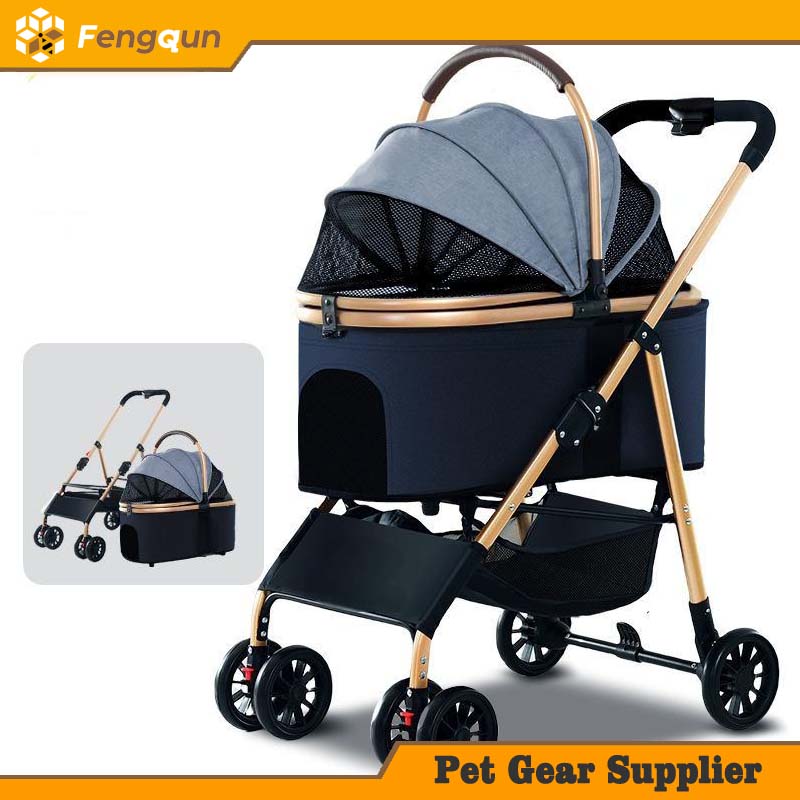
Key Takeaways
Match closure type to pet weight and behavior. Magnetic for calm pets under 8 kg; buckle for active small dogs 5–10 kg; avoid no‑zip entirely for pets over 10 kg or with escape history.
Always verify closure specifications: For magnets, look for N45+ grade, ≥4 pairs, ≥2 kg pull force per pair. For buckles, acetal material, ≥15 kg tensile strength, ≥3 buckles per door.
Hook‑and‑loop is not acceptable as a primary pet closure in any no‑zip stroller – it fails within months due to fur and dirt.
The internal harness tether is non‑negotiable. Without it, no no‑zip stroller is safe. The tether prevents escape even if the door opens.
Consider your environment. No‑zip closures leak rain and wind – use a rain cover or choose zippered for wet climates. For sandy or dusty areas, no‑zip is superior.
Test before buying. Open and close the door 20 times. Shake the stroller. The closure must remain secure under simulated bumping.
Senior pets benefit most from magnetic closures – silent, zero‑force closing, and low maintenance. Pair with pneumatic tires and a low entry height.
Maintenance is minimal but essential. Magnets need occasional corrosion checks; buckles need rinsing and lubrication. Avoid oil‑based products.
Hybrid designs (magnetic + backup zipper) offer the best of both worlds – convenience for daily walks and security for high‑risk situations.
When in doubt, choose a zippered stroller. No‑zip is excellent for a specific niche (calm small pets, dry environments, owners with hand limitations). For everyone else, a high‑quality zippered stroller remains the safer, more versatile choice.
By following this guide, you can confidently select a no‑zip pet stroller that matches your pet’s needs and your lifestyle – without falling for marketing hype or ending up with a product that fails when you need it most.
For more about How to Choose the Right No Zip Pet Stroller: 2026 Complete Guide, you can pay a visit to https://www.petgearstroller.com/product/ for more info.






