How Much Weight Can a Pet Stroller Hold?
The weight capacity specification of a pet stroller represents one of the most critical yet frequently misunderstood technical parameters in the product selection process. This article provides a rigorous engineering analysis of pet stroller weight ratings, examining the mechanical, material, and safety factors that determine actual load-bearing capability. Through systematic examination of frame structures, wheel systems, connection points, and dynamic loading conditions, this analysis establishes that published weight capacities are not absolute limits but rather engineering guidelines requiring contextual interpretation. The article presents technical frameworks for evaluating stroller capacity relative to individual pet characteristics, usage scenarios, and safety margins, enabling informed purchasing decisions based on engineering principles rather than marketing claims.
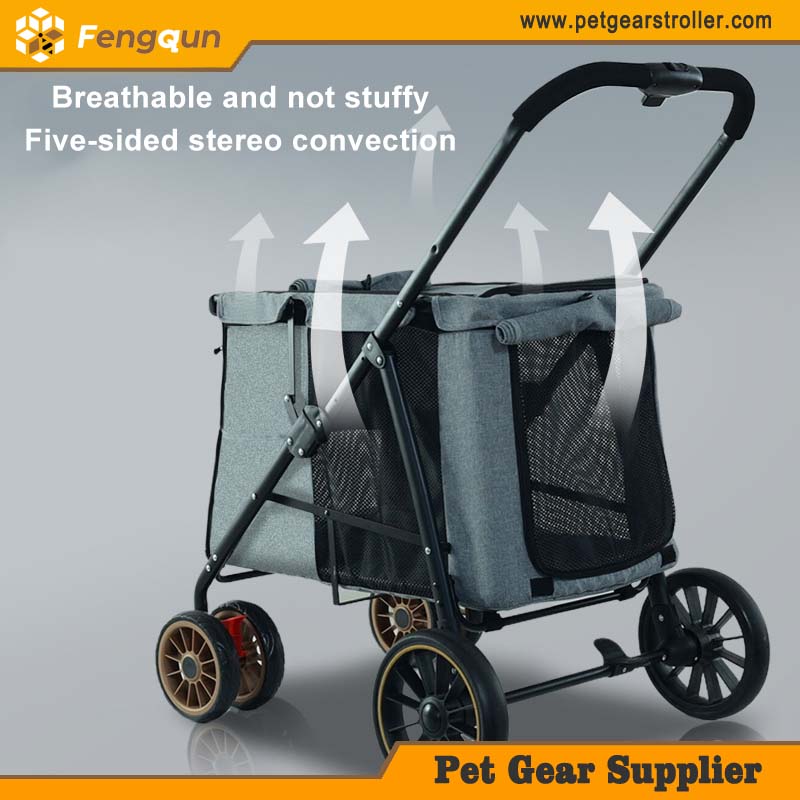
1. Introduction: The Complexity of Weight Ratings
The seemingly straightforward question—“How much weight can a pet stroller hold?”—resists simple numerical answers. While manufacturers publish weight capacity specifications ranging typically from 30 to 150 pounds depending on stroller classification, these figures represent only one dimension of a complex engineering equation. The actual safe carrying capacity of a pet stroller depends upon multiple interdependent variables including structural design, material properties, wheel configuration, terrain conditions, and usage patterns.
Understanding weight capacity requires moving beyond the advertised number to examine the engineering principles that determine how loads are distributed, how forces are transmitted through the structure, and what safety margins are appropriate for different applications. This technical analysis provides the framework for making that assessment.
2. Structural Engineering Fundamentals
2.1 Frame Materials and Mechanical Properties
The frame constitutes the primary load-bearing structure of any pet stroller, and its material properties fundamentally determine capacity. Three material categories dominate current designs, each with distinct mechanical characteristics:
Aluminum alloy frames represent the predominant choice in mid-to-premium strollers. The specific alloy composition varies, with 6000-series aluminum being most common. These alloys offer yield strengths ranging from 35,000 to 45,000 psi, providing excellent strength-to-weight ratios. Aluminum frames enable lightweight construction—typically 15–25 pounds for the complete stroller—while maintaining adequate structural integrity for loads up to 75 pounds in properly engineered designs.
Steel frames appear primarily in heavy-duty and budget categories. Steel’s higher modulus of elasticity (approximately 29,000 ksi compared to aluminum’s 10,000 ksi) provides greater stiffness under load, meaning steel frames exhibit less deflection when loaded. However, this stiffness comes at a significant weight penalty; steel-framed strollers often weigh 30–50 percent more than aluminum equivalents. Steel’s higher density (0.284 lb/in³ versus aluminum’s 0.098 lb/in³) necessitates either heavier construction or reduced material cross-sections that may compromise durability.
Composite frames utilize materials such as carbon fiber or fiberglass-reinforced polymers. These materials can achieve exceptional stiffness-to-weight ratios but require careful engineering at connection points where stress concentrations occur. Composite frames are typically reserved for premium products targeting weight-conscious users.
2.2 Structural Configuration and Load Paths
The geometric configuration of the stroller frame determines how loads travel from the pet compartment to the wheels and ultimately to the ground. Superior engineering designs incorporate:
Triangulated geometries that distribute loads through multiple members rather than concentrating stress at single points. Frames with diagonal bracing between primary tubes demonstrate significantly higher resistance to torsional loads than simple rectangular configurations.
Reinforced connection points where tubes join. The pivot points required for folding mechanisms represent potential weak points in load transmission. Quality designs use oversized bushings, metal-on-metal connections, and positive locking mechanisms that maintain structural integrity under load.
Continuous tube construction where possible, rather than assemblies of multiple short sections joined with connectors. Each connection point introduces potential failure modes and stress concentrations that reduce overall capacity.
2.3 Failure Modes Under Load
Understanding how strollers fail when overloaded informs appropriate capacity interpretation. The primary failure modes include:
Frame buckling, typically occurring at the longest unsupported tube sections or at folding mechanism pivot points. Buckling is a sudden failure mode with minimal warning, making it particularly hazardous.
Connection point separation where tubes joined by press-fit or friction connections pull apart under load. Quality designs incorporate positive mechanical locks rather than relying solely on friction.
Wheel axle deformation, where the axle bends under excessive vertical load, causing wheel misalignment and eventual failure.
Fabric carrier sag, where the soft-sided compartment deforms beyond usable shape. While less catastrophic than structural failure, excessive sag compromises pet comfort and may allow escape through loosened closures.
3. Wheel System Engineering and Load Distribution
3.1 Wheel and Axle Capacity
The wheel system bears the full weight of the stroller and its occupant, making wheel and axle specifications critical determinants of overall capacity. Key parameters include:
Axle diameter and material. Axles of 8mm or 10mm diameter, typically constructed from hardened steel, provide adequate capacity for loads up to 75 pounds in properly distributed four-wheel configurations. Smaller axles (6mm or less) are appropriate only for lightweight strollers with correspondingly lower capacity ratings.
Wheel bearing type. Sealed ball bearings distribute loads more effectively than sleeve bearings or plain bushings, maintaining smooth rotation under sustained load. Bearing quality directly affects rolling resistance and component longevity under capacity conditions.
Wheel material. Polyurethane and EVA foam wheels provide better load distribution than hard plastic alternatives, which may develop flat spots or cracking under sustained heavy loads. Pneumatic tires offer superior load absorption but introduce maintenance requirements and puncture risks.
3.2 Wheel Configuration Effects
The number of wheels and their arrangement fundamentally influences load distribution and capacity:
Four-wheel configurations distribute the total load across four contact points, reducing the load per wheel compared to three-wheel designs with equivalent total weight. This distribution advantage allows four-wheel strollers to achieve higher weight capacities—typically 75 to 110 pounds—while maintaining stability.
Three-wheel configurations concentrate the total load on three contact points, increasing the load per wheel and potentially reducing practical capacity despite similar frame strength. However, three-wheel designs offer maneuverability advantages that may outweigh capacity considerations for lighter pets.
Wheel size considerations. Larger diameter wheels (8 inches or greater) handle loads more effectively than smaller wheels due to reduced rolling resistance and improved obstacle negotiation. Larger wheels also provide greater mechanical advantage for braking systems.
4. Dynamic Loading and Safety Factors
4.1 Static vs. Dynamic Loads
The weight capacity published by manufacturers typically refers to static load—the maximum weight the stroller can support when stationary on level ground. However, real-world use involves dynamic loads that significantly exceed static weight due to:
Acceleration forces when starting and stopping. A stroller accelerated rapidly may impose lateral forces 1.5 to 2 times the static weight on wheel axles and frame connections.
Impact loads from traversing curbs, uneven terrain, or sudden drops. The instantaneous force when a wheel strikes an obstacle can exceed static load by factors of 3 to 5 times, depending on speed and obstacle height.
Vibration and oscillation from rough terrain creates cyclic loading that can accelerate fatigue failure even when peak loads remain within design limits.
4.2 Safety Margin Engineering
Responsible stroller engineering incorporates safety margins that account for dynamic loads. The relationship between published weight capacity and actual structural capability varies by manufacturer and design philosophy. Industry best practices suggest safety margins of 1.5 to 2 times published capacity for well-engineered products. This means a stroller rated for 50 pounds static load should withstand at least 75 to 100 pounds of dynamic loading without structural failure.
When evaluating weight capacity for specific applications, consider:
For smooth, level surfaces with careful operation, the published capacity provides an adequate guideline
For jogging or brisk walking, reduce effective capacity by 15–25 percent to account for acceleration forces
For off-road or uneven terrain use, reduce effective capacity by 25–35 percent to account for impact loading
For use on slopes, account for lateral load components that increase stress on wheel axles and folding mechanisms
5. Weight Capacity Categories and Applications
5.1 Light-Duty Strollers
Light-duty pet strollers typically carry capacity ratings of 30–40 pounds and are designed for toy breeds, cats, and small dogs under 25 pounds. These strollers feature:
Lightweight aluminum frames with smaller tube diameters
Smaller wheels (typically 5–7 inches)
Simplified folding mechanisms
Unibody construction with fewer connection points
The lighter construction yields advantages in portability and storage compactness but limits practical capacity. For pets approaching the rated capacity, the safety margin may be insufficient for dynamic loads encountered during normal use.
5.2 Medium-Duty Strollers
Medium-duty strollers, rated for 50–75 pounds, accommodate the majority of small to medium breeds. These strollers incorporate:
Robust aluminum or steel frames with larger tube diameters
Larger wheels (7–9 inches) with sealed bearings
Enhanced suspension systems
Reinforced connection points and folding mechanisms
This category offers the optimal balance of capacity and portability for most users, providing adequate safety margins for typical use scenarios.
5.3 Heavy-Duty Strollers
Heavy-duty strollers carry ratings of 75–150 pounds and are designed for multiple pets, large breeds, or extended use under demanding conditions. These strollers feature:
Large-diameter steel or heavy-gauge aluminum frames
Oversized wheels (10–12 inches) with pneumatic tires
Multi-point suspension systems
Reinforced axles and hubs
Extended wheelbases for stability
The substantial construction of heavy-duty strollers provides the largest safety margins but sacrifices portability; these products typically weigh 25–35 pounds and require significant storage space even when folded.
6. Component-Specific Capacity Considerations
6.1 Folding Mechanism Integrity
The folding mechanism represents the most complex structural element in a pet stroller and frequently the capacity-limiting component. The mechanism must maintain rigidity under load while enabling repeated folding cycles without wear accumulation.
Quality folding mechanisms incorporate:
Positive locking systems that engage mechanically rather than relying on friction. These systems typically use spring-loaded pins or cams that click into place, providing audible and tactile confirmation of secure engagement.
Metal-on-metal bearing surfaces at pivot points. Plastic bushings may deform under sustained load, introducing play that compromises stability and may allow unintended folding.
Redundant locking with secondary safety catches that prevent collapse even if the primary lock fails or is improperly engaged.
6.2 Carrier Fabric and Attachment
The soft-sided carrier portion must transmit the pet’s weight to the frame without tearing or excessive deformation. Critical factors include:
Fabric weight and construction. Oxford cloth with denier ratings of 600D or higher provides adequate strength for most applications. Seams should be reinforced with double stitching or binding tape at stress points.
Attachment points where the carrier connects to the frame. These points must distribute load evenly across the carrier structure. Point attachments (such as individual clips) concentrate load and require high-quality materials to prevent tear-out.
Floorboard rigidity. The carrier floor must support the pet’s weight without sagging that could compress the pet or interfere with wheel clearance. Removable, rigid floorboards provide superior support compared to fabric-only construction.
6.3 Handlebar and Push Ergonomics
While the handlebar does not directly support the pet’s weight, it transmits steering forces and must withstand the user’s input without failure. Quality handlebars feature:
Continuous connection to the frame rather than telescoping designs that introduce potential failure points
Secure locking mechanisms on adjustable-height handles
Adequate cross-section to prevent flexing under lateral steering loads
7. Practical Capacity Assessment Protocol
7.1 Pre-Purchase Evaluation
Before selecting a stroller, conduct the following technical assessment:
Weigh the pet accurately. Use a digital scale rather than estimating. Record current weight and account for potential growth in puppies or weight fluctuations in adults.
Measure the pet’s dimensions. Length from nose to base of tail, height from floor to top of head or ears when standing, and width across shoulders. These dimensions must be compared to stroller interior dimensions, as a pet that fits dimensionally but exceeds weight capacity is equally unsafe as one that fits weight-wise but lacks space.
Assess intended terrain. Smooth pavement, grass, gravel, or off-road conditions each impose different dynamic loads that affect appropriate safety margins.
Consider multiple pet transport. If carrying multiple pets, sum their weights and add 15–20 percent for movement-induced dynamic loads.
7.2 In-Use Capacity Verification
After acquisition, verify the stroller’s performance under actual operating conditions:
Observe frame deflection when loading the pet. Minimal, uniform deflection is normal; localized bending or twisting indicates inadequate capacity.
Monitor wheel alignment. Wheels should remain perpendicular to the ground under load. Camber or toe changes indicate axle or frame deformation.
Check folding mechanism security after each use. Any looseness or unintended movement during operation warrants immediate investigation.
8. Consequences of Overloading
Operating a pet stroller beyond its engineering capacity produces predictable consequences that range from premature wear to catastrophic failure:
Accelerated component wear manifests first in wheel bearings, bushings, and folding mechanism joints. Users may notice increased rolling resistance, noise, or play in moving parts.
Structural deformation may be permanent or progressive. Bent frame tubes, cracked welds, or distorted attachment points cannot be repaired safely and require complete replacement.
Catastrophic failure—sudden collapse of the folding mechanism, wheel axle breakage, or frame fracture—presents immediate safety hazards to both pet and owner. Such failures often occur without warning when accumulated fatigue damage reaches critical thresholds.
9. Capacity Ratings and Regulatory Context
Unlike baby strollers, which are subject to mandatory safety standards including specific structural testing protocols, pet strollers exist in a less regulated environment. The absence of uniform testing requirements means weight capacity claims vary in reliability across manufacturers.
Responsible engineering practices include:
Standardized testing protocols such as those used by reputable testing laboratories, which subject strollers to static load tests, dynamic impact tests, and stability assessments.
Clear capacity documentation that distinguishes between static load ratings and recommended operating loads.
Warranty alignment where capacity claims align with warranty coverage, providing recourse if structural failures occur within rated limits.
Conclusion
The question of how much weight a pet stroller can hold resolves not to a single numerical answer but to a complex engineering assessment involving frame materials, wheel systems, dynamic loading conditions, and usage contexts. The published weight capacity provides a starting point but must be interpreted in light of safety margins, terrain conditions, and the specific characteristics of the pet and owner.
For most users, selecting a stroller with capacity 20–30 percent above current pet weight provides adequate safety margin for normal use on level surfaces. For jogging, off-road use, or operation on slopes, this margin should increase to 40–50 percent. Multiple pet transport requires summing weights and adding additional margin for movement-induced dynamic loads.
Understanding weight capacity as an engineering parameter rather than a marketing claim empowers pet owners to select strollers that safely accommodate their companions across all intended use scenarios. The best stroller for any application is one whose capacity—when properly interpreted with appropriate safety margins—exceeds the demands that will be placed upon it.
For more about How Much Weight Can a Pet Stroller Hold? you can pay a visit to https://www.petgearstroller.com/product/ for more info.






