Deep Dive into Adjustable Airflow for the Dual-Compartment Ventilation System of Twins Pets Stroller
The modern pet stroller has evolved far beyond a simple canopy on wheels. For urban dwellers, multi-pet households, and caretakers of small animals, it has become an essential tool for safe and convenient transportation. Among the advanced features touted by premium models, ventilation stands paramount. Proper airflow is critical for pet safety, comfort, and stress reduction. The Twins Pets Stroller, a popular choice for owners with two pets, prominently features a "dual-compartment ventilation system." This naturally raises important design and functional questions: Is this system an independent design for each compartment, or a linked one sharing a common airflow? More crucially, can the ventilation volume for each side be adjusted separately to accommodate pets of different sizes, species, or temperaments? A thorough examination of product design principles, observable features, and practical pet care needs reveals a nuanced answer.
Defining the Design Dichotomy: Independent vs. Linked Ventilation
To analyze the Twins stroller, we must first establish what constitutes independent versus linked ventilation in a dual-compartment context.
An Independent Ventilation Design implies that each compartment has its own dedicated airflow pathway. Structurally, this means separate intake and exhaust vents for each side, with a physical barrier (the compartment divider) extending to the stroller's outer shell to prevent air crossover. Each side might have its own set of windows, mesh panels, and ceiling vents that operate autonomously. The core advantage is customization: a stressed dog prone to overheating on the left can receive maximum airflow, while a sleepy, hairless cat on the right can be placed in a more sheltered, draft-free environment. It also prevents the cross-contamination of allergens, fur, or odors between compartments.
A Linked Ventilation Design, conversely, treats the two compartments as sub-sections of a larger, shared air chamber. While there may be vents on each side, the airflow pathways are interconnected within the stroller's body. Air enters through common intakes, circulates throughout the internal space, and exits through shared exhausts. The divider in such a system is primarily a physical barrier for safety but not an airtight seal for airflow. This design is often simpler and cheaper to manufacture but offers less precise environmental control for each pet.
Analyzing the Twins Pets Stroller: Evidence of Design Intent
Without access to proprietary engineering schematics, we must infer the system type from marketed features, user manuals, and physical product analysis.
Structural Compartmentalization: True independent ventilation requires the central divider to be integrated into the stroller's chassis and fabric as a sealed or near-sealed barrier. In many twin strollers, including variants of the Twins model, the divider is often a removable mesh or fabric panel that zips or clips into place. While this provides excellent physical separation, it rarely creates an airtight seal, especially along its top and bottom edges. This suggests a tendency toward a linked or semi-linked system, as air can passively migrate around the divider.
Vent Placement and Control: The key to answering the adjustability question lies here. Do each of the compartments have separately operable vents?
If Yes (Independent/Adjustable): You would see two distinct sets of controls. For example, a zip-up mesh window on the left side and a separate, independently zippable mesh window on the right. A ceiling vent over the left compartment with its own flap, and a duplicate over the right. This configuration allows the owner to open one side wide while keeping the other closed.
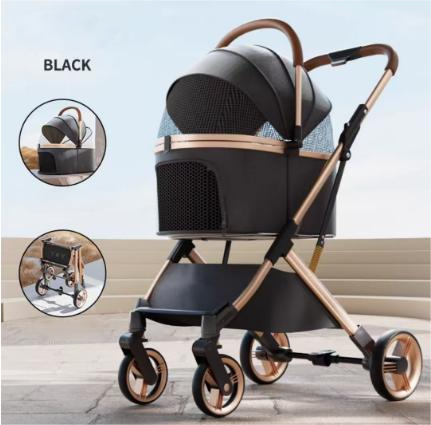
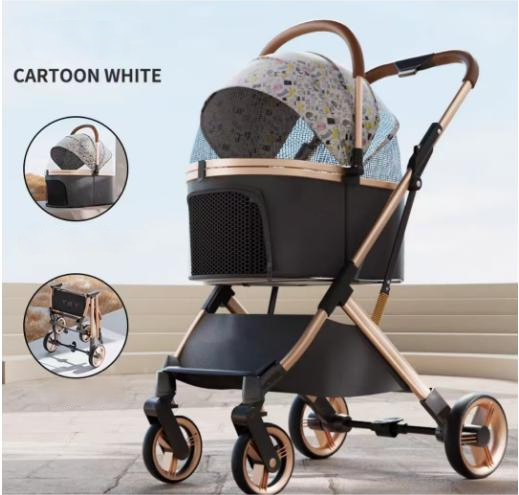
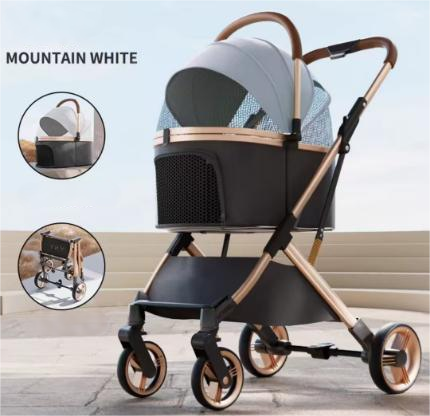
Common Configuration (Linked/Semi-Adjustable): Many twin strollers, including the typical Twins Pets model, feature large mesh panels on the rear and sides that span the entire width of the stroller. When you unzip this panel, you expose mesh for both compartments simultaneously. The airflow is therefore linked by this common aperture. There may be smaller, compartment-specific vents (e.g., on the front canopy or side panels), but the primary source of fresh air is often a shared opening.
Based on prevalent models, the Twins stroller often utilizes large, full-width mesh panels as its primary ventilation source. This points strongly toward a primarily linked ventilation architecture.
The Adjustability Question: Can Ventilation Be Tailored Per Pet?
This is the heart of the practical concern for a pet owner with a large French Bulldog and a small kitten. Can the airflow be modulated for each?
Given the likely linked design via full-width panels, fine-grained, separate adjustment of ventilation volume is often limited. You cannot direct "X cubic feet per minute" to the left and "Y cubic feet per minute" to the right in a mechanically controlled way. The airflow from the main vents will naturally distribute itself based on internal air pressure, pet positioning, and external wind direction.
However, this does not mean all control is lost. Intelligent design incorporates semi-independent adjustment strategies:
Secondary Vent Control: Higher-end models may include smaller, compartment-specific vents. A zip-out mesh section on the left sidewall only, or an adjustable peek-a-boo flap on the right canopy. These allow for supplemental or reductive adjustment for a specific side. You can't control the main linked airflow, but you can add an extra draft to one pet or shield another from a direct breeze.
The Divider as a Baffle: Even a non-airtight mesh divider acts as a baffle, disrupting and somewhat segregating airflow. A larger pet that takes up more space and generates more body heat will naturally create a convection current in its own compartment, drawing more of the shared fresh air toward its side.
Strategic Pet Placement: The owner has agency. The more heat-sensitive or larger pet can be placed directly adjacent to the primary intake vent (e.g., the main rear mesh). The smaller or cold-sensitive pet can be placed on the opposite end, benefiting from a milder, diffused airflow.
Therefore, while the system may not be fully independent with calibrated controls, practical, separate adjustability is achievable through a combination of secondary vents, the divider's baffle effect, and thoughtful owner intervention.
Engineering and Market Realities: Why This Design Prevails
The prevalence of the linked, full-width mesh design is not an oversight but a result of balancing multiple factors:
Cost and Simplicity: Creating two fully isolated ventilation ductworks within a flexible fabric structure is complex and expensive. A single, large mesh panel is cost-effective to produce and assemble.
Weight and Structure: Adding separate vent mechanisms for each side increases parts count, weight, and potential failure points.
Adequacy for Most Scenarios: For the vast majority of uses—two similarly-sized small dogs, or cats—a shared, well-ventilated space is perfectly sufficient. The primary goal is to prevent overheating and ensure ample fresh air, which a linked system accomplishes effectively.
Ease of Use: A single zipper to open the main mesh for both compartments is simpler for the owner than managing multiple individual vents.
Conclusion
The dual-compartment ventilation system in the typical Twins Pets Stroller is best classified as a semi-linked design. It relies heavily on large, shared mesh panels that provide linked primary airflow for both compartments, indicating it is not a fully independent system. The central divider provides physical separation and acts as an airflow baffle but does not create sealed, independent environments.
Consequently, precise, separate adjustment of ventilation volume via primary controls is not a standard feature. However, the system is not without nuance. Through the potential use of secondary compartment-specific vents, the natural baffling effect of the divider, and strategic pet placement, an owner can pragmatically tailor the airflow experience for each pet. A panting dog can be given the "windward" side near the main mesh, while a cozy kitten can be tucked into the more sheltered zone.
For pet parents with drastically different companions—say, a heavy-coated Husky puppy and a frail senior rabbit—investigating models that emphasize truly independent compartments with separate canopy vents is advisable. For most, the Twins stroller's system offers a robust, linked airflow that, when managed thoughtfully, can be effectively customized to meet the distinct needs of two beloved pets, ensuring a safe, comfortable, and stress-free journey for all aboard.
For more about deep dive into adjustable airflow for the dual-compartment ventilation system of twins pets stroller, you can pay a visit to FengQun Pet Gear Supplier for more info.






