What are the safety features of a jogging pet stroller?
Jogging with a dog is an excellent way to combine exercise with quality time. A jogging pet stroller allows you to bring a smaller, older, or injured dog along for the run without forcing the animal to keep pace. However, jogging strollers for pets differ fundamentally from standard pet strollers or child jogging strollers. They must withstand higher speeds, sudden directional changes, uneven terrain, and the dynamic forces generated by a running human. This article provides a technical overview of the essential safety features that a dedicated jogging pet stroller should incorporate.
1. Introduction: Why Jogging Strollers Need Extra Safety
A standard pet stroller is designed for walking speeds (3–5 km/h) on smooth pavement. A jogging stroller is used at speeds of 8–12 km/h or more, often on mixed terrain (pavement, gravel, grass, light trails). The increased speed multiplies kinetic energy, braking distances, and the risk of tip‑over during turns. Furthermore, the stroller must protect the pet from road vibrations, sudden stops, and potential collisions. Therefore, a jogging pet stroller must incorporate engineering features that go far beyond those of a casual stroller.
2. Wheel System and Tracking
2.1 Fixed Front Wheel (or Lockable Swivel)
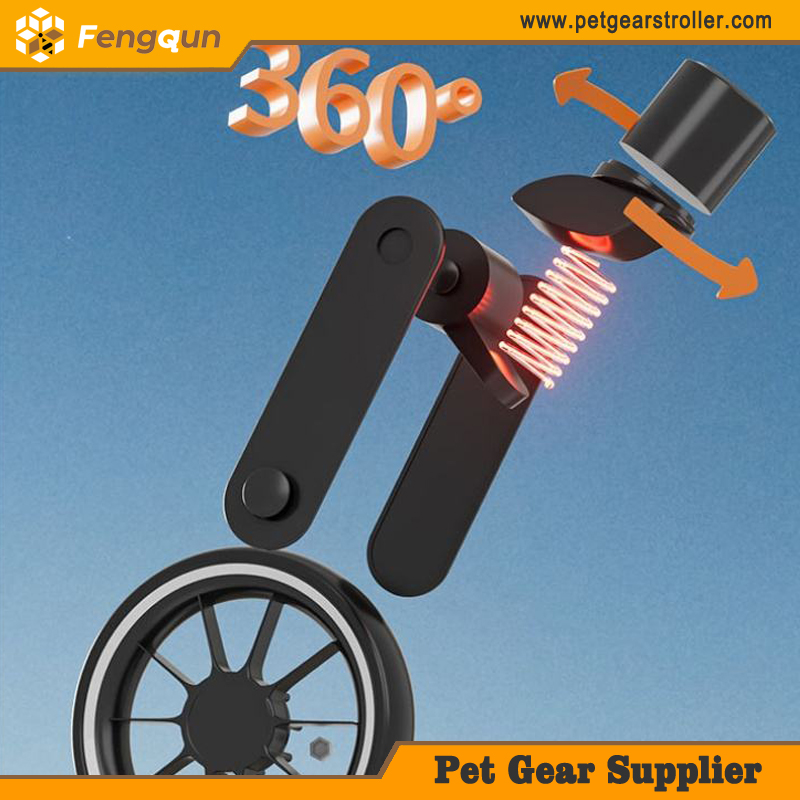
The most critical safety feature for a jogging stroller is a fixed front wheel or, at minimum, a front wheel that can be locked in a straight‑ahead position. When running at speed, a swivelling front wheel can suddenly turn due to a small rock or a slight handle movement, causing the stroller to veer dangerously or tip sideways. A fixed wheel provides directional stability, allowing the runner to maintain a straight line without constant corrections.
Technical requirement: The front wheel locking mechanism must be robust enough to stay locked under vibration and lateral forces. A simple spring‑loaded pin or a cam‑lock lever is acceptable, but it should engage with a positive click and not disengage accidentally. If the stroller has a swivel‑to‑fixed switch, it should be located where it cannot be kicked or bumped during a run.
2.2 Wheel Size and Material
Jogging strollers typically use large diameter wheels – 16 inches (40 cm) or more for the rear wheels, and 12–16 inches for the front. Larger wheels roll over obstacles (cracks, roots, small stones) more easily, reducing the risk of sudden jolts or stoppages. They also provide better flotation on soft surfaces like grass or packed dirt.
Wheel material: Pneumatic (air‑filled) tires are mandatory for jogging. Solid foam or plastic wheels transmit every shock directly to the pet and the frame, and they lack traction on wet or loose surfaces. Pneumatic tires should have a tread pattern suitable for mixed terrain – not too aggressive (which increases rolling resistance on pavement) but with enough bite for gravel or damp grass. The recommended pressure range (typically 30–50 psi) should be clearly marked; underinflation increases rolling resistance and rim damage risk, while overinflation reduces traction and shock absorption.
2.3 Sealed Bearings
All wheels must use sealed ball bearings (not bushings). Running at speed generates heat and exposes bearings to dust, moisture, and grit. Sealed bearings require minimal maintenance and resist contamination, ensuring the wheels spin freely without wobble or drag. Worn or unsealed bearings can cause wheel misalignment, increasing the risk of a crash.
3. Braking System
3.1 Dual‑Action Hand Brake
Unlike walking strollers that may only have a parking brake, a jogging pet stroller must have a hand‑operated brake (like a bicycle brake) for speed control. The ideal configuration is a dual‑action lever that actuates brakes on both rear wheels simultaneously. This allows the runner to slow down gradually on a downhill or to stop quickly in an emergency without pulling the stroller sideways.
Technical requirement: The brake lever should be within easy reach of the hand that stays on the handle (usually the right hand, but ambidextrous designs exist). It should provide progressive stopping power – not just on/off – to avoid abrupt deceleration that could throw the pet forward. Cable‑actuated disc brakes or rim brakes are both acceptable, but disc brakes offer better performance in wet conditions.
3.2 Parking Brake
In addition to the hand brake, a separate parking brake is essential. This is typically a foot‑operated lever that locks both rear wheels when the stroller is stationary. The parking brake must hold the stroller on a 15° incline (e.g., a steep driveway) even with a pet inside. When engaged, the stroller should not roll or creep. The parking brake mechanism should be independent of the hand brake – a single lever that combines both functions (like a bicycle brake with a lock) is acceptable, but the lock must be easy to engage and disengage without squatting.
3.3 Brake Cable Routing
Brake cables must be routed along the frame in a way that prevents snagging on vegetation, the runner’s clothing, or the dog’s leash. Ideally, the cables are enclosed in a protective sheath and clipped close to the frame. Exposed cables should be checked regularly for fraying.
4. Frame and Structural Integrity
4.1 Reinforced Chassis
Jogging strollers are subjected to repeated dynamic loads – every footstrike of the runner creates a small shock through the handle, and uneven terrain creates twisting forces. The frame must be made of high‑strength materials, typically 6061 or 7000 series aluminum or chromoly steel. Aluminum is lighter, resisting corrosion, but must have sufficient wall thickness (≥1.5 mm for main tubes) to avoid flex. Steel is heavier but more durable and easier to repair.
Critical design points:
Cross‑bracing – triangular gussets at the handle‑to‑frame junction and at the wheel axles prevent lateral flex.
Welded vs. bolted joints – welding is generally stronger and more rigid, but some bolted joints allow disassembly for travel. If bolted, use lock nuts or threadlocker.
Certification – Look for strollers that claim to meet ASTM or EN standards for child jogging strollers (even if adapted for pets). This ensures they have passed dynamic stability and braking tests.
4.2 Low Center of Gravity and Track Width
A jogging stroller must have a low center of gravity to resist tipping during high‑speed turns. The pet’s cabin should sit as low as practical (ground clearance of 10–15 cm is typical) rather than being elevated. The track width (distance between left and right wheels) should be at least 60 cm (24 inches) to provide lateral stability. A narrow track width increases the risk of rollover when cornering.
4.3 Handlebar Design
The handlebar must be wrapped with non‑slip material (rubber or foam) and positioned at a height (typically 100–110 cm) that allows the runner to maintain an upright posture without leaning forward excessively. A wrist strap (safety leash) attached to the handlebar is a valuable secondary safety feature: if the runner trips and releases the handle, the strap keeps the stroller from rolling away or into traffic.
5. Pet Restraint System
5.1 Internal Harness Tethers
Even at jogging speeds, a pet can shift its weight suddenly. The stroller must have one or two internal tether straps that clip to the pet’s harness (never a collar). The tethers should be short enough (15–25 cm) that the pet cannot reach the door or canopy, but long enough to allow the pet to stand, sit, or lie down. Elastic tethers absorb sudden jerks, reducing stress on the pet’s neck and the tether anchor points.
Anchor points: Tethers must attach to the rigid floor or the lower frame – not to fabric or mesh alone. The anchor should be a metal D‑ring or a slot reinforced with steel backing.
5.2 Enclosure Strength
The cabin of a jogging stroller is typically made of fabric (nylon or polyester) over a rigid frame. The fabric must be tear‑resistant (denier 600 or higher) and securely stitched. Mesh panels should have small apertures (≤2 cm) to prevent paws from protruding and getting caught. The zipper or closure system (if a no‑zip magnetic closure) must remain closed under vibration – for jogging, a zippered door is generally more secure than magnets, unless the magnetic pull is exceptionally strong (≥3 kg per pair). Some jogging strollers use a combination of zipper and buckle for redundancy.
5.3 Canopy and Visibility
The canopy should be removable – on hot days, the pet needs maximum airflow. It must be securely attached (snap buttons or a zipper that doesn’t come loose while running). A reflective trim on the canopy and on the stroller frame improves visibility to motorists and cyclists in low light.
6. Suspension and Vibration Damping
Unlike a child’s jogging stroller, a pet’s joints and spine are more vulnerable to repeated shocks. A good jogging pet stroller incorporates independent suspension on each wheel – typically coil springs or elastomer dampers. Suspension reduces peak vertical acceleration by 60–70%, protecting the pet from micro‑trauma and making the ride more comfortable.
What to look for:
Suspension travel: at least 2–3 cm (1 inch) per wheel.
Adjustable damping (rare in pet strollers but available in some high‑end models) allows tuning for the pet’s weight.
Pneumatic tires work in concert with suspension; a stroller with suspension but solid tires is still too harsh.
7. Safety Features for the Runner and Environment
7.1 Reflective Elements and Lighting
Jogging often occurs in low‑light hours (dawn, dusk). The stroller must have:
Reflective piping or panels on the front, sides, and rear of the canopy and lower cabin.
A mounting point for a LED safety light (e.g., a standard bike light bracket on the handlebar or rear axle).
A safety flag (orange or high‑visibility) that extends above the canopy – required by some municipalities for any vehicle on public paths.
7.2 Secondary Restraint (Tether from Stroller to Runner)
As mentioned, a wrist strap or waist belt that attaches the stroller to the runner’s body is a critical safety feature. If the runner trips, the stroller cannot roll into traffic or down a hill. The tether should be short (≤1 m) and have a quick‑release buckle in case of entanglement.
7.3 Bell or Horn
While not strictly a safety feature for the pet, a bell or horn allows the runner to alert pedestrians or cyclists when overtaking. This prevents sudden swerves or collisions.
8. Operational Safety Tips for Jogging with a Pet Stroller
Even the best‑equipped stroller requires correct use. Essential rules:
Always use the wrist strap – never rely on grip alone.
Lock the front wheel before every run (unless the stroller has a fixed front wheel design).
Check tire pressure before each outing – underinflation causes sluggish steering and rim damage; overinflation reduces traction.
Secure the pet with a harness and tether – a collar is dangerous for a pet that might try to jump out.
Start with short, slow runs to allow the pet to acclimate to the motion.
Avoid steep hills – jogging strollers are not designed for extreme descents; walking down is safer.
Keep the canopy open or partially open in warm weather to prevent overheating – a closed canopy traps heat.
Inspect the brake cable and fold locking mechanism before each use. A fold that accidentally releases during a run can be catastrophic.
9. Maintenance Checklist for Long‑Term Safety
| Component | Frequency | Action |
|---|---|---|
| Tire pressure | Before each jog | Adjust to recommended PSI (check sidewall). |
| Wheel bearings | Every 3 months or 500 km | Clean, repack with waterproof grease. |
| Brake pads/discs | Monthly | Check for wear; clean with isopropyl alcohol. |
| Brake cable tension | Monthly | Adjust barrel adjuster; replace if frayed. |
| Frame hinge bolts | Monthly | Tighten to torque spec; apply threadlocker. |
| Harness tethers and clips | Monthly | Inspect stitching and spring; replace if loose. |
| Fabric and mesh | After each muddy/dirty use | Wipe down; machine wash when needed. |
Storage: Keep the stroller indoors, away from UV and moisture. If storing for winter, deflate tires slightly and cover to prevent dust.
10. Conclusion
A jogging pet stroller is a specialized device that must balance speed, stability, and pet comfort. The essential safety features include: a fixed or lockable front wheel, large pneumatic tires with sealed bearings, a hand‑operated dual‑action brake plus a separate parking brake, a reinforced low‑center‑of‑gravity frame, a secure internal harness tether system, full suspension or at least pneumatic tires, and reflective elements for visibility. Additionally, a wrist tether connecting runner to stroller is a simple but life‑saving addition.
When selecting a jogging pet stroller, prioritize engineering integrity over cosmetic features. A stroller that lacks any of the above safety elements is not suitable for jogging, regardless of price. By equipping yourself with the correct equipment and following safe operating practices, you and your dog can enjoy the benefits of running together – with the peace of mind that your pet is as protected as possible.
For more about What are the safety features of a jogging pet stroller? you can pay a visit to https://www.petgearstroller.com/product/ for more info.